

512
O. Aksimentyeva et al.
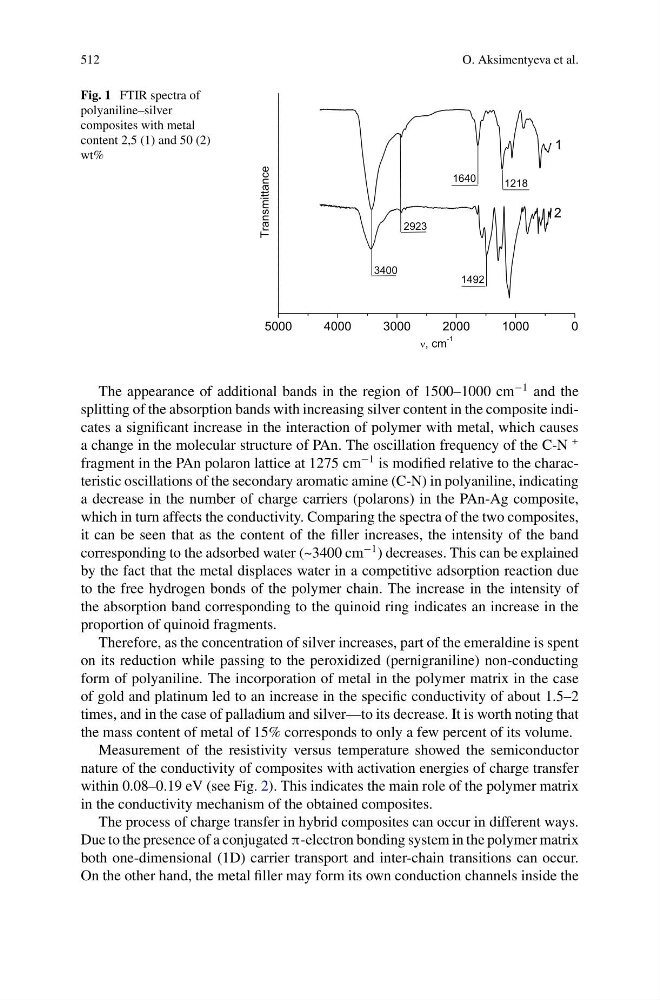
Fig. 1 FTIR spectra of
polyaniline–silver
composites with metal
content 2,5 (1) and 50 (2)
wt%
5000
4000
3000
2000
1000
0
1218
1492
1640
2923
3400
2
1
, сm
-1
Transmittance
The appearance of additional bands in the region of 1500–1000 cm
−1 and the
splitting of the absorption bands with increasing silver content in the composite indicates a significant increase in the interaction of polymer with metal, which causes
a change in the molecular structure of PAn. The oscillation frequency of the C-N
+
fragment in the PAn polaron lattice at 1275 cm
−1 is modified relative to the characteristic oscillations of the secondary aromatic amine (C-N) in polyaniline, indicating
a decrease in the number of charge carriers (polarons) in the PAn-Ag composite,
which in turn affects the conductivity. Comparing the spectra of the two composites,
it can be seen that as the content of the filler increases, the intensity of the band
corresponding to the adsorbed water (~3400 cm
−1 ) decreases. This can be explained
by the fact that the metal displaces water in a competitive adsorption reaction due
to the free hydrogen bonds of the polymer chain. The increase in the intensity of
the absorption band corresponding to the quinoid ring indicates an increase in the
proportion of quinoid fragments.
Therefore, as the concentration of silver increases, part of the emeraldine is spent
on its reduction while passing to the peroxidized (pernigraniline) non-conducting
form of polyaniline. The incorporation of metal in the polymer matrix in the case
of gold and platinum led to an increase in the specific conductivity of about 1.5–2
times, and in the case of palladium and silver—to its decrease. It is worth noting that
the mass content of metal of 15% corresponds to only a few percent of its volume.
Measurement of the resistivity versus temperature showed the semiconductor
nature of the conductivity of composites with activation energies of charge transfer
within 0.08–0.19 eV (see Fig. 2). This indicates the main role of the polymer matrix
in the conductivity mechanism of the obtained composites.
The process of charge transfer in hybrid composites can occur in different ways.
Due to the presence of a conjugated π-electron bonding system in the polymer matrix
both one-dimensional (1D) carrier transport and inter-chain transitions can occur.
On the other hand, the metal filler may form its own conduction channels inside the
O. Aksimentyeva et al.
Fig. 1 FTIR spectra of
polyaniline–silver
composites with metal
content 2,5 (1) and 50 (2)
wt%
5000
4000
3000
2000
1000
0
1218
1492
1640
2923
3400
2
1
, сm
-1
Transmittance
The appearance of additional bands in the region of 1500–1000 cm
−1 and the
splitting of the absorption bands with increasing silver content in the composite indicates a significant increase in the interaction of polymer with metal, which causes
a change in the molecular structure of PAn. The oscillation frequency of the C-N
+
fragment in the PAn polaron lattice at 1275 cm
−1 is modified relative to the characteristic oscillations of the secondary aromatic amine (C-N) in polyaniline, indicating
a decrease in the number of charge carriers (polarons) in the PAn-Ag composite,
which in turn affects the conductivity. Comparing the spectra of the two composites,
it can be seen that as the content of the filler increases, the intensity of the band
corresponding to the adsorbed water (~3400 cm
−1 ) decreases. This can be explained
by the fact that the metal displaces water in a competitive adsorption reaction due
to the free hydrogen bonds of the polymer chain. The increase in the intensity of
the absorption band corresponding to the quinoid ring indicates an increase in the
proportion of quinoid fragments.
Therefore, as the concentration of silver increases, part of the emeraldine is spent
on its reduction while passing to the peroxidized (pernigraniline) non-conducting
form of polyaniline. The incorporation of metal in the polymer matrix in the case
of gold and platinum led to an increase in the specific conductivity of about 1.5–2
times, and in the case of palladium and silver—to its decrease. It is worth noting that
the mass content of metal of 15% corresponds to only a few percent of its volume.
Measurement of the resistivity versus temperature showed the semiconductor
nature of the conductivity of composites with activation energies of charge transfer
within 0.08–0.19 eV (see Fig. 2). This indicates the main role of the polymer matrix
in the conductivity mechanism of the obtained composites.
The process of charge transfer in hybrid composites can occur in different ways.
Due to the presence of a conjugated π-electron bonding system in the polymer matrix
both one-dimensional (1D) carrier transport and inter-chain transitions can occur.
On the other hand, the metal filler may form its own conduction channels inside the