

Structure and Properties of Polyaniline Micro- and Nano …
511
other metals, and the high chemical activity of precursor compounds, which allows
to obtain filled materials during one-step synthesis without the use of additional
reagents. Typically, precious metal particles incorporated into the polymer matrix
exhibit increased activity in the catalysis of various chemical transformations and
are therefore of practical interest.
The idea of synthesis was that due to the change in the oxidation degree of the
newly formed polymer chains, the ions of the metal are reduced, forming nanosized
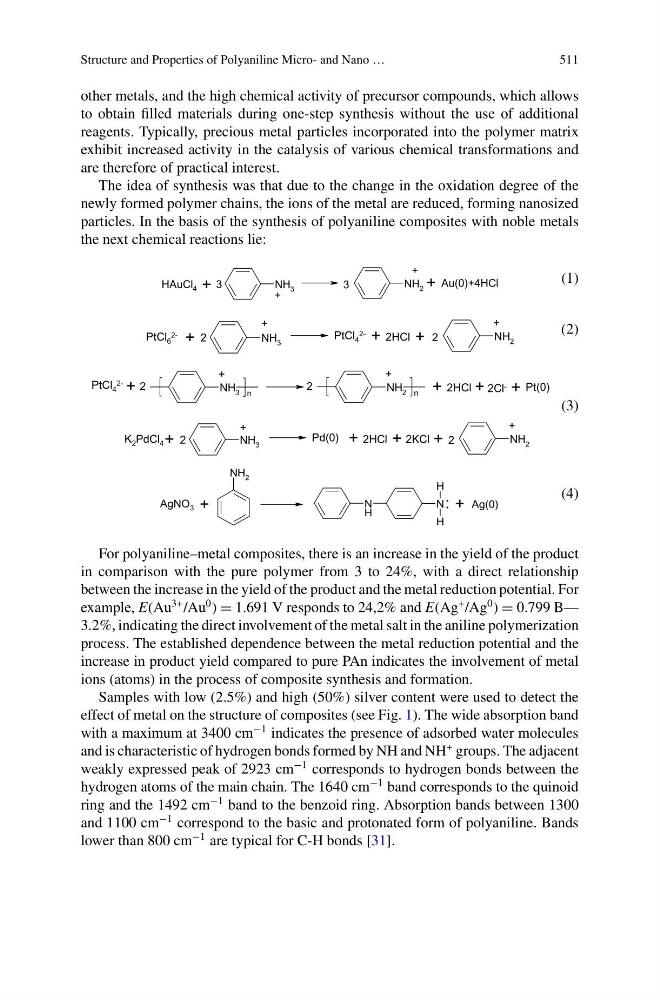
particles. In the basis of the synthesis of polyaniline composites with noble metals
the next chemical reactions lie:
NH 3
NH 2
3
+
+
HAuCl 4
3
+
+ Au(0)+4HCl
(1)
NH 3
NH 2
PtCl 6
2- + 2
+
PtCl 4
2- +
2
+
2HCl +
(2)
NH 3 n
NH 2 n
PtCl 4
22
+
+
2
+
+ 2HCl + 2Cl - + Pt(0)
NH 3
NH 2
K 2 PdCl 4+ 2
+
Pd(0) +
2
+
2HCl +
+
2KCl
(3)
NH 2
N
H
N
H
H
+
AgNO 3
: + Ag(0)
(4)
For polyaniline–metal composites, there is an increase in the yield of the product
in comparison with the pure polymer from 3 to 24%, with a direct relationship
between the increase in the yield of the product and the metal reduction potential. For
example, E(Au
3+ /Au
0 ) = 1.691 V responds to 24,2% and E(Ag
+ /Ag
0 ) = 0.799 B—
3.2%, indicating the direct involvement of the metal salt in the aniline polymerization
process. The established dependence between the metal reduction potential and the
increase in product yield compared to pure PAn indicates the involvement of metal
ions (atoms) in the process of composite synthesis and formation.
Samples with low (2.5%) and high (50%) silver content were used to detect the
effect of metal on the structure of composites (see Fig. 1). The wide absorption band
with a maximum at 3400 cm
−1 indicates the presence of adsorbed water molecules
and is characteristic of hydrogen bonds formed by NH and NH
+ groups. The adjacent
weakly expressed peak of 2923 cm
−1 corresponds to hydrogen bonds between the
hydrogen atoms of the main chain. The 1640 cm
−1 band corresponds to the quinoid
ring and the 1492 cm
−1 band to the benzoid ring. Absorption bands between 1300
and 1100 cm
−1 correspond to the basic and protonated form of polyaniline. Bands
lower than 800 cm
−1 are typical for C-H bonds [31].
511
other metals, and the high chemical activity of precursor compounds, which allows
to obtain filled materials during one-step synthesis without the use of additional
reagents. Typically, precious metal particles incorporated into the polymer matrix
exhibit increased activity in the catalysis of various chemical transformations and
are therefore of practical interest.
The idea of synthesis was that due to the change in the oxidation degree of the
newly formed polymer chains, the ions of the metal are reduced, forming nanosized
particles. In the basis of the synthesis of polyaniline composites with noble metals
the next chemical reactions lie:
NH 3
NH 2
3
+
+
HAuCl 4
3
+
+ Au(0)+4HCl
(1)
NH 3
NH 2
PtCl 6
2- + 2
+
PtCl 4
2- +
2
+
2HCl +
(2)
NH 3 n
NH 2 n
PtCl 4
22
+
+
2
+
+ 2HCl + 2Cl - + Pt(0)
NH 3
NH 2
K 2 PdCl 4+ 2
+
Pd(0) +
2
+
2HCl +
+
2KCl
(3)
NH 2
N
H
N
H
H
+
AgNO 3
: + Ag(0)
(4)
For polyaniline–metal composites, there is an increase in the yield of the product
in comparison with the pure polymer from 3 to 24%, with a direct relationship
between the increase in the yield of the product and the metal reduction potential. For
example, E(Au
3+ /Au
0 ) = 1.691 V responds to 24,2% and E(Ag
+ /Ag
0 ) = 0.799 B—
3.2%, indicating the direct involvement of the metal salt in the aniline polymerization
process. The established dependence between the metal reduction potential and the
increase in product yield compared to pure PAn indicates the involvement of metal
ions (atoms) in the process of composite synthesis and formation.
Samples with low (2.5%) and high (50%) silver content were used to detect the
effect of metal on the structure of composites (see Fig. 1). The wide absorption band
with a maximum at 3400 cm
−1 indicates the presence of adsorbed water molecules
and is characteristic of hydrogen bonds formed by NH and NH
+ groups. The adjacent
weakly expressed peak of 2923 cm
−1 corresponds to hydrogen bonds between the
hydrogen atoms of the main chain. The 1640 cm
−1 band corresponds to the quinoid
ring and the 1492 cm
−1 band to the benzoid ring. Absorption bands between 1300
and 1100 cm
−1 correspond to the basic and protonated form of polyaniline. Bands
lower than 800 cm
−1 are typical for C-H bonds [31].