

Heating and Coagulation of Nanoparticles in a Plasma Jet
27
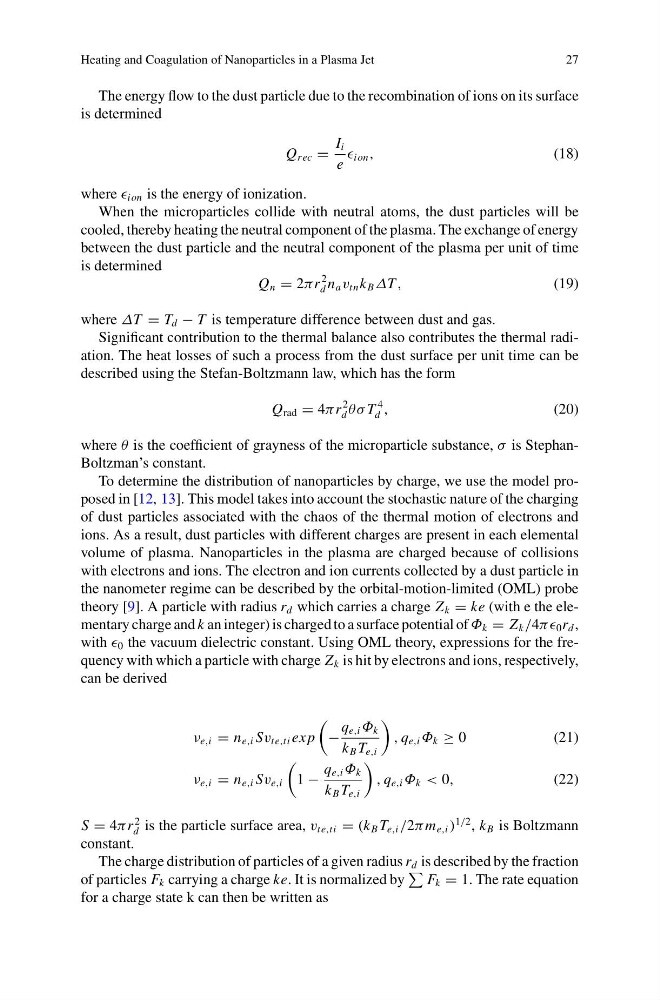
The energy flow to the dust particle due to the recombination of ions on its surface
is determined
Q rec =
I i
e
ion ,
(18)
where ion is the energy of ionization.
When the microparticles collide with neutral atoms, the dust particles will be
cooled, thereby heating the neutral component of the plasma. The exchange of energy
between the dust particle and the neutral component of the plasma per unit of time
is determined
Q n = 2πr
2
d n a v tn k B ΔT,
(19)
where ΔT = T d − T is temperature difference between dust and gas.
Significant contribution to the thermal balance also contributes the thermal radiation. The heat losses of such a process from the dust surface per unit time can be
described using the Stefan-Boltzmann law, which has the form
Q rad = 4πr
2
d θσ T
4
d ,
(20)
where θ is the coefficient of grayness of the microparticle substance, σ is StephanBoltzman’s constant.
To determine the distribution of nanoparticles by charge, we use the model proposed in [12, 13]. This model takes into account the stochastic nature of the charging
of dust particles associated with the chaos of the thermal motion of electrons and
ions. As a result, dust particles with different charges are present in each elemental
volume of plasma. Nanoparticles in the plasma are charged because of collisions
with electrons and ions. The electron and ion currents collected by a dust particle in
the nanometer regime can be described by the orbital-motion-limited (OML) probe
theory [9]. A particle with radius r d which carries a charge Z k = ke (with e the elementary charge and k an integer) is charged to a surface potential of Φ k = Z k /4ππ 0 r d ,
with 0 the vacuum dielectric constant. Using OML theory, expressions for the frequency with which a particle with charge Z k is hit by electrons and ions, respectively,
can be derived
ν e,i = n e,i Sv te,ti ex p
−
q e,i Φ k
k B T e,i
, q e,i Φ k ≥ 0
(21)
ν e,i = n e,i Sv e,i
1 −
q e,i Φ k
k B T e,i
, q e,i Φ k < 0,
(22)
S = 4πr
2
d is the particle surface area, v te,ti = (k B T e,i /2π m e,i )
1/2 , k B is Boltzmann
constant.
The charge distribution of particles of a given radius r d is described by the fraction
of particles F k carrying a charge ke. It is normalized by
F k = 1. The rate equation
for a charge state k can then be written as
27
The energy flow to the dust particle due to the recombination of ions on its surface
is determined
Q rec =
I i
e
ion ,
(18)
where ion is the energy of ionization.
When the microparticles collide with neutral atoms, the dust particles will be
cooled, thereby heating the neutral component of the plasma. The exchange of energy
between the dust particle and the neutral component of the plasma per unit of time
is determined
Q n = 2πr
2
d n a v tn k B ΔT,
(19)
where ΔT = T d − T is temperature difference between dust and gas.
Significant contribution to the thermal balance also contributes the thermal radiation. The heat losses of such a process from the dust surface per unit time can be
described using the Stefan-Boltzmann law, which has the form
Q rad = 4πr
2
d θσ T
4
d ,
(20)
where θ is the coefficient of grayness of the microparticle substance, σ is StephanBoltzman’s constant.
To determine the distribution of nanoparticles by charge, we use the model proposed in [12, 13]. This model takes into account the stochastic nature of the charging
of dust particles associated with the chaos of the thermal motion of electrons and
ions. As a result, dust particles with different charges are present in each elemental
volume of plasma. Nanoparticles in the plasma are charged because of collisions
with electrons and ions. The electron and ion currents collected by a dust particle in
the nanometer regime can be described by the orbital-motion-limited (OML) probe
theory [9]. A particle with radius r d which carries a charge Z k = ke (with e the elementary charge and k an integer) is charged to a surface potential of Φ k = Z k /4ππ 0 r d ,
with 0 the vacuum dielectric constant. Using OML theory, expressions for the frequency with which a particle with charge Z k is hit by electrons and ions, respectively,
can be derived
ν e,i = n e,i Sv te,ti ex p
−
q e,i Φ k
k B T e,i
, q e,i Φ k ≥ 0
(21)
ν e,i = n e,i Sv e,i
1 −
q e,i Φ k
k B T e,i
, q e,i Φ k < 0,
(22)
S = 4πr
2
d is the particle surface area, v te,ti = (k B T e,i /2π m e,i )
1/2 , k B is Boltzmann
constant.
The charge distribution of particles of a given radius r d is described by the fraction
of particles F k carrying a charge ke. It is normalized by
F k = 1. The rate equation
for a charge state k can then be written as