

26
O. Yu. Kravchenko and I. S. Maruschak
Let us dwell on the process of energy exchange between dust particles and plasma.
As is known, the electric current from plasma flows into a dust particle, the value of
which is determined by the parameters of the plasma and the geometric dimensions
of the dust. This process is accompanied not only by the transfer of the electric charge
from the plasma to the dust surface, but also by the transfer of energy. The heat fluxes
between the plasma and the dust particle can be divided into the following types:
radiation, kinetic energy transfer of electrons and ions upon contact with the surface
of the dust particle, recombination of ions on the surface of the particle with the
release of the corresponding energy.
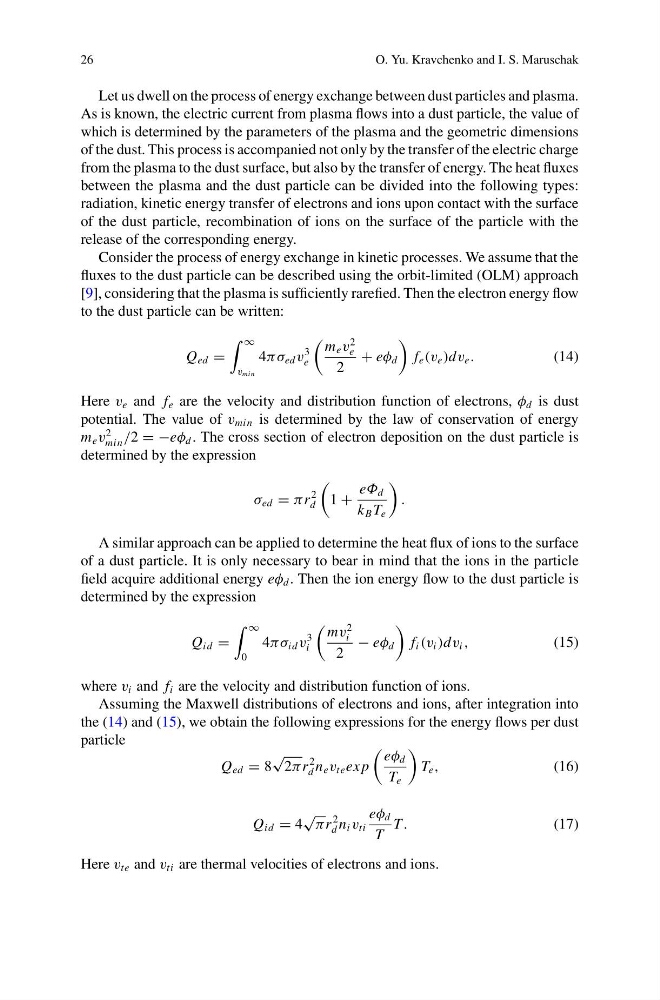
Consider the process of energy exchange in kinetic processes. We assume that the
fluxes to the dust particle can be described using the orbit-limited (OLM) approach
[9], considering that the plasma is sufficiently rarefied. Then the electron energy flow
to the dust particle can be written:
Q ed =
∞
v min
4πσ ed v
3
e
m e v
2
e
2
+ eφ d
f e (v e )dv e .
(14)
Here v e and f e are the velocity and distribution function of electrons, φ d is dust
potential. The value of v min is determined by the law of conservation of energy
m e v
2
min /2 = −eφ d . The cross section of electron deposition on the dust particle is
determined by the expression
σ ed = πr
2
d
1 +
eΦ d
k B T e
.
A similar approach can be applied to determine the heat flux of ions to the surface
of a dust particle. It is only necessary to bear in mind that the ions in the particle
field acquire additional energy eφ d . Then the ion energy flow to the dust particle is
determined by the expression
Q id =
∞
0
4πσ id v
3
i
mv
2
i
2
− eφ d
f i (v i )dv i ,
(15)
where v i and f i are the velocity and distribution function of ions.
Assuming the Maxwell distributions of electrons and ions, after integration into
the (14) and (15), we obtain the following expressions for the energy flows per dust
particle
Q ed = 8
√
2πr
2
d n e v te ex p
eφ d
T e
T e ,
(16)
Q id = 4
√ πr
2
d n i v ti
eφ d
T
T.
(17)
Here v te and v ti are thermal velocities of electrons and ions.
O. Yu. Kravchenko and I. S. Maruschak
Let us dwell on the process of energy exchange between dust particles and plasma.
As is known, the electric current from plasma flows into a dust particle, the value of
which is determined by the parameters of the plasma and the geometric dimensions
of the dust. This process is accompanied not only by the transfer of the electric charge
from the plasma to the dust surface, but also by the transfer of energy. The heat fluxes
between the plasma and the dust particle can be divided into the following types:
radiation, kinetic energy transfer of electrons and ions upon contact with the surface
of the dust particle, recombination of ions on the surface of the particle with the
release of the corresponding energy.
Consider the process of energy exchange in kinetic processes. We assume that the
fluxes to the dust particle can be described using the orbit-limited (OLM) approach
[9], considering that the plasma is sufficiently rarefied. Then the electron energy flow
to the dust particle can be written:
Q ed =
∞
v min
4πσ ed v
3
e
m e v
2
e
2
+ eφ d
f e (v e )dv e .
(14)
Here v e and f e are the velocity and distribution function of electrons, φ d is dust
potential. The value of v min is determined by the law of conservation of energy
m e v
2
min /2 = −eφ d . The cross section of electron deposition on the dust particle is
determined by the expression
σ ed = πr
2
d
1 +
eΦ d
k B T e
.
A similar approach can be applied to determine the heat flux of ions to the surface
of a dust particle. It is only necessary to bear in mind that the ions in the particle
field acquire additional energy eφ d . Then the ion energy flow to the dust particle is
determined by the expression
Q id =
∞
0
4πσ id v
3
i
mv
2
i
2
− eφ d
f i (v i )dv i ,
(15)
where v i and f i are the velocity and distribution function of ions.
Assuming the Maxwell distributions of electrons and ions, after integration into
the (14) and (15), we obtain the following expressions for the energy flows per dust
particle
Q ed = 8
√
2πr
2
d n e v te ex p
eφ d
T e
T e ,
(16)
Q id = 4
√ πr
2
d n i v ti
eφ d
T
T.
(17)
Here v te and v ti are thermal velocities of electrons and ions.