

Heating and Coagulation of Nanoparticles in a Plasma Jet
25
∂(nv)
∂t
+ div(nvw) = −
1
m
∂ P
∂z
−
n d f z
m
+
e
m
n i E z ,
(6)
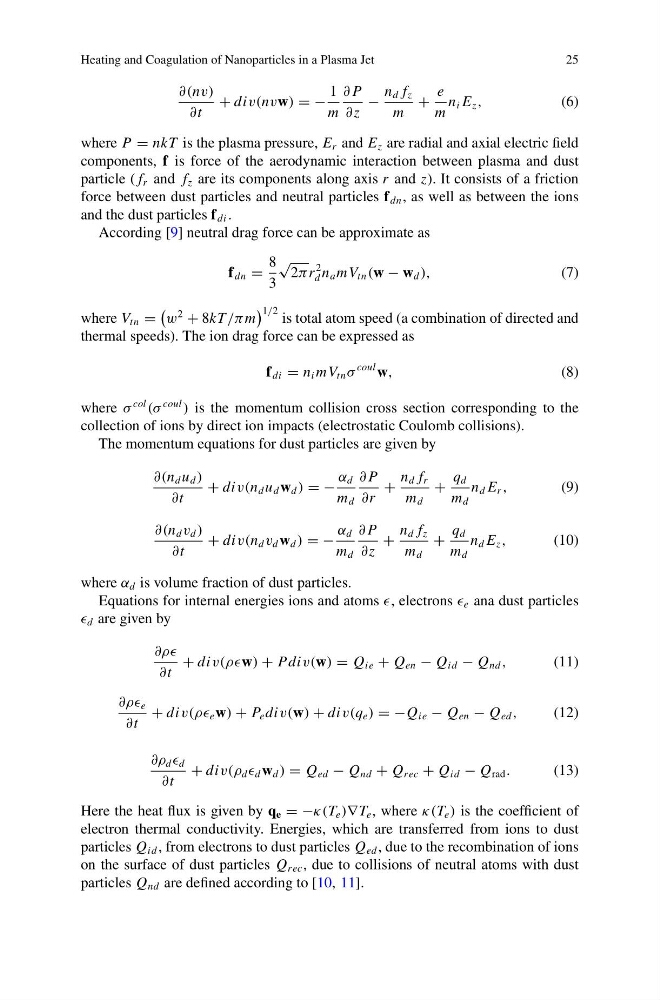
where P = nkT is the plasma pressure, E r and E z are radial and axial electric field
components, f is force of the aerodynamic interaction between plasma and dust
particle ( f r and f z are its components along axis r and z). It consists of a friction
force between dust particles and neutral particles f dn , as well as between the ions
and the dust particles f di .
According [9] neutral drag force can be approximate as
f dn =
8
3
√
2πr
2
d n a mV tn (w − w d ),
(7)
where V tn =
w
2
+ 8kT /π m
1/2 is total atom speed (a combination of directed and
thermal speeds). The ion drag force can be expressed as
f di = n i mV tn σ
coul w,
(8)
where σ
col
(σ
coul
) is the momentum collision cross section corresponding to the
collection of ions by direct ion impacts (electrostatic Coulomb collisions).
The momentum equations for dust particles are given by
∂(n d u d )
∂t
+ div(n d u d w d ) = −
α d
m d
∂ P
∂r
+
n d f r
m d
+
q d
m d
n d E r ,
(9)
∂(n d v d )
∂t
+ div(n d v d w d ) = −
α d
m d
∂ P
∂z
+
n d f z
m d
+
q d
m d
n d E z ,
(10)
where α d is volume fraction of dust particles.
Equations for internal energies ions and atoms , electrons e ana dust particles
d are given by
∂ρρ
∂t
+ div(ρρw) + Pdiv(w) = Q ie + Q en − Q id − Q nd ,
(11)
∂ρρ e
∂t
+ div(ρρ e w) + P e div(w) + div(q e ) = −Q ie − Q en − Q ed ,
(12)
∂ρ d d
∂t
+ div(ρ d d w d ) = Q ed − Q nd + Q rec + Q id − Q rad .
(13)
Here the heat flux is given by q e = −κ(T e )∇T e , where κ(T e ) is the coefficient of
electron thermal conductivity. Energies, which are transferred from ions to dust
particles Q id , from electrons to dust particles Q ed , due to the recombination of ions
on the surface of dust particles Q rec , due to collisions of neutral atoms with dust
particles Q nd are defined according to [10, 11].
25
∂(nv)
∂t
+ div(nvw) = −
1
m
∂ P
∂z
−
n d f z
m
+
e
m
n i E z ,
(6)
where P = nkT is the plasma pressure, E r and E z are radial and axial electric field
components, f is force of the aerodynamic interaction between plasma and dust
particle ( f r and f z are its components along axis r and z). It consists of a friction
force between dust particles and neutral particles f dn , as well as between the ions
and the dust particles f di .
According [9] neutral drag force can be approximate as
f dn =
8
3
√
2πr
2
d n a mV tn (w − w d ),
(7)
where V tn =
w
2
+ 8kT /π m
1/2 is total atom speed (a combination of directed and
thermal speeds). The ion drag force can be expressed as
f di = n i mV tn σ
coul w,
(8)
where σ
col
(σ
coul
) is the momentum collision cross section corresponding to the
collection of ions by direct ion impacts (electrostatic Coulomb collisions).
The momentum equations for dust particles are given by
∂(n d u d )
∂t
+ div(n d u d w d ) = −
α d
m d
∂ P
∂r
+
n d f r
m d
+
q d
m d
n d E r ,
(9)
∂(n d v d )
∂t
+ div(n d v d w d ) = −
α d
m d
∂ P
∂z
+
n d f z
m d
+
q d
m d
n d E z ,
(10)
where α d is volume fraction of dust particles.
Equations for internal energies ions and atoms , electrons e ana dust particles
d are given by
∂ρρ
∂t
+ div(ρρw) + Pdiv(w) = Q ie + Q en − Q id − Q nd ,
(11)
∂ρρ e
∂t
+ div(ρρ e w) + P e div(w) + div(q e ) = −Q ie − Q en − Q ed ,
(12)
∂ρ d d
∂t
+ div(ρ d d w d ) = Q ed − Q nd + Q rec + Q id − Q rad .
(13)
Here the heat flux is given by q e = −κ(T e )∇T e , where κ(T e ) is the coefficient of
electron thermal conductivity. Energies, which are transferred from ions to dust
particles Q id , from electrons to dust particles Q ed , due to the recombination of ions
on the surface of dust particles Q rec , due to collisions of neutral atoms with dust
particles Q nd are defined according to [10, 11].