

24
O. Yu. Kravchenko and I. S. Maruschak
2 Model Description
In this paper, we simulate the outflow of the plasma jet with dust particles through
a round hole of radius R 0 in the rarefied neutral gas. It is assumed that the plasma
velocity V 0 and its density ρ 0 are constant at the inlet during the plasma jet expansion.
The plasma considered in this article consists of four species, namely electrons, neutral argon atoms, singly ionized argon ions and nanoparticles. They will be denoted
by the subscript e, a, i and d, respectively. We use hydrodynamic model to describe
the expansion of the plasma jet with dust particles. In the model ions, electrons and
neutral atoms have the same drift velocity w = (u, v) due to effective momentum
exchange, and dust particles have drift velocity w d = (u d , v d ). Here u, u d are radial
velocity components and v, v d are axial velocity components.
The ions temperature equals to neutral atoms temperature T , but electrons temperature T e can differ from them.
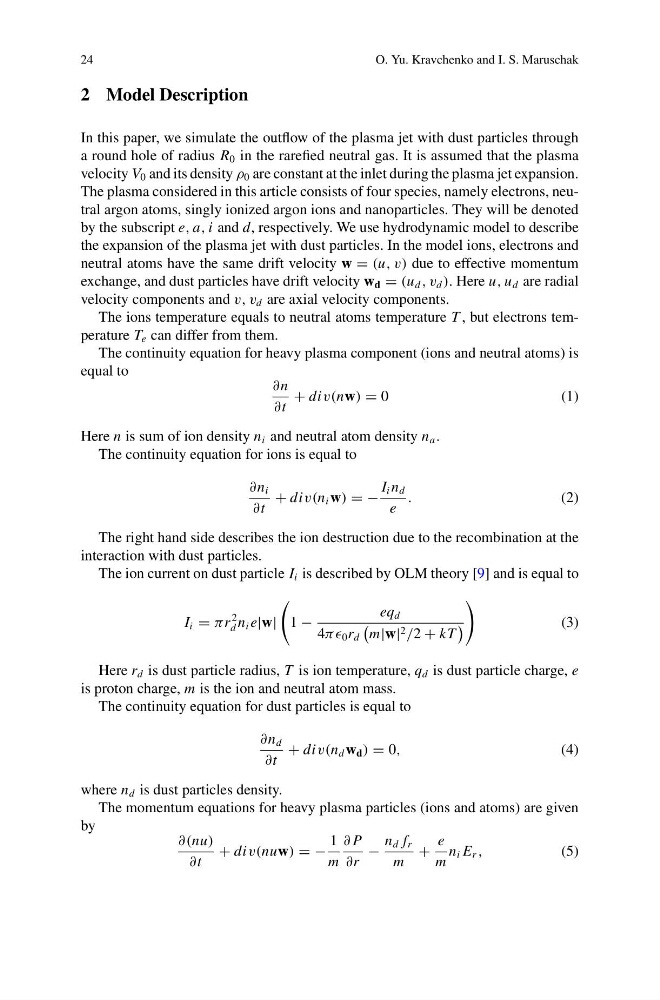
The continuity equation for heavy plasma component (ions and neutral atoms) is
equal to
∂n
∂t
+ div(nw) = 0
( 1 )
Here n is sum of ion density n i and neutral atom density n a .
The continuity equation for ions is equal to
∂n i
∂t
+ div(n i w) = −
I i n d
e
.
(2)
The right hand side describes the ion destruction due to the recombination at the
interaction with dust particles.
The ion current on dust particle I i is described by OLM theory [9] and is equal to
I i = πr
2
d n i e|w|
1 −
eq d
4ππ 0 r d
m|w| 2 /2 + kT
(3)
Here r d is dust particle radius, T is ion temperature, q d is dust particle charge, e
is proton charge, m is the ion and neutral atom mass.
The continuity equation for dust particles is equal to
∂n d
∂t
+ div(n d w d ) = 0,
(4)
where n d is dust particles density.
The momentum equations for heavy plasma particles (ions and atoms) are given
by
∂(nu)
∂t
+ div(nuw) = −
1
m
∂ P
∂r
−
n d f r
m
+
e
m
n i E r ,
(5)
O. Yu. Kravchenko and I. S. Maruschak
2 Model Description
In this paper, we simulate the outflow of the plasma jet with dust particles through
a round hole of radius R 0 in the rarefied neutral gas. It is assumed that the plasma
velocity V 0 and its density ρ 0 are constant at the inlet during the plasma jet expansion.
The plasma considered in this article consists of four species, namely electrons, neutral argon atoms, singly ionized argon ions and nanoparticles. They will be denoted
by the subscript e, a, i and d, respectively. We use hydrodynamic model to describe
the expansion of the plasma jet with dust particles. In the model ions, electrons and
neutral atoms have the same drift velocity w = (u, v) due to effective momentum
exchange, and dust particles have drift velocity w d = (u d , v d ). Here u, u d are radial
velocity components and v, v d are axial velocity components.
The ions temperature equals to neutral atoms temperature T , but electrons temperature T e can differ from them.
The continuity equation for heavy plasma component (ions and neutral atoms) is
equal to
∂n
∂t
+ div(nw) = 0
( 1 )
Here n is sum of ion density n i and neutral atom density n a .
The continuity equation for ions is equal to
∂n i
∂t
+ div(n i w) = −
I i n d
e
.
(2)
The right hand side describes the ion destruction due to the recombination at the
interaction with dust particles.
The ion current on dust particle I i is described by OLM theory [9] and is equal to
I i = πr
2
d n i e|w|
1 −
eq d
4ππ 0 r d
m|w| 2 /2 + kT
(3)
Here r d is dust particle radius, T is ion temperature, q d is dust particle charge, e
is proton charge, m is the ion and neutral atom mass.
The continuity equation for dust particles is equal to
∂n d
∂t
+ div(n d w d ) = 0,
(4)
where n d is dust particles density.
The momentum equations for heavy plasma particles (ions and atoms) are given
by
∂(nu)
∂t
+ div(nuw) = −
1
m
∂ P
∂r
−
n d f r
m
+
e
m
n i E r ,
(5)