

28
O. Yu. Kravchenko and I. S. Maruschak
d F k
dt
= ν
k+1
e
F k+1 − ν
k
e F k − ν
k
i F k + ν
k−1
i
F k−1 .
(23)
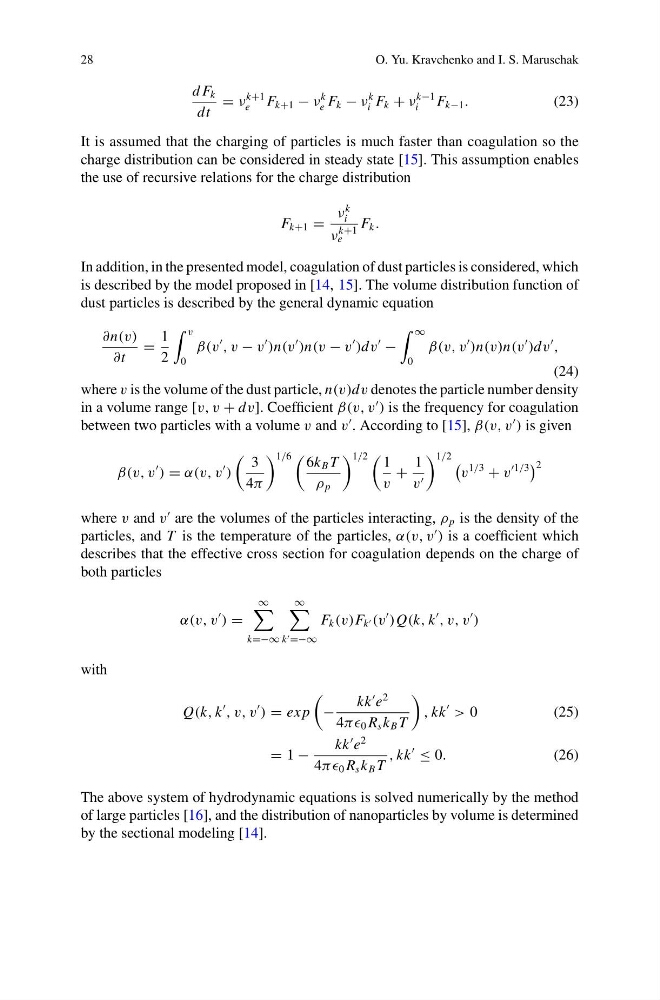
It is assumed that the charging of particles is much faster than coagulation so the
charge distribution can be considered in steady state [15]. This assumption enables
the use of recursive relations for the charge distribution
F k+1 =
ν
k
i
ν
k+1
e
F k .
In addition, in the presented model, coagulation of dust particles is considered, which
is described by the model proposed in [14, 15]. The volume distribution function of
dust particles is described by the general dynamic equation
∂n(v)
∂t
=
1
2
v
0
β(v
, v − v
)n(v
)n(v − v
)dv
−
∞
0
β(v, v
)n(v)n(v
)dv
,
(24)
where v is the volume of the dust particle, n(v)dv denotes the particle number density
in a volume range [v, v + dv]. Coefficient β(v, v
) is the frequency for coagulation
between two particles with a volume v and v
. According to [15], β(v, v
) is given
β(v, v
) = α(v, v
)
3
4π
1/6
6k B T
ρ p
1/2
1
v
+
1
v
1/2
v
1/3
+ v
1/3
2
where v and v
are the volumes of the particles interacting, ρ p is the density of the
particles, and T is the temperature of the particles, α(v, v
) is a coefficient which
describes that the effective cross section for coagulation depends on the charge of
both particles
α(v, v
) =
∞
k=−∞
∞
k =−∞
F k (v)F k (v
)Q(k, k
, v, v
)
with
Q(k, k
, v, v
) = ex p
−
kk
e
2
4ππ 0 R s k B T
, kk
> 0
(25)
= 1 −
kk
e
2
4ππ 0 R s k B T
, kk
≤ 0.
(26)
The above system of hydrodynamic equations is solved numerically by the method
of large particles [16], and the distribution of nanoparticles by volume is determined
by the sectional modeling [14].
O. Yu. Kravchenko and I. S. Maruschak
d F k
dt
= ν
k+1
e
F k+1 − ν
k
e F k − ν
k
i F k + ν
k−1
i
F k−1 .
(23)
It is assumed that the charging of particles is much faster than coagulation so the
charge distribution can be considered in steady state [15]. This assumption enables
the use of recursive relations for the charge distribution
F k+1 =
ν
k
i
ν
k+1
e
F k .
In addition, in the presented model, coagulation of dust particles is considered, which
is described by the model proposed in [14, 15]. The volume distribution function of
dust particles is described by the general dynamic equation
∂n(v)
∂t
=
1
2
v
0
β(v
, v − v
)n(v
)n(v − v
)dv
−
∞
0
β(v, v
)n(v)n(v
)dv
,
(24)
where v is the volume of the dust particle, n(v)dv denotes the particle number density
in a volume range [v, v + dv]. Coefficient β(v, v
) is the frequency for coagulation
between two particles with a volume v and v
. According to [15], β(v, v
) is given
β(v, v
) = α(v, v
)
3
4π
1/6
6k B T
ρ p
1/2
1
v
+
1
v
1/2
v
1/3
+ v
1/3
2
where v and v
are the volumes of the particles interacting, ρ p is the density of the
particles, and T is the temperature of the particles, α(v, v
) is a coefficient which
describes that the effective cross section for coagulation depends on the charge of
both particles
α(v, v
) =
∞
k=−∞
∞
k =−∞
F k (v)F k (v
)Q(k, k
, v, v
)
with
Q(k, k
, v, v
) = ex p
−
kk
e
2
4ππ 0 R s k B T
, kk
> 0
(25)
= 1 −
kk
e
2
4ππ 0 R s k B T
, kk
≤ 0.
(26)
The above system of hydrodynamic equations is solved numerically by the method
of large particles [16], and the distribution of nanoparticles by volume is determined
by the sectional modeling [14].