

496
L. V. Karabanova et al.
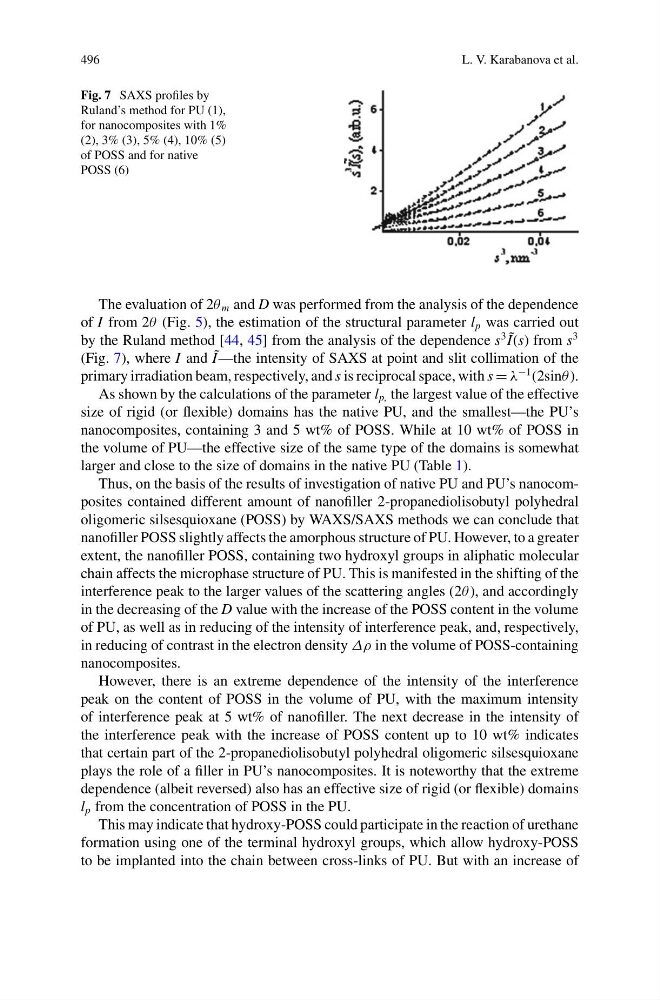
Fig. 7 SAXS profiles by
Ruland’s method for PU (1),
for nanocomposites with 1%
(2), 3% (3), 5% (4), 10% (5)
of POSS and for native
POSS (6)
The evaluation of 2θ m and D was performed from the analysis of the dependence
of I from 2θ (Fig. 5), the estimation of the structural parameter l p was carried out
by the Ruland method [44, 45] from the analysis of the dependence s
3 ˜
I(s) from s
3
(Fig. 7), where I and ˜
I—the intensity of SAXS at point and slit collimation of the
primary irradiation beam, respectively, and s is reciprocal space, with s = λ
−1 (2sinθ ).
As shown by the calculations of the parameter l p, the largest value of the effective
size of rigid (or flexible) domains has the native PU, and the smallest—the PU’s
nanocomposites, containing 3 and 5 wt% of POSS. While at 10 wt% of POSS in
the volume of PU—the effective size of the same type of the domains is somewhat
larger and close to the size of domains in the native PU (Table 1).
Thus, on the basis of the results of investigation of native PU and PU’s nanocomposites contained different amount of nanofiller 2-propanediolisobutyl polyhedral
oligomeric silsesquioxane (POSS) by WAXS/SAXS methods we can conclude that
nanofiller POSS slightly affects the amorphous structure of PU. However, to a greater
extent, the nanofiller POSS, containing two hydroxyl groups in aliphatic molecular
chain affects the microphase structure of PU. This is manifested in the shifting of the
interference peak to the larger values of the scattering angles (2θ ), and accordingly
in the decreasing of the D value with the increase of the POSS content in the volume
of PU, as well as in reducing of the intensity of interference peak, and, respectively,
in reducing of contrast in the electron density Δρ in the volume of POSS-containing
nanocomposites.
However, there is an extreme dependence of the intensity of the interference
peak on the content of POSS in the volume of PU, with the maximum intensity
of interference peak at 5 wt% of nanofiller. The next decrease in the intensity of
the interference peak with the increase of POSS content up to 10 wt% indicates
that certain part of the 2-propanediolisobutyl polyhedral oligomeric silsesquioxane
plays the role of a filler in PU’s nanocomposites. It is noteworthy that the extreme
dependence (albeit reversed) also has an effective size of rigid (or flexible) domains
l p from the concentration of POSS in the PU.
This may indicate that hydroxy-POSS could participate in the reaction of urethane
formation using one of the terminal hydroxyl groups, which allow hydroxy-POSS
to be implanted into the chain between cross-links of PU. But with an increase of
L. V. Karabanova et al.
Fig. 7 SAXS profiles by
Ruland’s method for PU (1),
for nanocomposites with 1%
(2), 3% (3), 5% (4), 10% (5)
of POSS and for native
POSS (6)
The evaluation of 2θ m and D was performed from the analysis of the dependence
of I from 2θ (Fig. 5), the estimation of the structural parameter l p was carried out
by the Ruland method [44, 45] from the analysis of the dependence s
3 ˜
I(s) from s
3
(Fig. 7), where I and ˜
I—the intensity of SAXS at point and slit collimation of the
primary irradiation beam, respectively, and s is reciprocal space, with s = λ
−1 (2sinθ ).
As shown by the calculations of the parameter l p, the largest value of the effective
size of rigid (or flexible) domains has the native PU, and the smallest—the PU’s
nanocomposites, containing 3 and 5 wt% of POSS. While at 10 wt% of POSS in
the volume of PU—the effective size of the same type of the domains is somewhat
larger and close to the size of domains in the native PU (Table 1).
Thus, on the basis of the results of investigation of native PU and PU’s nanocomposites contained different amount of nanofiller 2-propanediolisobutyl polyhedral
oligomeric silsesquioxane (POSS) by WAXS/SAXS methods we can conclude that
nanofiller POSS slightly affects the amorphous structure of PU. However, to a greater
extent, the nanofiller POSS, containing two hydroxyl groups in aliphatic molecular
chain affects the microphase structure of PU. This is manifested in the shifting of the
interference peak to the larger values of the scattering angles (2θ ), and accordingly
in the decreasing of the D value with the increase of the POSS content in the volume
of PU, as well as in reducing of the intensity of interference peak, and, respectively,
in reducing of contrast in the electron density Δρ in the volume of POSS-containing
nanocomposites.
However, there is an extreme dependence of the intensity of the interference
peak on the content of POSS in the volume of PU, with the maximum intensity
of interference peak at 5 wt% of nanofiller. The next decrease in the intensity of
the interference peak with the increase of POSS content up to 10 wt% indicates
that certain part of the 2-propanediolisobutyl polyhedral oligomeric silsesquioxane
plays the role of a filler in PU’s nanocomposites. It is noteworthy that the extreme
dependence (albeit reversed) also has an effective size of rigid (or flexible) domains
l p from the concentration of POSS in the PU.
This may indicate that hydroxy-POSS could participate in the reaction of urethane
formation using one of the terminal hydroxyl groups, which allow hydroxy-POSS
to be implanted into the chain between cross-links of PU. But with an increase of