

Structure and Properties of the POSS-Containing Nanocomposites …
495
It is noteworthy that the increase of the amount of POSS up to 3 wt% in the volume
of PU (Fig. 2, curve 3) results in the further shift of the interference maximum on
the intensity profile to the higher values of 2θ (2θ m = 1.7
o ), and accordingly in
the decrease of the D value (Table 1). At this POSS content in the PU, the intensity
of the interference peak is slightly higher than the maximum intensity of the PU’s
nanocomposite containing 1 wt% of POSS (Fig. 2, curves 2, 3). With an increase
of the POSS amount up to 5 wt% in the volume of PU, it was detected, that the
intensity of the interference peak is significantly higher compared to the intensity of
the peak of the PU’s nanocomposite contained 3 wt% of POSS. It should be noted
that at 5 wt% of POSS in the PU, the angular position of the interference peak,
and accordingly the value of D, remain the same as for PU nanocomposite, which
contains 3 wt% of the nanofilller (Table 1).
However, with an increase of the POSS content up to 10 wt% in the PU, the angular
position and, accordingly, the value of the structural parameter D, is similar to the
PU’s nanocomposites, containing 3 and 5 wt% of POSS (Table 1). But the intensity
of the interference maximum is slightly higher than the intensity of maximum of
PU’s nanocomposite, containing 3 wt% of POSS.
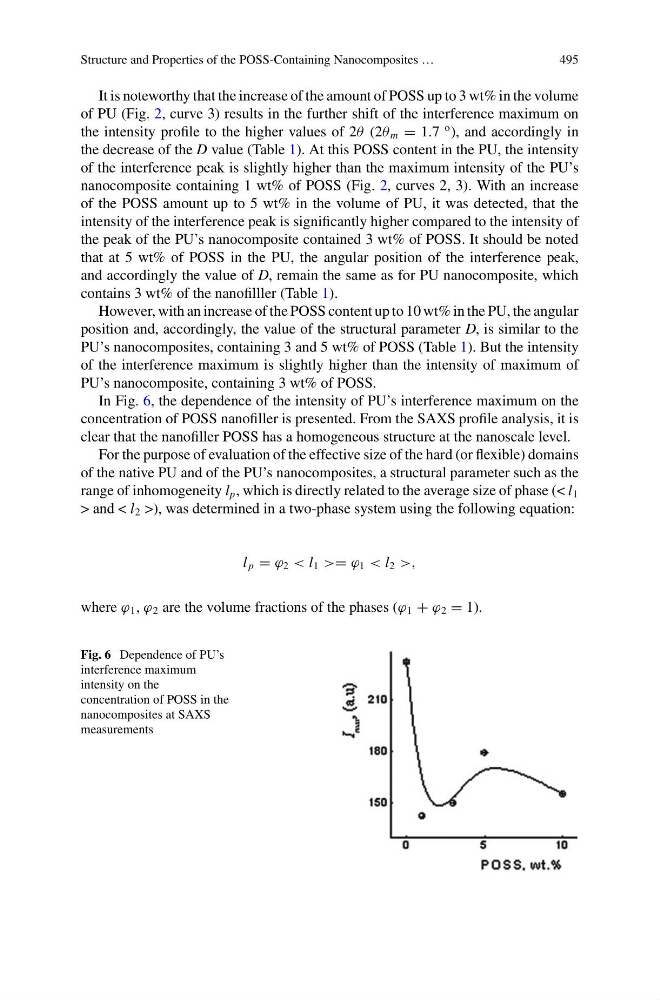
In Fig. 6, the dependence of the intensity of PU’s interference maximum on the
concentration of POSS nanofiller is presented. From the SAXS profile analysis, it is
clear that the nanofiller POSS has a homogeneous structure at the nanoscale level.
For the purpose of evaluation of the effective size of the hard (or flexible) domains
of the native PU and of the PU’s nanocomposites, a structural parameter such as the
range of inhomogeneity l p , which is directly related to the average size of phase (< l 1
> and < l 2 >), was determined in a two-phase system using the following equation:
l p = ϕ 2 < l 1 >= ϕ 1 < l 2 >,
where ϕ 1 , ϕ 2 are the volume fractions of the phases (ϕ 1 + ϕ 2 = 1).
Fig. 6 Dependence of PU’s
interference maximum
intensity on the
concentration of POSS in the
nanocomposites at SAXS
measurements
495
It is noteworthy that the increase of the amount of POSS up to 3 wt% in the volume
of PU (Fig. 2, curve 3) results in the further shift of the interference maximum on
the intensity profile to the higher values of 2θ (2θ m = 1.7
o ), and accordingly in
the decrease of the D value (Table 1). At this POSS content in the PU, the intensity
of the interference peak is slightly higher than the maximum intensity of the PU’s
nanocomposite containing 1 wt% of POSS (Fig. 2, curves 2, 3). With an increase
of the POSS amount up to 5 wt% in the volume of PU, it was detected, that the
intensity of the interference peak is significantly higher compared to the intensity of
the peak of the PU’s nanocomposite contained 3 wt% of POSS. It should be noted
that at 5 wt% of POSS in the PU, the angular position of the interference peak,
and accordingly the value of D, remain the same as for PU nanocomposite, which
contains 3 wt% of the nanofilller (Table 1).
However, with an increase of the POSS content up to 10 wt% in the PU, the angular
position and, accordingly, the value of the structural parameter D, is similar to the
PU’s nanocomposites, containing 3 and 5 wt% of POSS (Table 1). But the intensity
of the interference maximum is slightly higher than the intensity of maximum of
PU’s nanocomposite, containing 3 wt% of POSS.
In Fig. 6, the dependence of the intensity of PU’s interference maximum on the
concentration of POSS nanofiller is presented. From the SAXS profile analysis, it is
clear that the nanofiller POSS has a homogeneous structure at the nanoscale level.
For the purpose of evaluation of the effective size of the hard (or flexible) domains
of the native PU and of the PU’s nanocomposites, a structural parameter such as the
range of inhomogeneity l p , which is directly related to the average size of phase (< l 1
> and < l 2 >), was determined in a two-phase system using the following equation:
l p = ϕ 2 < l 1 >= ϕ 1 < l 2 >,
where ϕ 1 , ϕ 2 are the volume fractions of the phases (ϕ 1 + ϕ 2 = 1).
Fig. 6 Dependence of PU’s
interference maximum
intensity on the
concentration of POSS in the
nanocomposites at SAXS
measurements