

474
B. M. Gorelov et al.
Thus, TDMS-data shows that embedding MLGNPs into the epoxy result in stabilizing its 3D-molecular network structure [73] due to binding of both free and looselycoupled dipole moieties to ASSs and in its electric ordering in the vicinity of the
nanoparticles.
3.3 Data Obtained by Ultrasound Probing and Static
Mechanical Loading
3.3.1 Ultrasonic Probing
Both experimental and theoretical loading dependences of the normalized Young’s
module E
C f
/E(0) (a) and the normalized Poisson’s ratio ν
C f
/ν(0) (b) for the
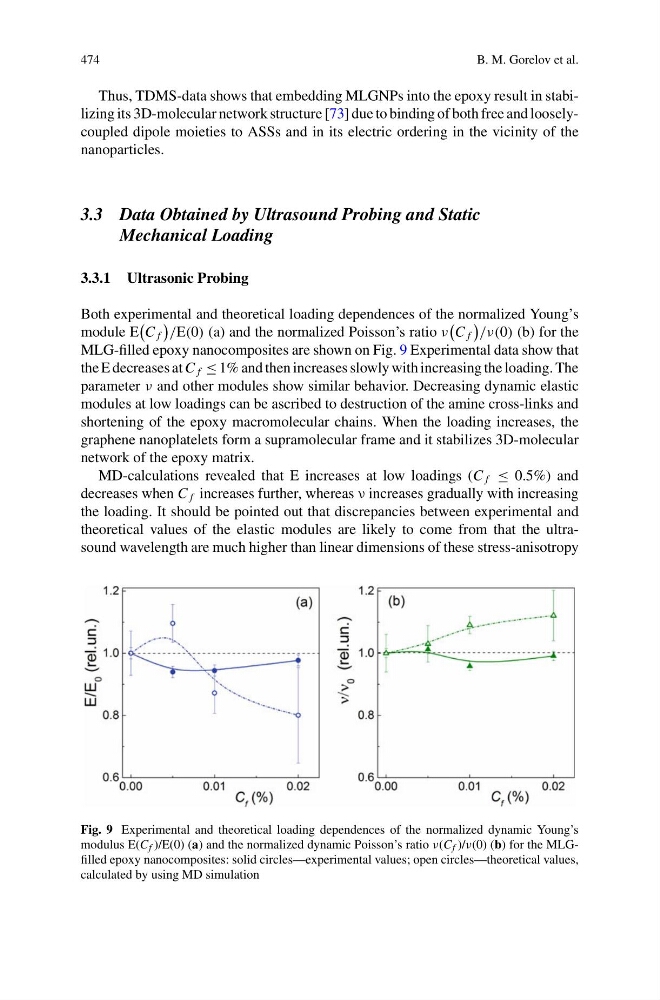
MLG-filled epoxy nanocomposites are shown on Fig. 9 Experimental data show that
the E decreases at C f ≤ 1% and then increases slowly with increasing the loading. The
parameter ν and other modules show similar behavior. Decreasing dynamic elastic
modules at low loadings can be ascribed to destruction of the amine cross-links and
shortening of the epoxy macromolecular chains. When the loading increases, the
graphene nanoplatelets form a supramolecular frame and it stabilizes 3D-molecular
network of the epoxy matrix.
MD-calculations revealed that E increases at low loadings (C f ≤ 0.5%) and
decreases when C f increases further, whereas ν increases gradually with increasing
the loading. It should be pointed out that discrepancies between experimental and
theoretical values of the elastic modules are likely to come from that the ultrasound wavelength are much higher than linear dimensions of these stress-anisotropy
Fig. 9 Experimental and theoretical loading dependences of the normalized dynamic Young’s
modulus E(C f )/E(0) (a) and the normalized dynamic Poisson’s ratio ν(C f )/ν(0) (b) for the MLGfilled epoxy nanocomposites: solid circles—experimental values; open circles—theoretical values,
calculated by using MD simulation
B. M. Gorelov et al.
Thus, TDMS-data shows that embedding MLGNPs into the epoxy result in stabilizing its 3D-molecular network structure [73] due to binding of both free and looselycoupled dipole moieties to ASSs and in its electric ordering in the vicinity of the
nanoparticles.
3.3 Data Obtained by Ultrasound Probing and Static
Mechanical Loading
3.3.1 Ultrasonic Probing
Both experimental and theoretical loading dependences of the normalized Young’s
module E
C f
/E(0) (a) and the normalized Poisson’s ratio ν
C f
/ν(0) (b) for the
MLG-filled epoxy nanocomposites are shown on Fig. 9 Experimental data show that
the E decreases at C f ≤ 1% and then increases slowly with increasing the loading. The
parameter ν and other modules show similar behavior. Decreasing dynamic elastic
modules at low loadings can be ascribed to destruction of the amine cross-links and
shortening of the epoxy macromolecular chains. When the loading increases, the
graphene nanoplatelets form a supramolecular frame and it stabilizes 3D-molecular
network of the epoxy matrix.
MD-calculations revealed that E increases at low loadings (C f ≤ 0.5%) and
decreases when C f increases further, whereas ν increases gradually with increasing
the loading. It should be pointed out that discrepancies between experimental and
theoretical values of the elastic modules are likely to come from that the ultrasound wavelength are much higher than linear dimensions of these stress-anisotropy
Fig. 9 Experimental and theoretical loading dependences of the normalized dynamic Young’s
modulus E(C f )/E(0) (a) and the normalized dynamic Poisson’s ratio ν(C f )/ν(0) (b) for the MLGfilled epoxy nanocomposites: solid circles—experimental values; open circles—theoretical values,
calculated by using MD simulation