

468
B. M. Gorelov et al.
advantageous for γ -dipoles to line up with the neighboring ones in an antiparallel
direction, and in such a case g i < 1 [71]. This situation is likely to take place in
both tightly packed and loosely packed areas where different types of γ -dipoles are
dominant.
Averaging the sets of F RT
T γ
calculated by using (4) at different temperatures
T γ , we have obtained the mean values F RT
C f
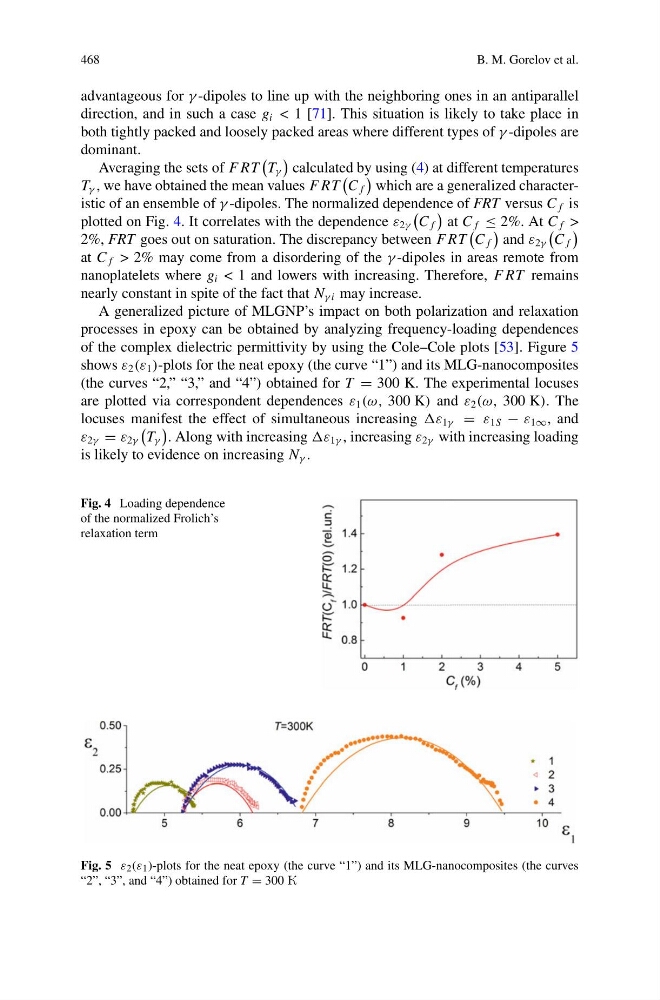
which are a generalized characteristic of an ensemble of γ -dipoles. The normalized dependence of FRT versus C f is
plotted on Fig. 4. It correlates with the dependence ε 2γ
C f
at C f ≤ 2%. At C f >
2%, FRT goes out on saturation. The discrepancy between F RT
C f
and ε 2γ
C f
at C f > 2% may come from a disordering of the γ -dipoles in areas remote from
nanoplatelets where g i < 1 and lowers with increasing. Therefore, F RT remains
nearly constant in spite of the fact that N γ i may increase.
A generalized picture of MLGNP’s impact on both polarization and relaxation
processes in epoxy can be obtained by analyzing frequency-loading dependences
of the complex dielectric permittivity by using the Cole–Cole plots [53]. Figure 5
shows ε 2 (ε 1 )-plots for the neat epoxy (the curve “1”) and its MLG-nanocomposites
(the curves “2,” “3,” and “4”) obtained for T = 300 K. The experimental locuses
are plotted via correspondent dependences ε 1 (ω, 300 K) and ε 2 (ω, 300 K). The
locuses manifest the effect of simultaneous increasing ε 1γ = ε 1S − ε 1∞ , and
ε 2γ = ε 2γ
T γ
. Along with increasing ε 1γ , increasing ε 2γ with increasing loading
is likely to evidence on increasing N γ .
Fig. 4 Loading dependence
of the normalized Frolich’s
relaxation term
Fig. 5 ε 2 (ε 1 )-plots for the neat epoxy (the curve “1”) and its MLG-nanocomposites (the curves
“2”, “3”, and “4”) obtained for T = 300 K
B. M. Gorelov et al.
advantageous for γ -dipoles to line up with the neighboring ones in an antiparallel
direction, and in such a case g i < 1 [71]. This situation is likely to take place in
both tightly packed and loosely packed areas where different types of γ -dipoles are
dominant.
Averaging the sets of F RT
T γ
calculated by using (4) at different temperatures
T γ , we have obtained the mean values F RT
C f
which are a generalized characteristic of an ensemble of γ -dipoles. The normalized dependence of FRT versus C f is
plotted on Fig. 4. It correlates with the dependence ε 2γ
C f
at C f ≤ 2%. At C f >
2%, FRT goes out on saturation. The discrepancy between F RT
C f
and ε 2γ
C f
at C f > 2% may come from a disordering of the γ -dipoles in areas remote from
nanoplatelets where g i < 1 and lowers with increasing. Therefore, F RT remains
nearly constant in spite of the fact that N γ i may increase.
A generalized picture of MLGNP’s impact on both polarization and relaxation
processes in epoxy can be obtained by analyzing frequency-loading dependences
of the complex dielectric permittivity by using the Cole–Cole plots [53]. Figure 5
shows ε 2 (ε 1 )-plots for the neat epoxy (the curve “1”) and its MLG-nanocomposites
(the curves “2,” “3,” and “4”) obtained for T = 300 K. The experimental locuses
are plotted via correspondent dependences ε 1 (ω, 300 K) and ε 2 (ω, 300 K). The
locuses manifest the effect of simultaneous increasing ε 1γ = ε 1S − ε 1∞ , and
ε 2γ = ε 2γ
T γ
. Along with increasing ε 1γ , increasing ε 2γ with increasing loading
is likely to evidence on increasing N γ .
Fig. 4 Loading dependence
of the normalized Frolich’s
relaxation term
Fig. 5 ε 2 (ε 1 )-plots for the neat epoxy (the curve “1”) and its MLG-nanocomposites (the curves
“2”, “3”, and “4”) obtained for T = 300 K