

Epoxy Molecular Structure Alteration in Graphene …
467
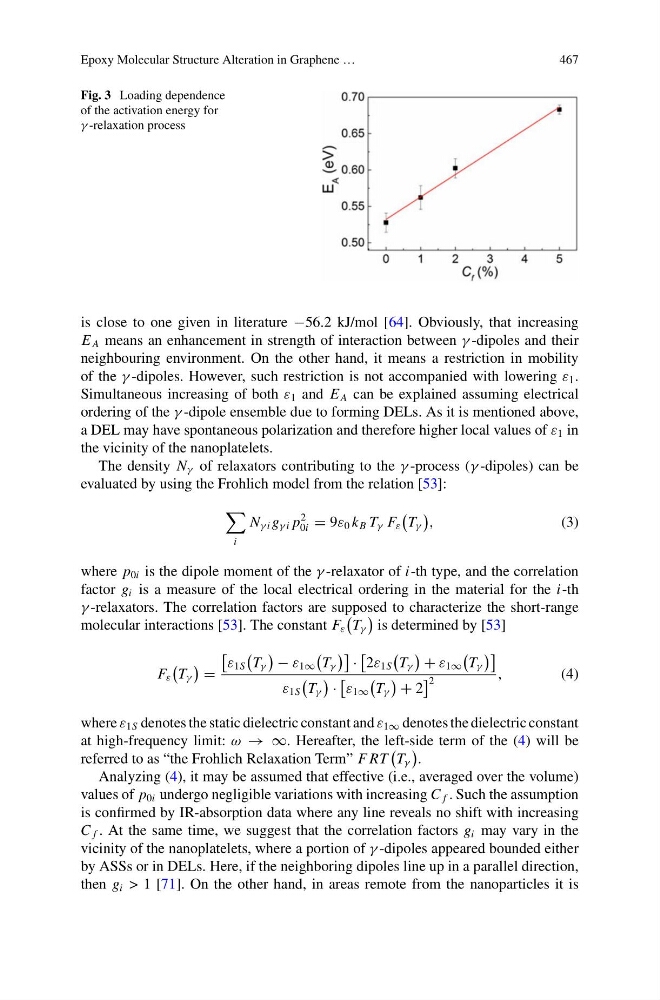
Fig. 3 Loading dependence
of the activation energy for
γ -relaxation process
is close to one given in literature −56.2 kJ/mol [64]. Obviously, that increasing
E A means an enhancement in strength of interaction between γ -dipoles and their
neighbouring environment. On the other hand, it means a restriction in mobility
of the γ -dipoles. However, such restriction is not accompanied with lowering ε 1 .
Simultaneous increasing of both ε 1 and E A can be explained assuming electrical
ordering of the γ -dipole ensemble due to forming DELs. As it is mentioned above,
a DEL may have spontaneous polarization and therefore higher local values of ε 1 in
the vicinity of the nanoplatelets.
The density N γ of relaxators contributing to the γ -process (γ -dipoles) can be
evaluated by using the Frohlich model from the relation [53]:
i
N γ i g γ i p
2
0i = 9ε 0 k B T γ F ε
T γ
,
(3)
where p 0i is the dipole moment of the γ -relaxator of i-th type, and the correlation
factor g i is a measure of the local electrical ordering in the material for the i-th
γ -relaxators. The correlation factors are supposed to characterize the short-range
molecular interactions [53]. The constant F ε
T γ
is determined by [53]
F ε
T γ
=
ε 1S
T γ
− ε 1∞
T γ
·
2ε 1S
T γ
+ ε 1∞
T γ
ε 1S
T γ
·
ε 1∞
T γ
+ 2
2
,
(4)
where ε 1S denotes the static dielectric constant and ε 1∞ denotes the dielectric constant
at high-frequency limit: ω → ∞. Hereafter, the left-side term of the (4) will be
referred to as “the Frohlich Relaxation Term” F RT
T γ
.
Analyzing (4), it may be assumed that effective (i.e., averaged over the volume)
values of p 0i undergo negligible variations with increasing C f . Such the assumption
is confirmed by IR-absorption data where any line reveals no shift with increasing
C f . At the same time, we suggest that the correlation factors g i may vary in the
vicinity of the nanoplatelets, where a portion of γ -dipoles appeared bounded either
by ASSs or in DELs. Here, if the neighboring dipoles line up in a parallel direction,
then g i > 1 [71]. On the other hand, in areas remote from the nanoparticles it is
467
Fig. 3 Loading dependence
of the activation energy for
γ -relaxation process
is close to one given in literature −56.2 kJ/mol [64]. Obviously, that increasing
E A means an enhancement in strength of interaction between γ -dipoles and their
neighbouring environment. On the other hand, it means a restriction in mobility
of the γ -dipoles. However, such restriction is not accompanied with lowering ε 1 .
Simultaneous increasing of both ε 1 and E A can be explained assuming electrical
ordering of the γ -dipole ensemble due to forming DELs. As it is mentioned above,
a DEL may have spontaneous polarization and therefore higher local values of ε 1 in
the vicinity of the nanoplatelets.
The density N γ of relaxators contributing to the γ -process (γ -dipoles) can be
evaluated by using the Frohlich model from the relation [53]:
i
N γ i g γ i p
2
0i = 9ε 0 k B T γ F ε
T γ
,
(3)
where p 0i is the dipole moment of the γ -relaxator of i-th type, and the correlation
factor g i is a measure of the local electrical ordering in the material for the i-th
γ -relaxators. The correlation factors are supposed to characterize the short-range
molecular interactions [53]. The constant F ε
T γ
is determined by [53]
F ε
T γ
=
ε 1S
T γ
− ε 1∞
T γ
·
2ε 1S
T γ
+ ε 1∞
T γ
ε 1S
T γ
·
ε 1∞
T γ
+ 2
2
,
(4)
where ε 1S denotes the static dielectric constant and ε 1∞ denotes the dielectric constant
at high-frequency limit: ω → ∞. Hereafter, the left-side term of the (4) will be
referred to as “the Frohlich Relaxation Term” F RT
T γ
.
Analyzing (4), it may be assumed that effective (i.e., averaged over the volume)
values of p 0i undergo negligible variations with increasing C f . Such the assumption
is confirmed by IR-absorption data where any line reveals no shift with increasing
C f . At the same time, we suggest that the correlation factors g i may vary in the
vicinity of the nanoplatelets, where a portion of γ -dipoles appeared bounded either
by ASSs or in DELs. Here, if the neighboring dipoles line up in a parallel direction,
then g i > 1 [71]. On the other hand, in areas remote from the nanoparticles it is