

466
B. M. Gorelov et al.
scanning microscopy [66, 67] confirmed that epoxy-amine resins possess a heterogeneous, nodular structure, which is composed of regions of relatively higher crosslinking surrounded by an interstitial phase of a relatively lower cross-link density
[66, 68].
Also, It has previously been shown [59–62] that the dielectric β-relaxation in
epoxy resins cured with the amine-contained hardeners is affected mainly by the
chemical structure of the curing agents. Namely, the β-peak was tentatively assigned
to the local motion of the dipolar groups that are created during the cross-linking
reactions. These were the hydroxyl-ether groups and the secondary or tertiary amines.
Later, Johari and Mangion [63] have studied dielectric relaxation of bisphenol-Abased thermosets cured with diaminodiphenyl methane and diaminodiphenyl sulfone.
They found that the γ -relaxation process is more prominent than the β-relaxation
process and supposed the γ -peaks to be partly due to local motions of those dipoles
that remain as the unreacted components during the curing of the thermosets. Also,
their results show that the β-relaxation peak becomes increasingly more prominent
as the number of cross-links and the chain length increases. Not recently, Hassan
et al. [64] reported substantial suppression of β-peaks as compared to γ -peaks
for DGEBA-epoxy networks prepared using 3,3- and 4,4-diaminodiphenyl sulfone
isomer cross-linkers.
On the whole, there is ambiguity in treating MDR-peaks in various epoxy systems,
i.e., in ascribing various dipole moieties to β-or γ -relaxators. In our experiments,
the MDR-processes manifest themselves in frequency dependences of ε 2 as rather
broad single peaks. In the neat epoxy, the peaks have been observed at T > 175 K
over the entire frequency region studied. Therefore, we assumed that β-and γ -peaks
overlap due to various relaxators possessing close values of the activation energy are
present in both the neat resin and its nanocomposites.
Analyzing shifts in γ -peak temperature position with increasing frequency for
every nanocomposite, the loading dependence for effective activation energy (E γ )
of γ -dipoles can be determined. Within a frame of the classic Debye theory [52], in
the temperature position (T γ ) of the peak in ε 2 (T )− curve obtained at the certain
frequency ω γ is related to the correspondent macroscopic relaxation time τ γ by
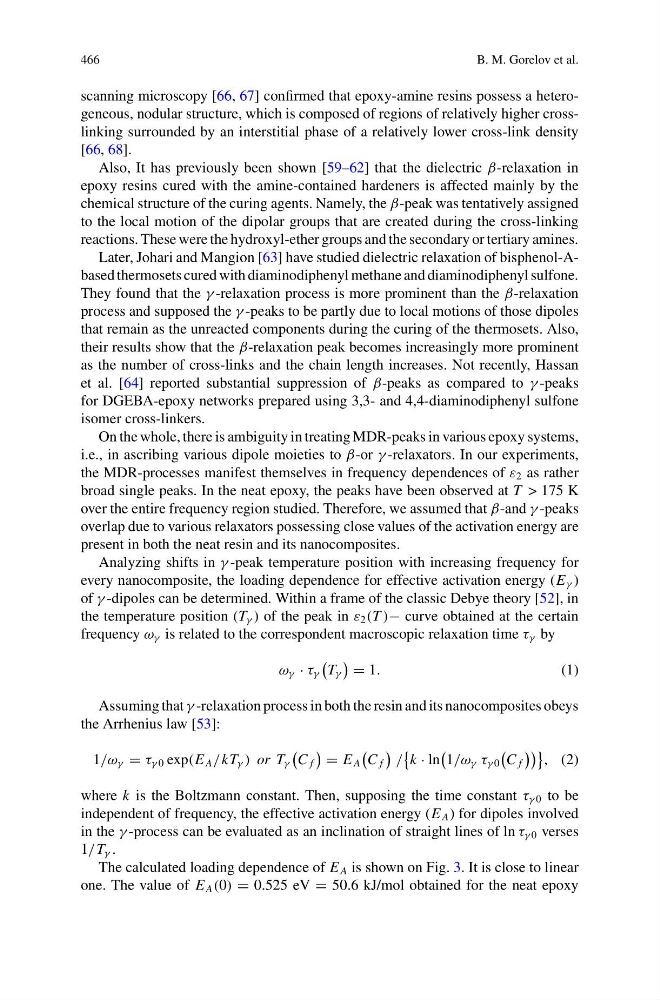
ω γ · τ γ
T γ
= 1.
(1)
Assuming that γ -relaxation process in both the resin and its nanocomposites obeys
the Arrhenius law [53]:
1/ω γ = τ γ 0 exp(E A /kT γ ) or T γ
C f
= E A
C f
/
k · ln
1/ω γ τ γ 0
C f
, (2)
where k is the Boltzmann constant. Then, supposing the time constant τ γ 0 to be
independent of frequency, the effective activation energy (E A ) for dipoles involved
in the γ -process can be evaluated as an inclination of straight lines of ln τ γ 0 verses
1/T γ .
The calculated loading dependence of E A is shown on Fig. 3. It is close to linear
one. The value of E A (0) = 0.525 eV = 50.6 kJ/mol obtained for the neat epoxy
B. M. Gorelov et al.
scanning microscopy [66, 67] confirmed that epoxy-amine resins possess a heterogeneous, nodular structure, which is composed of regions of relatively higher crosslinking surrounded by an interstitial phase of a relatively lower cross-link density
[66, 68].
Also, It has previously been shown [59–62] that the dielectric β-relaxation in
epoxy resins cured with the amine-contained hardeners is affected mainly by the
chemical structure of the curing agents. Namely, the β-peak was tentatively assigned
to the local motion of the dipolar groups that are created during the cross-linking
reactions. These were the hydroxyl-ether groups and the secondary or tertiary amines.
Later, Johari and Mangion [63] have studied dielectric relaxation of bisphenol-Abased thermosets cured with diaminodiphenyl methane and diaminodiphenyl sulfone.
They found that the γ -relaxation process is more prominent than the β-relaxation
process and supposed the γ -peaks to be partly due to local motions of those dipoles
that remain as the unreacted components during the curing of the thermosets. Also,
their results show that the β-relaxation peak becomes increasingly more prominent
as the number of cross-links and the chain length increases. Not recently, Hassan
et al. [64] reported substantial suppression of β-peaks as compared to γ -peaks
for DGEBA-epoxy networks prepared using 3,3- and 4,4-diaminodiphenyl sulfone
isomer cross-linkers.
On the whole, there is ambiguity in treating MDR-peaks in various epoxy systems,
i.e., in ascribing various dipole moieties to β-or γ -relaxators. In our experiments,
the MDR-processes manifest themselves in frequency dependences of ε 2 as rather
broad single peaks. In the neat epoxy, the peaks have been observed at T > 175 K
over the entire frequency region studied. Therefore, we assumed that β-and γ -peaks
overlap due to various relaxators possessing close values of the activation energy are
present in both the neat resin and its nanocomposites.
Analyzing shifts in γ -peak temperature position with increasing frequency for
every nanocomposite, the loading dependence for effective activation energy (E γ )
of γ -dipoles can be determined. Within a frame of the classic Debye theory [52], in
the temperature position (T γ ) of the peak in ε 2 (T )− curve obtained at the certain
frequency ω γ is related to the correspondent macroscopic relaxation time τ γ by
ω γ · τ γ
T γ
= 1.
(1)
Assuming that γ -relaxation process in both the resin and its nanocomposites obeys
the Arrhenius law [53]:
1/ω γ = τ γ 0 exp(E A /kT γ ) or T γ
C f
= E A
C f
/
k · ln
1/ω γ τ γ 0
C f
, (2)
where k is the Boltzmann constant. Then, supposing the time constant τ γ 0 to be
independent of frequency, the effective activation energy (E A ) for dipoles involved
in the γ -process can be evaluated as an inclination of straight lines of ln τ γ 0 verses
1/T γ .
The calculated loading dependence of E A is shown on Fig. 3. It is close to linear
one. The value of E A (0) = 0.525 eV = 50.6 kJ/mol obtained for the neat epoxy