

452
I. I. Gab et al.
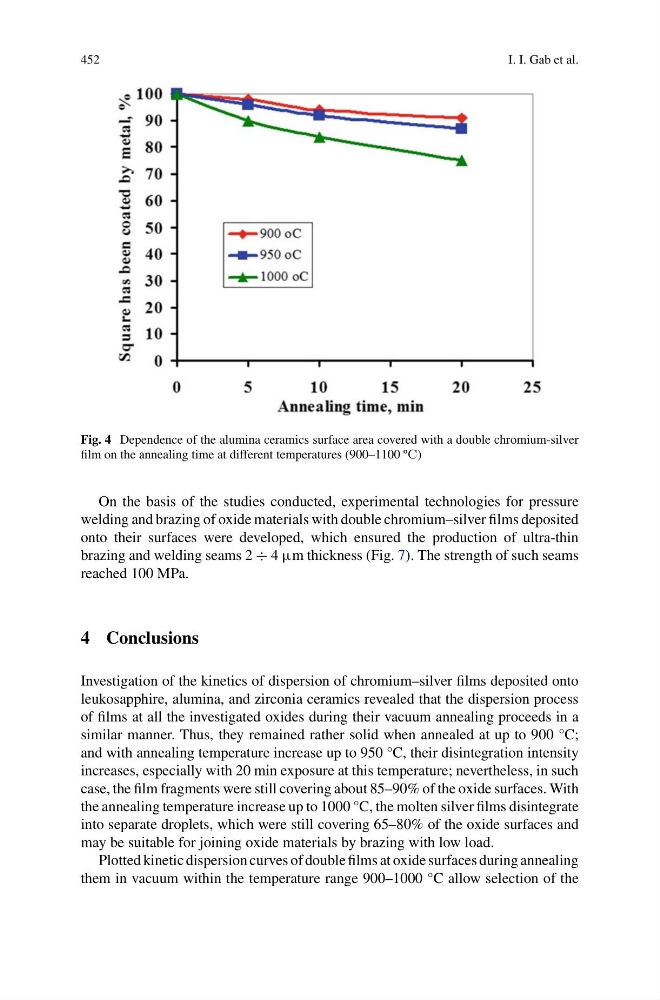
Fig. 4 Dependence of the alumina ceramics surface area covered with a double chromium-silver
film on the annealing time at different temperatures (900–1100 ºS)
On the basis of the studies conducted, experimental technologies for pressure
welding and brazing of oxide materials with double chromium–silver films deposited
onto their surfaces were developed, which ensured the production of ultra-thin
brazing and welding seams 2 ÷ 4 µm thickness (Fig. 7). The strength of such seams
reached 100 MPa.
4 Conclusions
Investigation of the kinetics of dispersion of chromium–silver films deposited onto
leukosapphire, alumina, and zirconia ceramics revealed that the dispersion process
of films at all the investigated oxides during their vacuum annealing proceeds in a
similar manner. Thus, they remained rather solid when annealed at up to 900 °C;
and with annealing temperature increase up to 950 °C, their disintegration intensity
increases, especially with 20 min exposure at this temperature; nevertheless, in such
case, the film fragments were still covering about 85–90% of the oxide surfaces. With
the annealing temperature increase up to 1000 °C, the molten silver films disintegrate
into separate droplets, which were still covering 65–80% of the oxide surfaces and
may be suitable for joining oxide materials by brazing with low load.
Plotted kinetic dispersion curves of double films at oxide surfaces during annealing
them in vacuum within the temperature range 900–1000 °C allow selection of the
I. I. Gab et al.
Fig. 4 Dependence of the alumina ceramics surface area covered with a double chromium-silver
film on the annealing time at different temperatures (900–1100 ºS)
On the basis of the studies conducted, experimental technologies for pressure
welding and brazing of oxide materials with double chromium–silver films deposited
onto their surfaces were developed, which ensured the production of ultra-thin
brazing and welding seams 2 ÷ 4 µm thickness (Fig. 7). The strength of such seams
reached 100 MPa.
4 Conclusions
Investigation of the kinetics of dispersion of chromium–silver films deposited onto
leukosapphire, alumina, and zirconia ceramics revealed that the dispersion process
of films at all the investigated oxides during their vacuum annealing proceeds in a
similar manner. Thus, they remained rather solid when annealed at up to 900 °C;
and with annealing temperature increase up to 950 °C, their disintegration intensity
increases, especially with 20 min exposure at this temperature; nevertheless, in such
case, the film fragments were still covering about 85–90% of the oxide surfaces. With
the annealing temperature increase up to 1000 °C, the molten silver films disintegrate
into separate droplets, which were still covering 65–80% of the oxide surfaces and
may be suitable for joining oxide materials by brazing with low load.
Plotted kinetic dispersion curves of double films at oxide surfaces during annealing
them in vacuum within the temperature range 900–1000 °C allow selection of the