

Dispersion Kinetics of Thin Double Chromium-Silver Films …
451
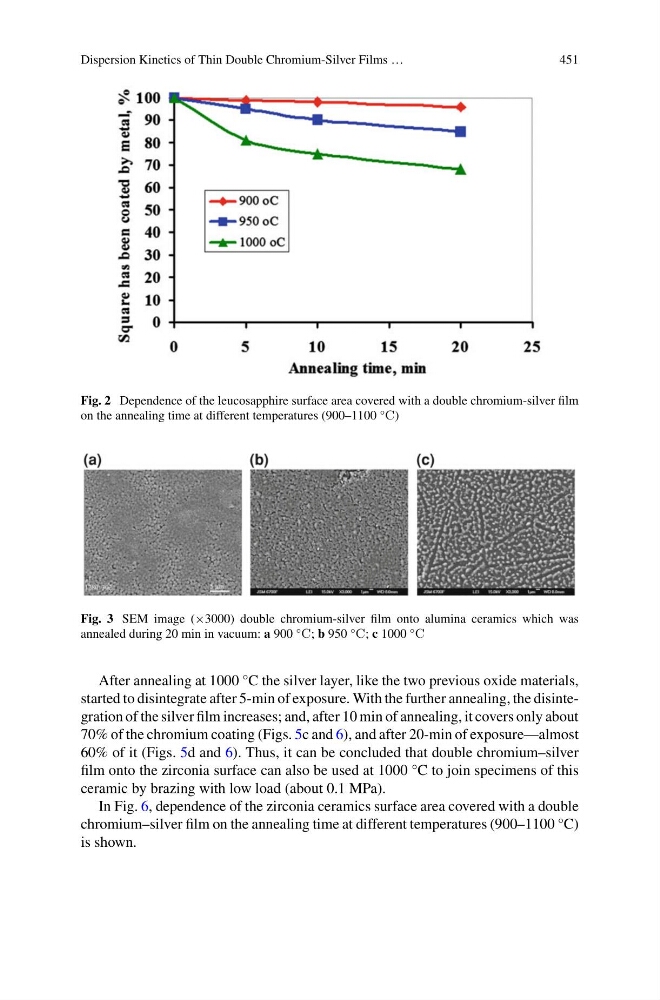
Fig. 2 Dependence of the leucosapphire surface area covered with a double chromium-silver film
on the annealing time at different temperatures (900–1100 °S)
Fig. 3 SEM image (×3000) double chromium-silver film onto alumina ceramics which was
annealed during 20 min in vacuum: a 900 °S; b 950 °S; c 1000 °S
After annealing at 1000 °C the silver layer, like the two previous oxide materials,
started to disintegrate after 5-min of exposure. With the further annealing, the disintegration of the silver film increases; and, after 10 min of annealing, it covers only about
70% of the chromium coating (Figs. 5c and 6), and after 20-min of exposure—almost
60% of it (Figs. 5d and 6). Thus, it can be concluded that double chromium–silver
film onto the zirconia surface can also be used at 1000 °C to join specimens of this
ceramic by brazing with low load (about 0.1 MPa).
In Fig. 6, dependence of the zirconia ceramics surface area covered with a double
chromium–silver film on the annealing time at different temperatures (900–1100 °C)
is shown.
451
Fig. 2 Dependence of the leucosapphire surface area covered with a double chromium-silver film
on the annealing time at different temperatures (900–1100 °S)
Fig. 3 SEM image (×3000) double chromium-silver film onto alumina ceramics which was
annealed during 20 min in vacuum: a 900 °S; b 950 °S; c 1000 °S
After annealing at 1000 °C the silver layer, like the two previous oxide materials,
started to disintegrate after 5-min of exposure. With the further annealing, the disintegration of the silver film increases; and, after 10 min of annealing, it covers only about
70% of the chromium coating (Figs. 5c and 6), and after 20-min of exposure—almost
60% of it (Figs. 5d and 6). Thus, it can be concluded that double chromium–silver
film onto the zirconia surface can also be used at 1000 °C to join specimens of this
ceramic by brazing with low load (about 0.1 MPa).
In Fig. 6, dependence of the zirconia ceramics surface area covered with a double
chromium–silver film on the annealing time at different temperatures (900–1100 °C)
is shown.