

450
I. I. Gab et al.
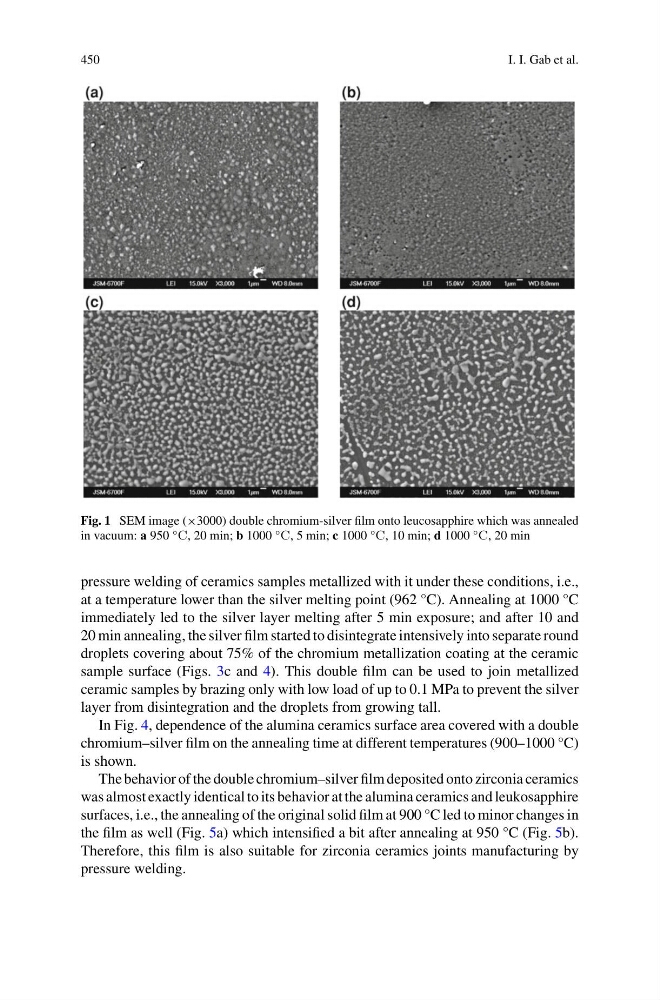
Fig. 1 SEM image (×3000) double chromium-silver film onto leucosapphire which was annealed
in vacuum: a 950 °S, 20 min; b 1000 °S, 5 min; c 1000 °S, 10 min; d 1000 °S, 20 min
pressure welding of ceramics samples metallized with it under these conditions, i.e.,
at a temperature lower than the silver melting point (962 °C). Annealing at 1000 °C
immediately led to the silver layer melting after 5 min exposure; and after 10 and
20 min annealing, the silver film started to disintegrate intensively into separate round
droplets covering about 75% of the chromium metallization coating at the ceramic
sample surface (Figs. 3c and 4). This double film can be used to join metallized
ceramic samples by brazing only with low load of up to 0.1 MPa to prevent the silver
layer from disintegration and the droplets from growing tall.
In Fig. 4, dependence of the alumina ceramics surface area covered with a double
chromium–silver film on the annealing time at different temperatures (900–1000 °C)
is shown.
The behavior of the double chromium–silver film deposited onto zirconia ceramics
was almost exactly identical to its behavior at the alumina ceramics and leukosapphire
surfaces, i.e., the annealing of the original solid film at 900 °C led to minor changes in
the film as well (Fig. 5a) which intensified a bit after annealing at 950 °C (Fig. 5b).
Therefore, this film is also suitable for zirconia ceramics joints manufacturing by
pressure welding.
I. I. Gab et al.
Fig. 1 SEM image (×3000) double chromium-silver film onto leucosapphire which was annealed
in vacuum: a 950 °S, 20 min; b 1000 °S, 5 min; c 1000 °S, 10 min; d 1000 °S, 20 min
pressure welding of ceramics samples metallized with it under these conditions, i.e.,
at a temperature lower than the silver melting point (962 °C). Annealing at 1000 °C
immediately led to the silver layer melting after 5 min exposure; and after 10 and
20 min annealing, the silver film started to disintegrate intensively into separate round
droplets covering about 75% of the chromium metallization coating at the ceramic
sample surface (Figs. 3c and 4). This double film can be used to join metallized
ceramic samples by brazing only with low load of up to 0.1 MPa to prevent the silver
layer from disintegration and the droplets from growing tall.
In Fig. 4, dependence of the alumina ceramics surface area covered with a double
chromium–silver film on the annealing time at different temperatures (900–1000 °C)
is shown.
The behavior of the double chromium–silver film deposited onto zirconia ceramics
was almost exactly identical to its behavior at the alumina ceramics and leukosapphire
surfaces, i.e., the annealing of the original solid film at 900 °C led to minor changes in
the film as well (Fig. 5a) which intensified a bit after annealing at 950 °C (Fig. 5b).
Therefore, this film is also suitable for zirconia ceramics joints manufacturing by
pressure welding.