

418
T. L. Tsaregradskaya et al.
described in [13]. At numerical annealing, the positions of the atoms were relaxed in
accordance with the forces calculated from the first principles. At that, the volume of
the supercell was allowed to change while maintaining its shape (cubic). It is quite
expected that the replacement of three Fe atoms (z = 26) with Zr atoms (z = 40) will
increase the volume of the original supercell by about 0.3%.
Thus, we obtained the initial “crystalline” supercell Fe 29 Zr 3 close to the eutectic
composition (C Zr = 9.375 at.%), which has an fcc structure, as in the hightemperature modification of γ-Fe. Of course, since Zr is insoluble in Fe, it is not a true
crystalline solid solution or intermetallic alloy. The closest stable intermetallic alloy
is Fe 2 Zr [3]. Some researchers have also reported the existence of intermetallic alloys
Fe 23 Zr 6 and Fe 3 Zr, but they are considered metastable [1]. The supercell described
above, which we call the “crystalline” one, is necessary for further modeling of the
“liquid” phase of the corresponding composition.
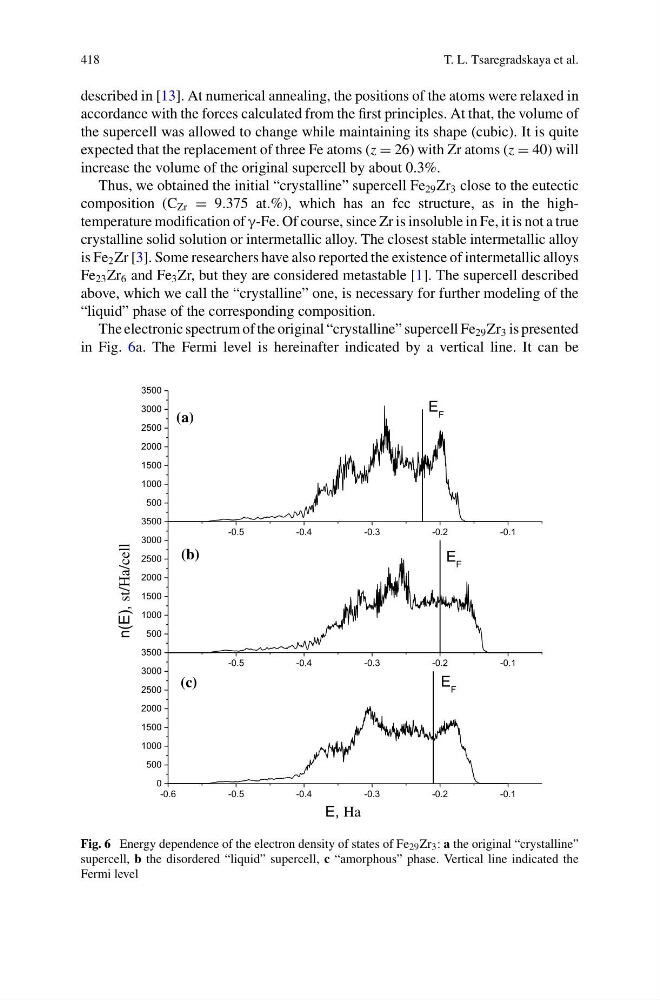
The electronic spectrum of the original “crystalline” supercell Fe 29 Zr 3 is presented
in Fig. 6a. The Fermi level is hereinafter indicated by a vertical line. It can be
-0.6
-0.5
-0.4
-0.3
-0.2
-0.1
0
500
1000
1500
2000
2500
3000
3500
-0.5
-0.4
-0.3
-0.2
-0.1
500
1000
1500
2000
2500
3000
3500
-0.5
-0.4
-0.3
-0.2
-0.1
500
1000
1500
2000
2500
3000
3500
(c)
E, Ha
E F
(b)
n(E),
st/Ha/cell
E F
E F
(a)
Fig. 6 Energy dependence of the electron density of states of Fe 29 Zr 3 : a the original “crystalline”
supercell, b the disordered “liquid” supercell, c “amorphous” phase. Vertical line indicated the
Fermi level
T. L. Tsaregradskaya et al.
described in [13]. At numerical annealing, the positions of the atoms were relaxed in
accordance with the forces calculated from the first principles. At that, the volume of
the supercell was allowed to change while maintaining its shape (cubic). It is quite
expected that the replacement of three Fe atoms (z = 26) with Zr atoms (z = 40) will
increase the volume of the original supercell by about 0.3%.
Thus, we obtained the initial “crystalline” supercell Fe 29 Zr 3 close to the eutectic
composition (C Zr = 9.375 at.%), which has an fcc structure, as in the hightemperature modification of γ-Fe. Of course, since Zr is insoluble in Fe, it is not a true
crystalline solid solution or intermetallic alloy. The closest stable intermetallic alloy
is Fe 2 Zr [3]. Some researchers have also reported the existence of intermetallic alloys
Fe 23 Zr 6 and Fe 3 Zr, but they are considered metastable [1]. The supercell described
above, which we call the “crystalline” one, is necessary for further modeling of the
“liquid” phase of the corresponding composition.
The electronic spectrum of the original “crystalline” supercell Fe 29 Zr 3 is presented
in Fig. 6a. The Fermi level is hereinafter indicated by a vertical line. It can be
-0.6
-0.5
-0.4
-0.3
-0.2
-0.1
0
500
1000
1500
2000
2500
3000
3500
-0.5
-0.4
-0.3
-0.2
-0.1
500
1000
1500
2000
2500
3000
3500
-0.5
-0.4
-0.3
-0.2
-0.1
500
1000
1500
2000
2500
3000
3500
(c)
E, Ha
E F
(b)
n(E),
st/Ha/cell
E F
E F
(a)
Fig. 6 Energy dependence of the electron density of states of Fe 29 Zr 3 : a the original “crystalline”
supercell, b the disordered “liquid” supercell, c “amorphous” phase. Vertical line indicated the
Fermi level