

Features of Phase Formation Processes in Amorphous Alloys …
417
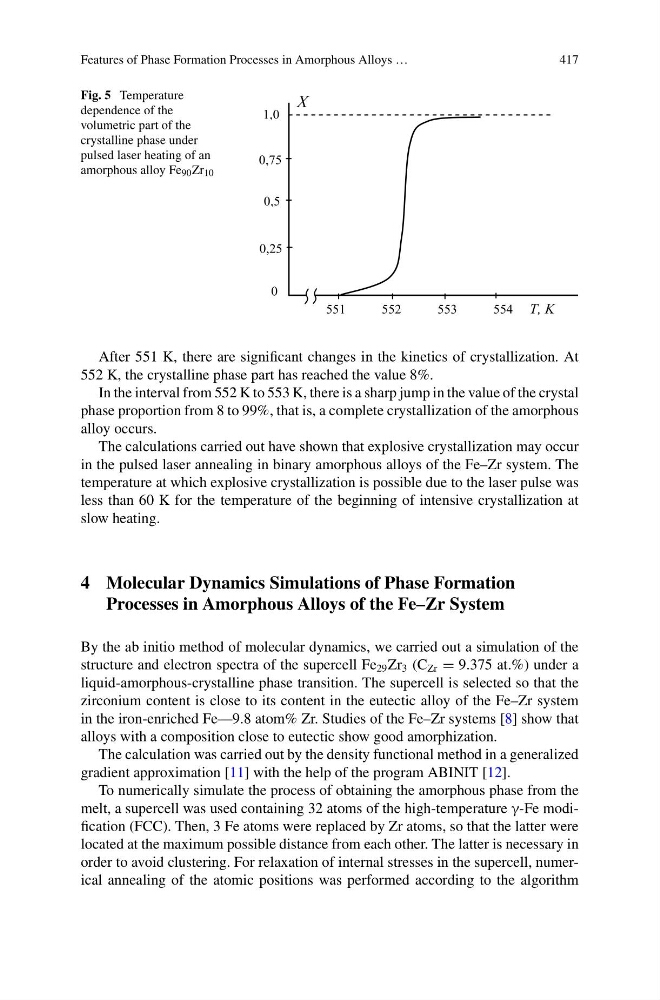
Fig. 5 Temperature
dependence of the
volumetric part of the
crystalline phase under
pulsed laser heating of an
amorphous alloy Fe 90 Zr 10
After 551 K, there are significant changes in the kinetics of crystallization. At
552 K, the crystalline phase part has reached the value 8%.
In the interval from 552 K to 553 K, there is a sharp jump in the value of the crystal
phase proportion from 8 to 99%, that is, a complete crystallization of the amorphous
alloy occurs.
The calculations carried out have shown that explosive crystallization may occur
in the pulsed laser annealing in binary amorphous alloys of the Fe–Zr system. The
temperature at which explosive crystallization is possible due to the laser pulse was
less than 60 K for the temperature of the beginning of intensive crystallization at
slow heating.
4 Molecular Dynamics Simulations of Phase Formation
Processes in Amorphous Alloys of the Fe–Zr System
By the ab initio method of molecular dynamics, we carried out a simulation of the
structure and electron spectra of the supercell Fe 29 Zr 3 (C Zr = 9.375 at.%) under a
liquid-amorphous-crystalline phase transition. The supercell is selected so that the
zirconium content is close to its content in the eutectic alloy of the Fe–Zr system
in the iron-enriched Fe—9.8 atom% Zr. Studies of the Fe–Zr systems [8] show that
alloys with a composition close to eutectic show good amorphization.
The calculation was carried out by the density functional method in a generalized
gradient approximation [11] with the help of the program ABINIT [12].
To numerically simulate the process of obtaining the amorphous phase from the
melt, a supercell was used containing 32 atoms of the high-temperature γ-Fe modification (FCC). Then, 3 Fe atoms were replaced by Zr atoms, so that the latter were
located at the maximum possible distance from each other. The latter is necessary in
order to avoid clustering. For relaxation of internal stresses in the supercell, numerical annealing of the atomic positions was performed according to the algorithm
417
Fig. 5 Temperature
dependence of the
volumetric part of the
crystalline phase under
pulsed laser heating of an
amorphous alloy Fe 90 Zr 10
After 551 K, there are significant changes in the kinetics of crystallization. At
552 K, the crystalline phase part has reached the value 8%.
In the interval from 552 K to 553 K, there is a sharp jump in the value of the crystal
phase proportion from 8 to 99%, that is, a complete crystallization of the amorphous
alloy occurs.
The calculations carried out have shown that explosive crystallization may occur
in the pulsed laser annealing in binary amorphous alloys of the Fe–Zr system. The
temperature at which explosive crystallization is possible due to the laser pulse was
less than 60 K for the temperature of the beginning of intensive crystallization at
slow heating.
4 Molecular Dynamics Simulations of Phase Formation
Processes in Amorphous Alloys of the Fe–Zr System
By the ab initio method of molecular dynamics, we carried out a simulation of the
structure and electron spectra of the supercell Fe 29 Zr 3 (C Zr = 9.375 at.%) under a
liquid-amorphous-crystalline phase transition. The supercell is selected so that the
zirconium content is close to its content in the eutectic alloy of the Fe–Zr system
in the iron-enriched Fe—9.8 atom% Zr. Studies of the Fe–Zr systems [8] show that
alloys with a composition close to eutectic show good amorphization.
The calculation was carried out by the density functional method in a generalized
gradient approximation [11] with the help of the program ABINIT [12].
To numerically simulate the process of obtaining the amorphous phase from the
melt, a supercell was used containing 32 atoms of the high-temperature γ-Fe modification (FCC). Then, 3 Fe atoms were replaced by Zr atoms, so that the latter were
located at the maximum possible distance from each other. The latter is necessary in
order to avoid clustering. For relaxation of internal stresses in the supercell, numerical annealing of the atomic positions was performed according to the algorithm