

392
A. V. Panko et al.
a few cases of underwater cable breaking since 1929 year, which were induced by
powerful turbidity currents. It is obvious, that such currents are forming frequently,
but their catastrophic collisions with technical structures are rare. Thus, deposits on
abyssal plains are presented by layers of turbidities with fine nanostructured pelagic
sediments. These processes explain big layers of oozes and turbidities in deep oceanic
channels with thickness up to 30 km, which were formed during 1–3 mln years. Thus,
it turns out that both in our days and in the Earth geological history, the catastrophic
phenomena have a significant role, but their investigation had the lack of attention.
Especially, it concerns the influence on them of nanochemical, biocolloidal, colloid–
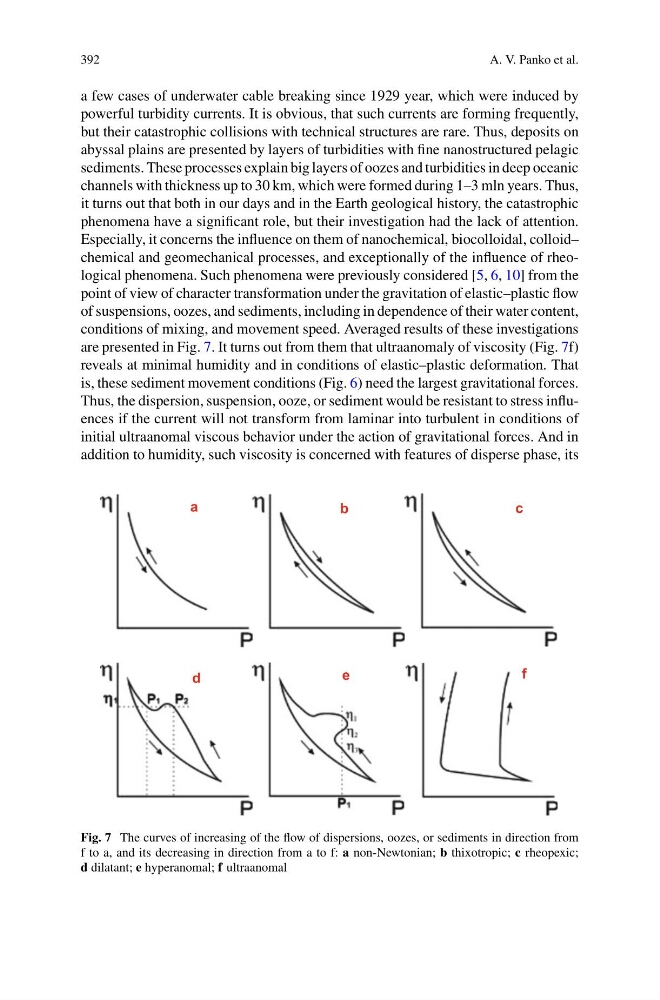
chemical and geomechanical processes, and exceptionally of the influence of rheological phenomena. Such phenomena were previously considered [5, 6, 10] from the
point of view of character transformation under the gravitation of elastic–plastic flow
of suspensions, oozes, and sediments, including in dependence of their water content,
conditions of mixing, and movement speed. Averaged results of these investigations
are presented in Fig. 7. It turns out from them that ultraanomaly of viscosity (Fig. 7f)
reveals at minimal humidity and in conditions of elastic–plastic deformation. That
is, these sediment movement conditions (Fig. 6) need the largest gravitational forces.
Thus, the dispersion, suspension, ooze, or sediment would be resistant to stress influences if the current will not transform from laminar into turbulent in conditions of
initial ultraanomal viscous behavior under the action of gravitational forces. And in
addition to humidity, such viscosity is concerned with features of disperse phase, its
а
b
c
d
e
f
Fig. 7 The curves of increasing of the flow of dispersions, oozes, or sediments in direction from
f to a, and its decreasing in direction from a to f: a non-Newtonian; b thixotropic; c rheopexic;
d dilatant; e hyperanomal; f ultraanomal
A. V. Panko et al.
a few cases of underwater cable breaking since 1929 year, which were induced by
powerful turbidity currents. It is obvious, that such currents are forming frequently,
but their catastrophic collisions with technical structures are rare. Thus, deposits on
abyssal plains are presented by layers of turbidities with fine nanostructured pelagic
sediments. These processes explain big layers of oozes and turbidities in deep oceanic
channels with thickness up to 30 km, which were formed during 1–3 mln years. Thus,
it turns out that both in our days and in the Earth geological history, the catastrophic
phenomena have a significant role, but their investigation had the lack of attention.
Especially, it concerns the influence on them of nanochemical, biocolloidal, colloid–
chemical and geomechanical processes, and exceptionally of the influence of rheological phenomena. Such phenomena were previously considered [5, 6, 10] from the
point of view of character transformation under the gravitation of elastic–plastic flow
of suspensions, oozes, and sediments, including in dependence of their water content,
conditions of mixing, and movement speed. Averaged results of these investigations
are presented in Fig. 7. It turns out from them that ultraanomaly of viscosity (Fig. 7f)
reveals at minimal humidity and in conditions of elastic–plastic deformation. That
is, these sediment movement conditions (Fig. 6) need the largest gravitational forces.
Thus, the dispersion, suspension, ooze, or sediment would be resistant to stress influences if the current will not transform from laminar into turbulent in conditions of
initial ultraanomal viscous behavior under the action of gravitational forces. And in
addition to humidity, such viscosity is concerned with features of disperse phase, its
а
b
c
d
e
f
Fig. 7 The curves of increasing of the flow of dispersions, oozes, or sediments in direction from
f to a, and its decreasing in direction from a to f: a non-Newtonian; b thixotropic; c rheopexic;
d dilatant; e hyperanomal; f ultraanomal