

Catastrophic Phenomena on Marine Slopes and in Artificial Dams …
391
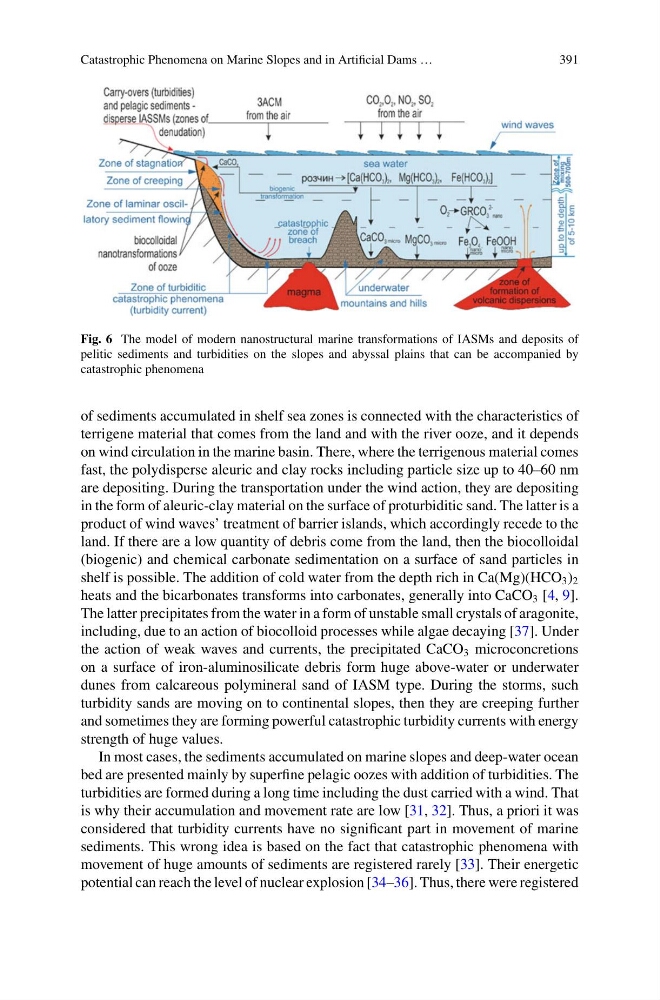
Fig. 6 The model of modern nanostructural marine transformations of IASMs and deposits of
pelitic sediments and turbidities on the slopes and abyssal plains that can be accompanied by
catastrophic phenomena
of sediments accumulated in shelf sea zones is connected with the characteristics of
terrigene material that comes from the land and with the river ooze, and it depends
on wind circulation in the marine basin. There, where the terrigenous material comes
fast, the polydisperse aleuric and clay rocks including particle size up to 40–60 nm
are depositing. During the transportation under the wind action, they are depositing
in the form of aleuric-clay material on the surface of proturbiditic sand. The latter is a
product of wind waves’ treatment of barrier islands, which accordingly recede to the
land. If there are a low quantity of debris come from the land, then the biocolloidal
(biogenic) and chemical carbonate sedimentation on a surface of sand particles in
shelf is possible. The addition of cold water from the depth rich in Ca(Mg)(HCO 3 ) 2
heats and the bicarbonates transforms into carbonates, generally into CaCO 3 [4, 9].
The latter precipitates from the water in a form of unstable small crystals of aragonite,
including, due to an action of biocolloid processes while algae decaying [37]. Under
the action of weak waves and currents, the precipitated CaCO 3 microconcretions
on a surface of iron-aluminosilicate debris form huge above-water or underwater
dunes from calcareous polymineral sand of IASM type. During the storms, such
turbidity sands are moving on to continental slopes, then they are creeping further
and sometimes they are forming powerful catastrophic turbidity currents with energy
strength of huge values.
In most cases, the sediments accumulated on marine slopes and deep-water ocean
bed are presented mainly by superfine pelagic oozes with addition of turbidities. The
turbidities are formed during a long time including the dust carried with a wind. That
is why their accumulation and movement rate are low [31, 32]. Thus, a priori it was
considered that turbidity currents have no significant part in movement of marine
sediments. This wrong idea is based on the fact that catastrophic phenomena with
movement of huge amounts of sediments are registered rarely [33]. Their energetic
potential can reach the level of nuclear explosion [34–36]. Thus, there were registered
391
Fig. 6 The model of modern nanostructural marine transformations of IASMs and deposits of
pelitic sediments and turbidities on the slopes and abyssal plains that can be accompanied by
catastrophic phenomena
of sediments accumulated in shelf sea zones is connected with the characteristics of
terrigene material that comes from the land and with the river ooze, and it depends
on wind circulation in the marine basin. There, where the terrigenous material comes
fast, the polydisperse aleuric and clay rocks including particle size up to 40–60 nm
are depositing. During the transportation under the wind action, they are depositing
in the form of aleuric-clay material on the surface of proturbiditic sand. The latter is a
product of wind waves’ treatment of barrier islands, which accordingly recede to the
land. If there are a low quantity of debris come from the land, then the biocolloidal
(biogenic) and chemical carbonate sedimentation on a surface of sand particles in
shelf is possible. The addition of cold water from the depth rich in Ca(Mg)(HCO 3 ) 2
heats and the bicarbonates transforms into carbonates, generally into CaCO 3 [4, 9].
The latter precipitates from the water in a form of unstable small crystals of aragonite,
including, due to an action of biocolloid processes while algae decaying [37]. Under
the action of weak waves and currents, the precipitated CaCO 3 microconcretions
on a surface of iron-aluminosilicate debris form huge above-water or underwater
dunes from calcareous polymineral sand of IASM type. During the storms, such
turbidity sands are moving on to continental slopes, then they are creeping further
and sometimes they are forming powerful catastrophic turbidity currents with energy
strength of huge values.
In most cases, the sediments accumulated on marine slopes and deep-water ocean
bed are presented mainly by superfine pelagic oozes with addition of turbidities. The
turbidities are formed during a long time including the dust carried with a wind. That
is why their accumulation and movement rate are low [31, 32]. Thus, a priori it was
considered that turbidity currents have no significant part in movement of marine
sediments. This wrong idea is based on the fact that catastrophic phenomena with
movement of huge amounts of sediments are registered rarely [33]. Their energetic
potential can reach the level of nuclear explosion [34–36]. Thus, there were registered