

The Influence of La Doping on Structural, Optical …
369
3.3 Textural Studies
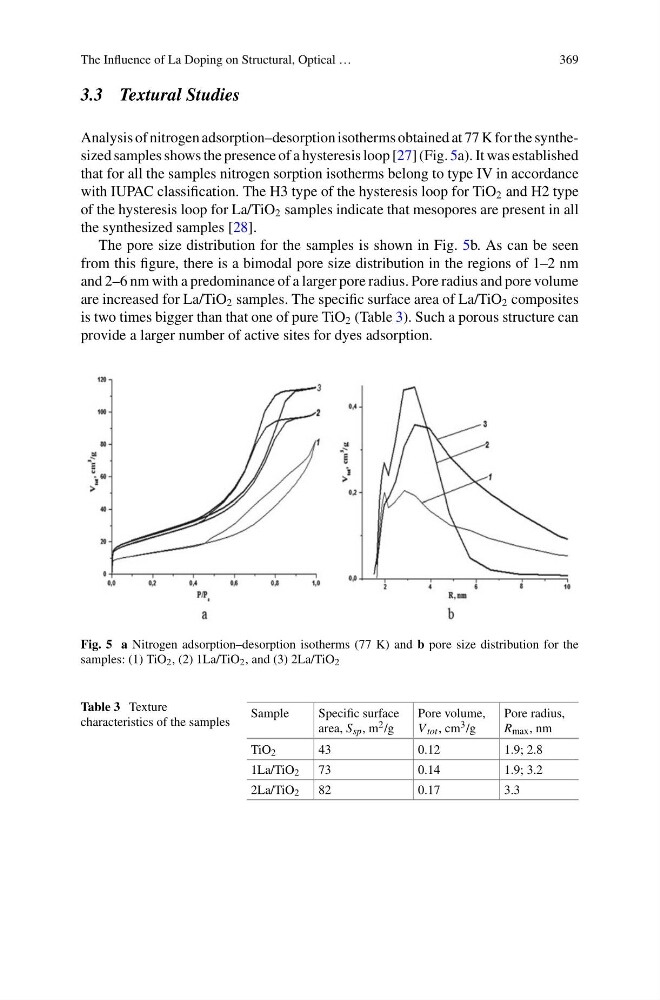
Analysis of nitrogen adsorption–desorption isotherms obtained at 77 K for the synthesized samples shows the presence of a hysteresis loop [27] (Fig. 5a). It was established
that for all the samples nitrogen sorption isotherms belong to type IV in accordance
with IUPAC classification. The H3 type of the hysteresis loop for TiO 2 and H2 type
of the hysteresis loop for La/TiO 2 samples indicate that mesopores are present in all
the synthesized samples [28].
The pore size distribution for the samples is shown in Fig. 5b. As can be seen
from this figure, there is a bimodal pore size distribution in the regions of 1–2 nm
and 2–6 nm with a predominance of a larger pore radius. Pore radius and pore volume
are increased for La/TiO 2 samples. The specific surface area of La/TiO 2 composites
is two times bigger than that one of pure TiO 2 (Table 3). Such a porous structure can
provide a larger number of active sites for dyes adsorption.
Fig. 5 a Nitrogen adsorption–desorption isotherms (77 K) and b pore size distribution for the
samples: (1) TiO 2 , (2) 1La/TiO 2 , and (3) 2La/TiO 2
Table 3 Texture
characteristics of the samples
Sample
Specific surface
area, S sp , m 2 /g
Pore volume,
V tot , cm 3 /g
Pore radius,
R max , nm
TiO 2
43
0.12
1.9; 2.8
1La/TiO 2
73
0.14
1.9; 3.2
2La/TiO 2
82
0.17
3.3
369
3.3 Textural Studies
Analysis of nitrogen adsorption–desorption isotherms obtained at 77 K for the synthesized samples shows the presence of a hysteresis loop [27] (Fig. 5a). It was established
that for all the samples nitrogen sorption isotherms belong to type IV in accordance
with IUPAC classification. The H3 type of the hysteresis loop for TiO 2 and H2 type
of the hysteresis loop for La/TiO 2 samples indicate that mesopores are present in all
the synthesized samples [28].
The pore size distribution for the samples is shown in Fig. 5b. As can be seen
from this figure, there is a bimodal pore size distribution in the regions of 1–2 nm
and 2–6 nm with a predominance of a larger pore radius. Pore radius and pore volume
are increased for La/TiO 2 samples. The specific surface area of La/TiO 2 composites
is two times bigger than that one of pure TiO 2 (Table 3). Such a porous structure can
provide a larger number of active sites for dyes adsorption.
Fig. 5 a Nitrogen adsorption–desorption isotherms (77 K) and b pore size distribution for the
samples: (1) TiO 2 , (2) 1La/TiO 2 , and (3) 2La/TiO 2
Table 3 Texture
characteristics of the samples
Sample
Specific surface
area, S sp , m 2 /g
Pore volume,
V tot , cm 3 /g
Pore radius,
R max , nm
TiO 2
43
0.12
1.9; 2.8
1La/TiO 2
73
0.14
1.9; 3.2
2La/TiO 2
82
0.17
3.3