

344
H. Karakurkchi et al.
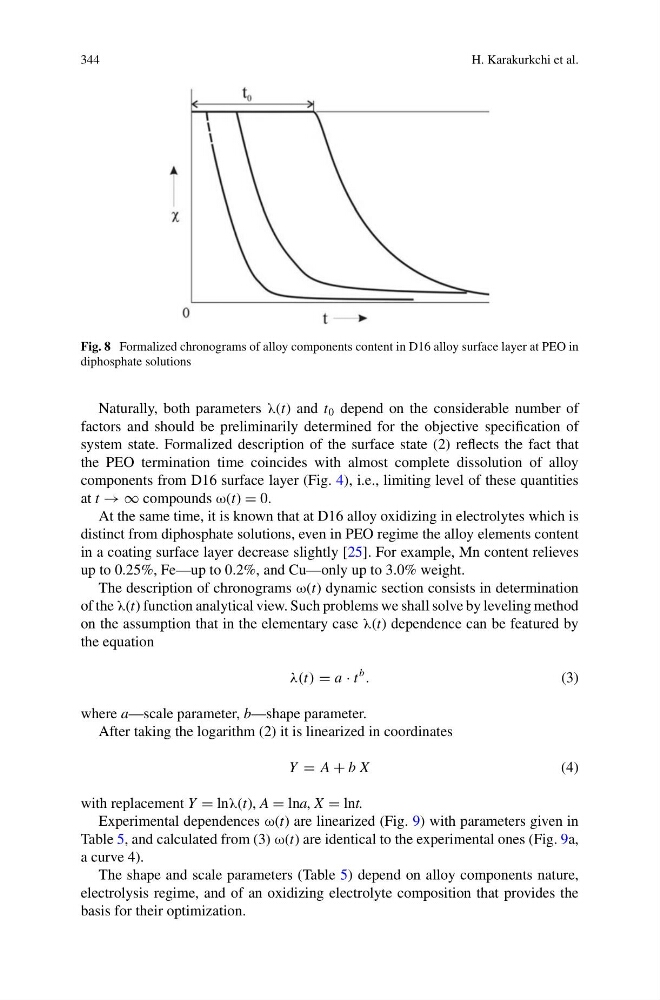
Fig. 8 Formalized chronograms of alloy components content in D16 alloy surface layer at PEO in
diphosphate solutions
Naturally, both parameters λ(t) and t 0 depend on the considerable number of
factors and should be preliminarily determined for the objective specification of
system state. Formalized description of the surface state (2) reflects the fact that
the PEO termination time coincides with almost complete dissolution of alloy
components from D16 surface layer (Fig. 4), i.e., limiting level of these quantities
at t → ∞ compounds ω(t) = 0.
At the same time, it is known that at D16 alloy oxidizing in electrolytes which is
distinct from diphosphate solutions, even in PEO regime the alloy elements content
in a coating surface layer decrease slightly [25]. For example, Mn content relieves
up to 0.25%, Fe—up to 0.2%, and Cu—only up to 3.0% weight.
The description of chronograms ω(t) dynamic section consists in determination
of the λ(t) function analytical view. Such problems we shall solve by leveling method
on the assumption that in the elementary case λ(t) dependence can be featured by
the equation
λ(t) = a · t
b
.
(3)
where a—scale parameter, b—shape parameter.
After taking the logarithm (2) it is linearized in coordinates
Y = A + b X
(4)
with replacement Y = lnλ(t), A = lna, X = lnt.
Experimental dependences ω(t) are linearized (Fig. 9) with parameters given in
Table 5, and calculated from (3) ω(t) are identical to the experimental ones (Fig. 9a,
a curve 4).
The shape and scale parameters (Table 5) depend on alloy components nature,
electrolysis regime, and of an oxidizing electrolyte composition that provides the
basis for their optimization.
H. Karakurkchi et al.
Fig. 8 Formalized chronograms of alloy components content in D16 alloy surface layer at PEO in
diphosphate solutions
Naturally, both parameters λ(t) and t 0 depend on the considerable number of
factors and should be preliminarily determined for the objective specification of
system state. Formalized description of the surface state (2) reflects the fact that
the PEO termination time coincides with almost complete dissolution of alloy
components from D16 surface layer (Fig. 4), i.e., limiting level of these quantities
at t → ∞ compounds ω(t) = 0.
At the same time, it is known that at D16 alloy oxidizing in electrolytes which is
distinct from diphosphate solutions, even in PEO regime the alloy elements content
in a coating surface layer decrease slightly [25]. For example, Mn content relieves
up to 0.25%, Fe—up to 0.2%, and Cu—only up to 3.0% weight.
The description of chronograms ω(t) dynamic section consists in determination
of the λ(t) function analytical view. Such problems we shall solve by leveling method
on the assumption that in the elementary case λ(t) dependence can be featured by
the equation
λ(t) = a · t
b
.
(3)
where a—scale parameter, b—shape parameter.
After taking the logarithm (2) it is linearized in coordinates
Y = A + b X
(4)
with replacement Y = lnλ(t), A = lna, X = lnt.
Experimental dependences ω(t) are linearized (Fig. 9) with parameters given in
Table 5, and calculated from (3) ω(t) are identical to the experimental ones (Fig. 9a,
a curve 4).
The shape and scale parameters (Table 5) depend on alloy components nature,
electrolysis regime, and of an oxidizing electrolyte composition that provides the
basis for their optimization.