

Electric Field-Controlled Magnetic Anisotropy …
11
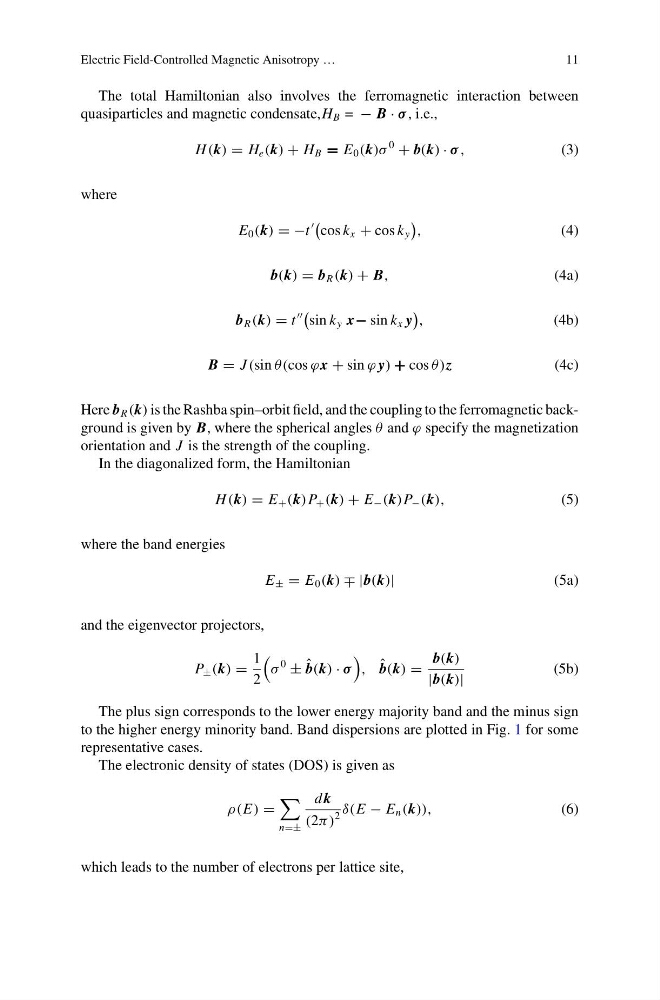
The total Hamiltonian also involves the ferromagnetic interaction between
quasiparticles and magnetic condensate,H B = − B · σ , i.e.,
H (k) = H e (k) + H B = E 0 (k)σ
0
+ b(k) · σ ,
(3)
where
E 0 (k) = −t
cos k x + cos k y
,
(4)
b(k) = b R (k) + B,
(4a)
b R (k) = t
sin k y x− sin k x y
,
(4b)
B = J (sin θ (cos ϕx + sin ϕ y) + cos θ)z
(4c)
Here b R (k) is the Rashba spin–orbit field, and the coupling to the ferromagnetic background is given by B, where the spherical angles θ and ϕ specify the magnetization
orientation and J is the strength of the coupling.
In the diagonalized form, the Hamiltonian
H (k) = E + (k)P + (k) + E − (k)P − (k),
(5)
where the band energies
E ± = E 0 (k) ∓ |b(k)|
(5a)
and the eigenvector projectors,
P ± (k) =
1
2
σ
0
± ˆ
b(k) · σ
, ˆ
b(k) =
b(k)
|b(k)|
(5b)
The plus sign corresponds to the lower energy majority band and the minus sign
to the higher energy minority band. Band dispersions are plotted in Fig. 1 for some
representative cases.
The electronic density of states (DOS) is given as
ρ(E) =
n=±
d k
(2π )
2
δ(E − E n (k)),
(6)
which leads to the number of electrons per lattice site,
11
The total Hamiltonian also involves the ferromagnetic interaction between
quasiparticles and magnetic condensate,H B = − B · σ , i.e.,
H (k) = H e (k) + H B = E 0 (k)σ
0
+ b(k) · σ ,
(3)
where
E 0 (k) = −t
cos k x + cos k y
,
(4)
b(k) = b R (k) + B,
(4a)
b R (k) = t
sin k y x− sin k x y
,
(4b)
B = J (sin θ (cos ϕx + sin ϕ y) + cos θ)z
(4c)
Here b R (k) is the Rashba spin–orbit field, and the coupling to the ferromagnetic background is given by B, where the spherical angles θ and ϕ specify the magnetization
orientation and J is the strength of the coupling.
In the diagonalized form, the Hamiltonian
H (k) = E + (k)P + (k) + E − (k)P − (k),
(5)
where the band energies
E ± = E 0 (k) ∓ |b(k)|
(5a)
and the eigenvector projectors,
P ± (k) =
1
2
σ
0
± ˆ
b(k) · σ
, ˆ
b(k) =
b(k)
|b(k)|
(5b)
The plus sign corresponds to the lower energy majority band and the minus sign
to the higher energy minority band. Band dispersions are plotted in Fig. 1 for some
representative cases.
The electronic density of states (DOS) is given as
ρ(E) =
n=±
d k
(2π )
2
δ(E − E n (k)),
(6)
which leads to the number of electrons per lattice site,