

10
A. M. Korostil and M. M. Krupa
a ferromagnet/heavy metal bilayer, driven by interfacial Rashba SOC, highlighting
different physical regimes [7]. The corresponding description is based on an electron
tight-binding model, which allows us to analyze the MAE with respect to the three
competing energy scales: the non-relativistic kinetic energy, t
, the Rashba SOC
strength t
, and the strength of the exchange coupling, J to the ferromagnetic order
parameter. This leads to conditions for the realization of the PMA and its dependence
on the electron structure of the system.
2 Model of Two-Layer Magnetic Nanostructure
with the Spin–Orbit Rashba Interaction
The properties of itinerant electrons with broken inversion symmetry and SOC in
a two-dimensional lattice with one orbital per site, nearest-neighbor hopping, and
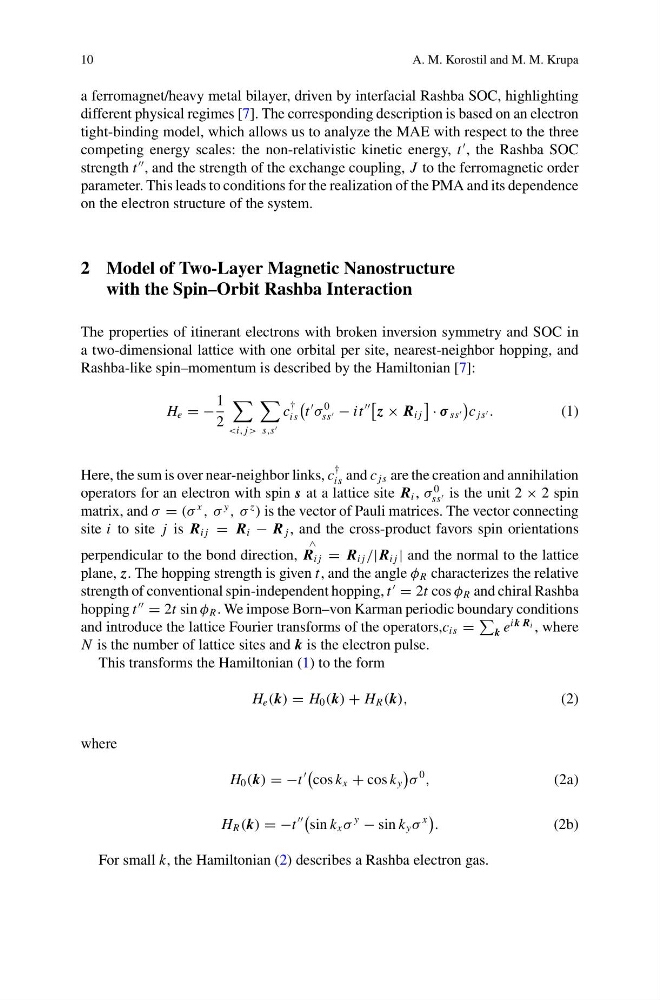
Rashba-like spin–momentum is described by the Hamiltonian [7]:
H e = −
1
2
s,s
c
†
is
t
σ
0
ss − it
z × R i j
· σ ss
c js .
(1)
Here, the sum is over near-neighbor links, c
†
is and c js are the creation and annihilation
operators for an electron with spin s at a lattice site R i , σ
0
ss is the unit 2 × 2 spin
matrix, and σ = (σ
x
, σ
y
, σ
z
) is the vector of Pauli matrices. The vector connecting
site i to site j is R i j = R i − R j , and the cross-product favors spin orientations
perpendicular to the bond direction,
∧
R i j = R i j /|R i j | and the normal to the lattice
plane, z. The hopping strength is given t, and the angle φ R characterizes the relative
strength of conventional spin-independent hopping, t
= 2t cos φ R and chiral Rashba
hopping t
= 2t sin φ R . We impose Born–von Karman periodic boundary conditions
and introduce the lattice Fourier transforms of the operators,c is =
k e
i k R i , where
N is the number of lattice sites and k is the electron pulse.
This transforms the Hamiltonian (1) to the form
H e (k) = H 0 (k) + H R (k),
(2)
where
H 0 (k) = −t
cos k x + cos k y
σ
0
,
(2a)
H R (k) = −t
sin k x σ
y
− sin k y σ
x
.
(2b)
For small k, the Hamiltonian (2) describes a Rashba electron gas.
A. M. Korostil and M. M. Krupa
a ferromagnet/heavy metal bilayer, driven by interfacial Rashba SOC, highlighting
different physical regimes [7]. The corresponding description is based on an electron
tight-binding model, which allows us to analyze the MAE with respect to the three
competing energy scales: the non-relativistic kinetic energy, t
, the Rashba SOC
strength t
, and the strength of the exchange coupling, J to the ferromagnetic order
parameter. This leads to conditions for the realization of the PMA and its dependence
on the electron structure of the system.
2 Model of Two-Layer Magnetic Nanostructure
with the Spin–Orbit Rashba Interaction
The properties of itinerant electrons with broken inversion symmetry and SOC in
a two-dimensional lattice with one orbital per site, nearest-neighbor hopping, and
Rashba-like spin–momentum is described by the Hamiltonian [7]:
H e = −
1
2
s,s
c
†
is
t
σ
0
ss − it
z × R i j
· σ ss
c js .
(1)
Here, the sum is over near-neighbor links, c
†
is and c js are the creation and annihilation
operators for an electron with spin s at a lattice site R i , σ
0
ss is the unit 2 × 2 spin
matrix, and σ = (σ
x
, σ
y
, σ
z
) is the vector of Pauli matrices. The vector connecting
site i to site j is R i j = R i − R j , and the cross-product favors spin orientations
perpendicular to the bond direction,
∧
R i j = R i j /|R i j | and the normal to the lattice
plane, z. The hopping strength is given t, and the angle φ R characterizes the relative
strength of conventional spin-independent hopping, t
= 2t cos φ R and chiral Rashba
hopping t
= 2t sin φ R . We impose Born–von Karman periodic boundary conditions
and introduce the lattice Fourier transforms of the operators,c is =
k e
i k R i , where
N is the number of lattice sites and k is the electron pulse.
This transforms the Hamiltonian (1) to the form
H e (k) = H 0 (k) + H R (k),
(2)
where
H 0 (k) = −t
cos k x + cos k y
σ
0
,
(2a)
H R (k) = −t
sin k x σ
y
− sin k y σ
x
.
(2b)
For small k, the Hamiltonian (2) describes a Rashba electron gas.