

12
A. M. Korostil and M. M. Krupa
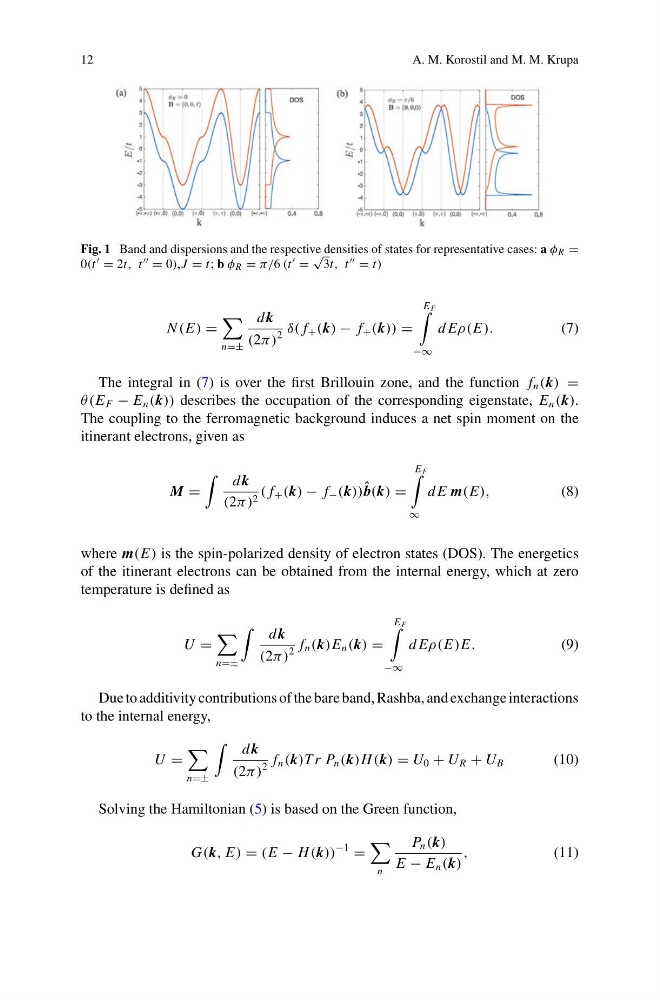
Fig. 1 Band and dispersions and the respective densities of states for representative cases: a φ R =
0(t = 2t, t = 0),J = t; b φ R = π/6 (t =
√
3t, t = t)
N (E) =
n=±
d k
(2π)
2
δ( f + (k) − f + (k)) =
E F
−∞
d Eρ(E).
(7)
The integral in (7) is over the first Brillouin zone, and the function f n (k) =
θ (E F − E n (k)) describes the occupation of the corresponding eigenstate, E n (k).
The coupling to the ferromagnetic background induces a net spin moment on the
itinerant electrons, given as
M =
d k
(2π) 2 ( f + (k) − f − (k)) ˆ
b(k) =
E F
∞
d E m(E),
(8)
where m(E) is the spin-polarized density of electron states (DOS). The energetics
of the itinerant electrons can be obtained from the internal energy, which at zero
temperature is defined as
U =
n=±
d k
(2π )
2
f n (k)E n (k) =
E F
−∞
d Eρ(E)E.
(9)
Due to additivity contributions of the bare band, Rashba, and exchange interactions
to the internal energy,
U =
n=±
d k
(2π)
2
f n (k)T r P n (k)H (k) = U 0 + U R + U B
(10)
Solving the Hamiltonian (5) is based on the Green function,
G(k, E) = (E − H (k))
−1
=
n
P n (k)
E − E n (k)
,
(11)
A. M. Korostil and M. M. Krupa
Fig. 1 Band and dispersions and the respective densities of states for representative cases: a φ R =
0(t = 2t, t = 0),J = t; b φ R = π/6 (t =
√
3t, t = t)
N (E) =
n=±
d k
(2π)
2
δ( f + (k) − f + (k)) =
E F
−∞
d Eρ(E).
(7)
The integral in (7) is over the first Brillouin zone, and the function f n (k) =
θ (E F − E n (k)) describes the occupation of the corresponding eigenstate, E n (k).
The coupling to the ferromagnetic background induces a net spin moment on the
itinerant electrons, given as
M =
d k
(2π) 2 ( f + (k) − f − (k)) ˆ
b(k) =
E F
∞
d E m(E),
(8)
where m(E) is the spin-polarized density of electron states (DOS). The energetics
of the itinerant electrons can be obtained from the internal energy, which at zero
temperature is defined as
U =
n=±
d k
(2π )
2
f n (k)E n (k) =
E F
−∞
d Eρ(E)E.
(9)
Due to additivity contributions of the bare band, Rashba, and exchange interactions
to the internal energy,
U =
n=±
d k
(2π)
2
f n (k)T r P n (k)H (k) = U 0 + U R + U B
(10)
Solving the Hamiltonian (5) is based on the Green function,
G(k, E) = (E − H (k))
−1
=
n
P n (k)
E − E n (k)
,
(11)