

342
H. Karakurkchi et al.
electrical insulating, catalytic active, and electric isolating, thermo- and corrosionresistant. Application of the alkali metals diphosphate as the basic component of
the electrolyte for PEO [22, 23] produced thick oxide coatings on aluminum alloys.
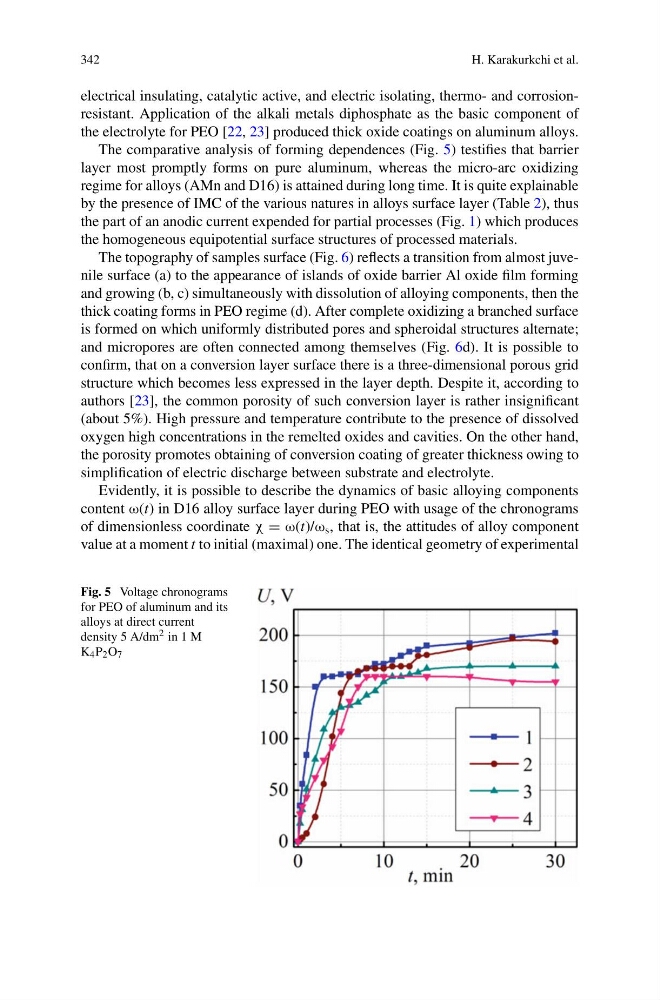
The comparative analysis of forming dependences (Fig. 5) testifies that barrier
layer most promptly forms on pure aluminum, whereas the micro-arc oxidizing
regime for alloys (AMn and D16) is attained during long time. It is quite explainable
by the presence of IMC of the various natures in alloys surface layer (Table 2), thus
the part of an anodic current expended for partial processes (Fig. 1) which produces
the homogeneous equipotential surface structures of processed materials.
The topography of samples surface (Fig. 6) reflects a transition from almost juvenile surface (a) to the appearance of islands of oxide barrier Al oxide film forming
and growing (b, c) simultaneously with dissolution of alloying components, then the
thick coating forms in PEO regime (d). After complete oxidizing a branched surface
is formed on which uniformly distributed pores and spheroidal structures alternate;
and micropores are often connected among themselves (Fig. 6d). It is possible to
confirm, that on a conversion layer surface there is a three-dimensional porous grid
structure which becomes less expressed in the layer depth. Despite it, according to
authors [23], the common porosity of such conversion layer is rather insignificant
(about 5%). High pressure and temperature contribute to the presence of dissolved
oxygen high concentrations in the remelted oxides and cavities. On the other hand,
the porosity promotes obtaining of conversion coating of greater thickness owing to
simplification of electric discharge between substrate and electrolyte.
Evidently, it is possible to describe the dynamics of basic alloying components
content ω(t) in D16 alloy surface layer during PEO with usage of the chronograms
of dimensionless coordinate χ = ω(t)/ω s , that is, the attitudes of alloy component
value at a moment t to initial (maximal) one. The identical geometry of experimental
Fig. 5 Voltage chronograms
for PEO of aluminum and its
alloys at direct current
density 5 A/dm 2 in 1 M
K 4 P 2 O 7
H. Karakurkchi et al.
electrical insulating, catalytic active, and electric isolating, thermo- and corrosionresistant. Application of the alkali metals diphosphate as the basic component of
the electrolyte for PEO [22, 23] produced thick oxide coatings on aluminum alloys.
The comparative analysis of forming dependences (Fig. 5) testifies that barrier
layer most promptly forms on pure aluminum, whereas the micro-arc oxidizing
regime for alloys (AMn and D16) is attained during long time. It is quite explainable
by the presence of IMC of the various natures in alloys surface layer (Table 2), thus
the part of an anodic current expended for partial processes (Fig. 1) which produces
the homogeneous equipotential surface structures of processed materials.
The topography of samples surface (Fig. 6) reflects a transition from almost juvenile surface (a) to the appearance of islands of oxide barrier Al oxide film forming
and growing (b, c) simultaneously with dissolution of alloying components, then the
thick coating forms in PEO regime (d). After complete oxidizing a branched surface
is formed on which uniformly distributed pores and spheroidal structures alternate;
and micropores are often connected among themselves (Fig. 6d). It is possible to
confirm, that on a conversion layer surface there is a three-dimensional porous grid
structure which becomes less expressed in the layer depth. Despite it, according to
authors [23], the common porosity of such conversion layer is rather insignificant
(about 5%). High pressure and temperature contribute to the presence of dissolved
oxygen high concentrations in the remelted oxides and cavities. On the other hand,
the porosity promotes obtaining of conversion coating of greater thickness owing to
simplification of electric discharge between substrate and electrolyte.
Evidently, it is possible to describe the dynamics of basic alloying components
content ω(t) in D16 alloy surface layer during PEO with usage of the chronograms
of dimensionless coordinate χ = ω(t)/ω s , that is, the attitudes of alloy component
value at a moment t to initial (maximal) one. The identical geometry of experimental
Fig. 5 Voltage chronograms
for PEO of aluminum and its
alloys at direct current
density 5 A/dm 2 in 1 M
K 4 P 2 O 7