

Formation of Manganese-Containing PEO Coatings on Aluminum Alloys
341
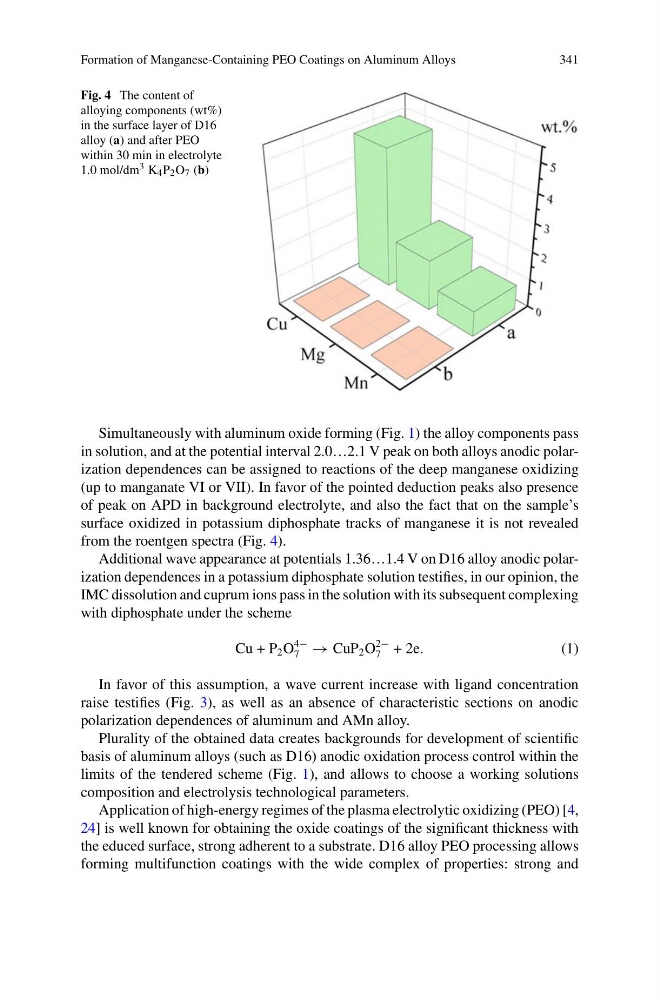
Fig. 4 The content of
alloying components (wt%)
in the surface layer of D16
alloy (a) and after PEO
within 30 min in electrolyte
1.0 mol/dm 3 K 4 P 2 O 7 (b)
Simultaneously with aluminum oxide forming (Fig. 1) the alloy components pass
in solution, and at the potential interval 2.0…2.1 V peak on both alloys anodic polarization dependences can be assigned to reactions of the deep manganese oxidizing
(up to manganate VI or VII). In favor of the pointed deduction peaks also presence
of peak on APD in background electrolyte, and also the fact that on the sample’s
surface oxidized in potassium diphosphate tracks of manganese it is not revealed
from the roentgen spectra (Fig. 4).
Additional wave appearance at potentials 1.36…1.4 V on D16 alloy anodic polarization dependences in a potassium diphosphate solution testifies, in our opinion, the
IMC dissolution and cuprum ions pass in the solution with its subsequent complexing
with diphosphate under the scheme
Cu + P 2 O
4−
7 → CuP 2 O
2−
7 + 2e.
(1)
In favor of this assumption, a wave current increase with ligand concentration
raise testifies (Fig. 3), as well as an absence of characteristic sections on anodic
polarization dependences of aluminum and AMn alloy.
Plurality of the obtained data creates backgrounds for development of scientific
basis of aluminum alloys (such as D16) anodic oxidation process control within the
limits of the tendered scheme (Fig. 1), and allows to choose a working solutions
composition and electrolysis technological parameters.
Application of high-energy regimes of the plasma electrolytic oxidizing (PEO) [4,
24] is well known for obtaining the oxide coatings of the significant thickness with
the educed surface, strong adherent to a substrate. D16 alloy PEO processing allows
forming multifunction coatings with the wide complex of properties: strong and
341
Fig. 4 The content of
alloying components (wt%)
in the surface layer of D16
alloy (a) and after PEO
within 30 min in electrolyte
1.0 mol/dm 3 K 4 P 2 O 7 (b)
Simultaneously with aluminum oxide forming (Fig. 1) the alloy components pass
in solution, and at the potential interval 2.0…2.1 V peak on both alloys anodic polarization dependences can be assigned to reactions of the deep manganese oxidizing
(up to manganate VI or VII). In favor of the pointed deduction peaks also presence
of peak on APD in background electrolyte, and also the fact that on the sample’s
surface oxidized in potassium diphosphate tracks of manganese it is not revealed
from the roentgen spectra (Fig. 4).
Additional wave appearance at potentials 1.36…1.4 V on D16 alloy anodic polarization dependences in a potassium diphosphate solution testifies, in our opinion, the
IMC dissolution and cuprum ions pass in the solution with its subsequent complexing
with diphosphate under the scheme
Cu + P 2 O
4−
7 → CuP 2 O
2−
7 + 2e.
(1)
In favor of this assumption, a wave current increase with ligand concentration
raise testifies (Fig. 3), as well as an absence of characteristic sections on anodic
polarization dependences of aluminum and AMn alloy.
Plurality of the obtained data creates backgrounds for development of scientific
basis of aluminum alloys (such as D16) anodic oxidation process control within the
limits of the tendered scheme (Fig. 1), and allows to choose a working solutions
composition and electrolysis technological parameters.
Application of high-energy regimes of the plasma electrolytic oxidizing (PEO) [4,
24] is well known for obtaining the oxide coatings of the significant thickness with
the educed surface, strong adherent to a substrate. D16 alloy PEO processing allows
forming multifunction coatings with the wide complex of properties: strong and