

328
A. P. Chebanenko et al.
As can be seen, the sensitivity of the films increases with the increasing of applied
voltage and reaches a maximum value of 0.76 relative units at a voltage of 300 V.
The type of current/time dependence (Fig. 2) is close to an exponential law.
Namely, the current increase at the time of water vapor inlet occurs according to the
law:
I = I 0
1 − e
−
t
τa
(2)
A current decline in time when letting dry air in—takes place according to the
law:
I = I 0 e
−
t
τ d
(3)
Here τ a and τ d are some time constants which characterize the rate of adsorption
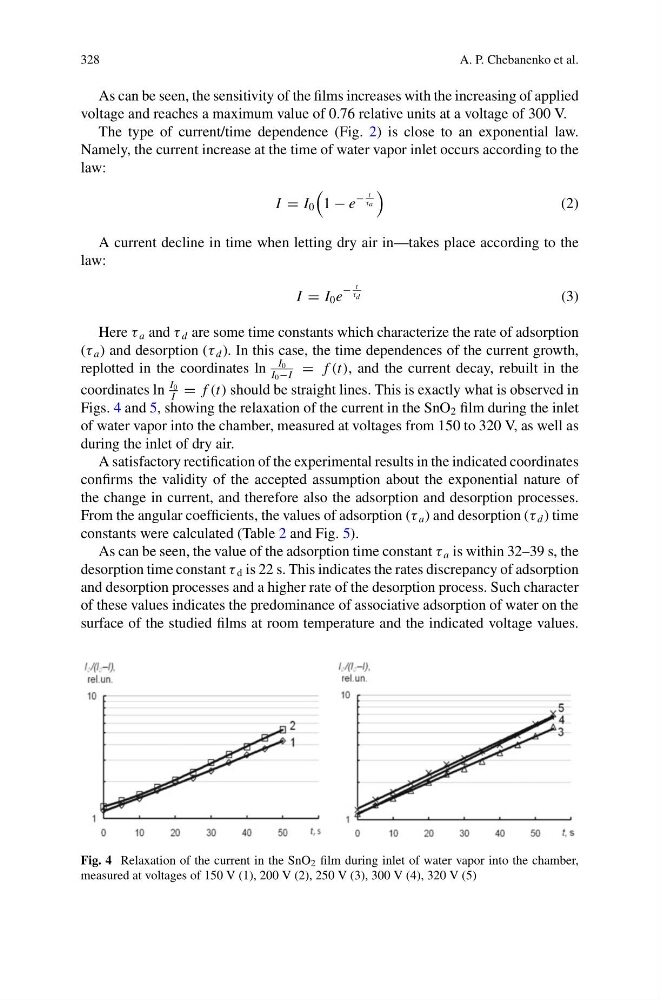
(τ a ) and desorption (τ d ). In this case, the time dependences of the current growth,
replotted in the coordinates ln
I 0
I 0 −I
= f (t), and the current decay, rebuilt in the
coordinates ln
I 0
I
= f (t) should be straight lines. This is exactly what is observed in
Figs. 4 and 5, showing the relaxation of the current in the SnO 2 film during the inlet
of water vapor into the chamber, measured at voltages from 150 to 320 V, as well as
during the inlet of dry air.
A satisfactory rectification of the experimental results in the indicated coordinates
confirms the validity of the accepted assumption about the exponential nature of
the change in current, and therefore also the adsorption and desorption processes.
From the angular coefficients, the values of adsorption (τ a ) and desorption (τ d ) time
constants were calculated (Table 2 and Fig. 5).
As can be seen, the value of the adsorption time constant τ a is within 32–39 s, the
desorption time constant τ d is 22 s. This indicates the rates discrepancy of adsorption
and desorption processes and a higher rate of the desorption process. Such character
of these values indicates the predominance of associative adsorption of water on the
surface of the studied films at room temperature and the indicated voltage values.
Fig. 4 Relaxation of the current in the SnO 2 film during inlet of water vapor into the chamber,
measured at voltages of 150 V (1), 200 V (2), 250 V (3), 300 V (4), 320 V (5)
A. P. Chebanenko et al.
As can be seen, the sensitivity of the films increases with the increasing of applied
voltage and reaches a maximum value of 0.76 relative units at a voltage of 300 V.
The type of current/time dependence (Fig. 2) is close to an exponential law.
Namely, the current increase at the time of water vapor inlet occurs according to the
law:
I = I 0
1 − e
−
t
τa
(2)
A current decline in time when letting dry air in—takes place according to the
law:
I = I 0 e
−
t
τ d
(3)
Here τ a and τ d are some time constants which characterize the rate of adsorption
(τ a ) and desorption (τ d ). In this case, the time dependences of the current growth,
replotted in the coordinates ln
I 0
I 0 −I
= f (t), and the current decay, rebuilt in the
coordinates ln
I 0
I
= f (t) should be straight lines. This is exactly what is observed in
Figs. 4 and 5, showing the relaxation of the current in the SnO 2 film during the inlet
of water vapor into the chamber, measured at voltages from 150 to 320 V, as well as
during the inlet of dry air.
A satisfactory rectification of the experimental results in the indicated coordinates
confirms the validity of the accepted assumption about the exponential nature of
the change in current, and therefore also the adsorption and desorption processes.
From the angular coefficients, the values of adsorption (τ a ) and desorption (τ d ) time
constants were calculated (Table 2 and Fig. 5).
As can be seen, the value of the adsorption time constant τ a is within 32–39 s, the
desorption time constant τ d is 22 s. This indicates the rates discrepancy of adsorption
and desorption processes and a higher rate of the desorption process. Such character
of these values indicates the predominance of associative adsorption of water on the
surface of the studied films at room temperature and the indicated voltage values.
Fig. 4 Relaxation of the current in the SnO 2 film during inlet of water vapor into the chamber,
measured at voltages of 150 V (1), 200 V (2), 250 V (3), 300 V (4), 320 V (5)