

The Sensitivity to Moisture Peculiarities of Nanoscale …
329
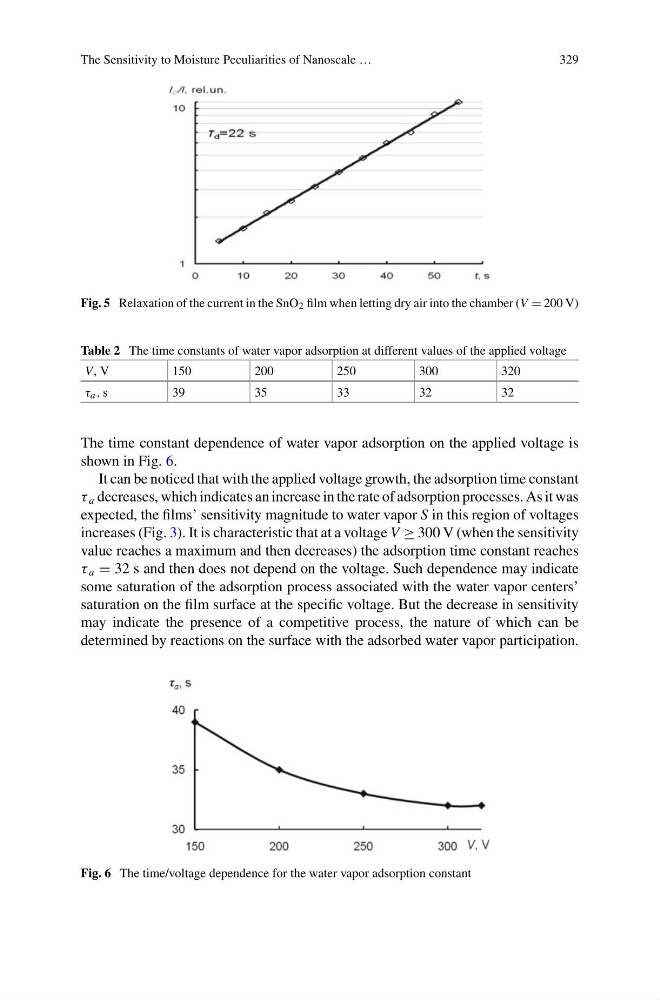
Fig. 5 Relaxation of the current in the SnO 2 film when letting dry air into the chamber (V = 200 V)
Table 2 The time constants of water vapor adsorption at different values of the applied voltage
V, V
150
200
250
300
320
τ a , s
39
35
33
32
32
The time constant dependence of water vapor adsorption on the applied voltage is
shown in Fig. 6.
It can be noticed that with the applied voltage growth, the adsorption time constant
τ a decreases, which indicates an increase in the rate of adsorption processes. As it was
expected, the films’ sensitivity magnitude to water vapor S in this region of voltages
increases (Fig. 3). It is characteristic that at a voltage V ≥ 300 V (when the sensitivity
value reaches a maximum and then decreases) the adsorption time constant reaches
τ a = 32 s and then does not depend on the voltage. Such dependence may indicate
some saturation of the adsorption process associated with the water vapor centers’
saturation on the film surface at the specific voltage. But the decrease in sensitivity
may indicate the presence of a competitive process, the nature of which can be
determined by reactions on the surface with the adsorbed water vapor participation.
Fig. 6 The time/voltage dependence for the water vapor adsorption constant
329
Fig. 5 Relaxation of the current in the SnO 2 film when letting dry air into the chamber (V = 200 V)
Table 2 The time constants of water vapor adsorption at different values of the applied voltage
V, V
150
200
250
300
320
τ a , s
39
35
33
32
32
The time constant dependence of water vapor adsorption on the applied voltage is
shown in Fig. 6.
It can be noticed that with the applied voltage growth, the adsorption time constant
τ a decreases, which indicates an increase in the rate of adsorption processes. As it was
expected, the films’ sensitivity magnitude to water vapor S in this region of voltages
increases (Fig. 3). It is characteristic that at a voltage V ≥ 300 V (when the sensitivity
value reaches a maximum and then decreases) the adsorption time constant reaches
τ a = 32 s and then does not depend on the voltage. Such dependence may indicate
some saturation of the adsorption process associated with the water vapor centers’
saturation on the film surface at the specific voltage. But the decrease in sensitivity
may indicate the presence of a competitive process, the nature of which can be
determined by reactions on the surface with the adsorbed water vapor participation.
Fig. 6 The time/voltage dependence for the water vapor adsorption constant