

294
L. V. Shmeleva et al.
Supplements P
(0)s
i j n j are small relative to other additions in (9) in the presence of
fracture, and, in some approximation, can be neglected in the presence of fracture.
Equation (9) is a boundary condition for the balance of the impulse flow for the
problem of the influence of the powerful pulsed radiation to the surface of the medium
in the presence of surface destruction. It is formulated in a local coordinate system
associated with the interface. For a non-destructive process, this surface coincides
with the standard laboratory system, since it is motionless. In the case when there
is destruction, the system (9) is “attached” to the surface at each local point and
moves with it. Let the local frame of reference be characterized by the unit vectors
e ξ , e η , e ζ ,, where the unit vector e ζ is the unit vector normal to the surface, and the
unit vectors e ξ and e η lie in the plane tangent to the surface at the point from which
the normal vector n ≡ e ζ emerges. Due to this, in each local reference frame of the
projections e ξ and e η are equal to zero, and the projection e ζ = 1. Then, in explicit
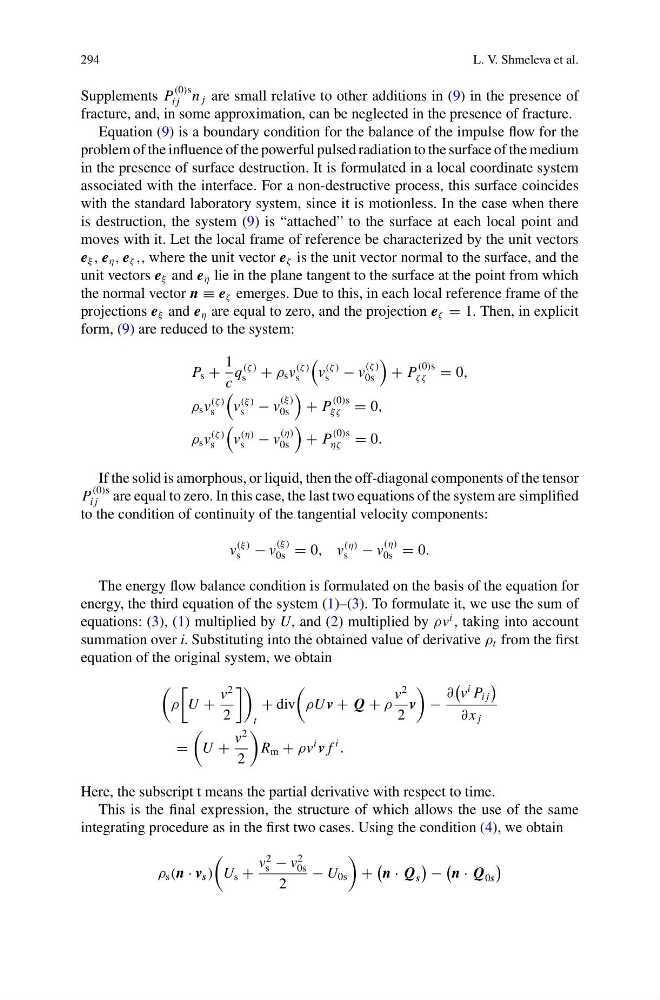
form, (9) are reduced to the system:
P s +
1
c
q
(ζ )
s + ρ s v
(ζ )
s
v
(ζ )
s − v
(ζ )
0s
+ P
(0)s
ζ ζ = 0,
ρ s v
(ζ )
s
v
(ξ )
s − v
(ξ )
0s
+ P
(0)s
ξζ = 0,
ρ s v
(ζ )
s
v
(η)
s − v
(η)
0s
+ P
(0)s
ηζ = 0.
If the solid is amorphous, or liquid, then the off-diagonal components of the tensor
P
(0)s
i j are equal to zero. In this case, the last two equations of the system are simplified
to the condition of continuity of the tangential velocity components:
v
(ξ )
s − v
(ξ )
0s = 0, v
(η)
s − v
(η)
0s = 0.
The energy flow balance condition is formulated on the basis of the equation for
energy, the third equation of the system (1)–(3). To formulate it, we use the sum of
equations: (3), (1) multiplied by U, and (2) multiplied by ρv
i , taking into account
summation over i. Substituting into the obtained value of derivative ρ t from the first
equation of the original system, we obtain
ρ
U +
v
2
2
t
+ div
ρU v + Q + ρ
v
2
2
v
−
∂
v
i P i j
∂ x j
=
U +
v
2
2
R m + ρv
i v f
i
.
Here, the subscript t means the partial derivative with respect to time.
This is the final expression, the structure of which allows the use of the same
integrating procedure as in the first two cases. Using the condition (4), we obtain
ρ s (n · v s )
U s +
v
2
s − v
2
0s
2
− U 0s
+
n · Q s
−
n · Q 0s
L. V. Shmeleva et al.
Supplements P
(0)s
i j n j are small relative to other additions in (9) in the presence of
fracture, and, in some approximation, can be neglected in the presence of fracture.
Equation (9) is a boundary condition for the balance of the impulse flow for the
problem of the influence of the powerful pulsed radiation to the surface of the medium
in the presence of surface destruction. It is formulated in a local coordinate system
associated with the interface. For a non-destructive process, this surface coincides
with the standard laboratory system, since it is motionless. In the case when there
is destruction, the system (9) is “attached” to the surface at each local point and
moves with it. Let the local frame of reference be characterized by the unit vectors
e ξ , e η , e ζ ,, where the unit vector e ζ is the unit vector normal to the surface, and the
unit vectors e ξ and e η lie in the plane tangent to the surface at the point from which
the normal vector n ≡ e ζ emerges. Due to this, in each local reference frame of the
projections e ξ and e η are equal to zero, and the projection e ζ = 1. Then, in explicit
form, (9) are reduced to the system:
P s +
1
c
q
(ζ )
s + ρ s v
(ζ )
s
v
(ζ )
s − v
(ζ )
0s
+ P
(0)s
ζ ζ = 0,
ρ s v
(ζ )
s
v
(ξ )
s − v
(ξ )
0s
+ P
(0)s
ξζ = 0,
ρ s v
(ζ )
s
v
(η)
s − v
(η)
0s
+ P
(0)s
ηζ = 0.
If the solid is amorphous, or liquid, then the off-diagonal components of the tensor
P
(0)s
i j are equal to zero. In this case, the last two equations of the system are simplified
to the condition of continuity of the tangential velocity components:
v
(ξ )
s − v
(ξ )
0s = 0, v
(η)
s − v
(η)
0s = 0.
The energy flow balance condition is formulated on the basis of the equation for
energy, the third equation of the system (1)–(3). To formulate it, we use the sum of
equations: (3), (1) multiplied by U, and (2) multiplied by ρv
i , taking into account
summation over i. Substituting into the obtained value of derivative ρ t from the first
equation of the original system, we obtain
ρ
U +
v
2
2
t
+ div
ρU v + Q + ρ
v
2
2
v
−
∂
v
i P i j
∂ x j
=
U +
v
2
2
R m + ρv
i v f
i
.
Here, the subscript t means the partial derivative with respect to time.
This is the final expression, the structure of which allows the use of the same
integrating procedure as in the first two cases. Using the condition (4), we obtain
ρ s (n · v s )
U s +
v
2
s − v
2
0s
2
− U 0s
+
n · Q s
−
n · Q 0s