

Specificity of Boundary Conditions for Laser-Stimulated …
295
− n j v
i
s P
s
i j + n j v
i
0s P
(0)s
i j
= 0.
(10)
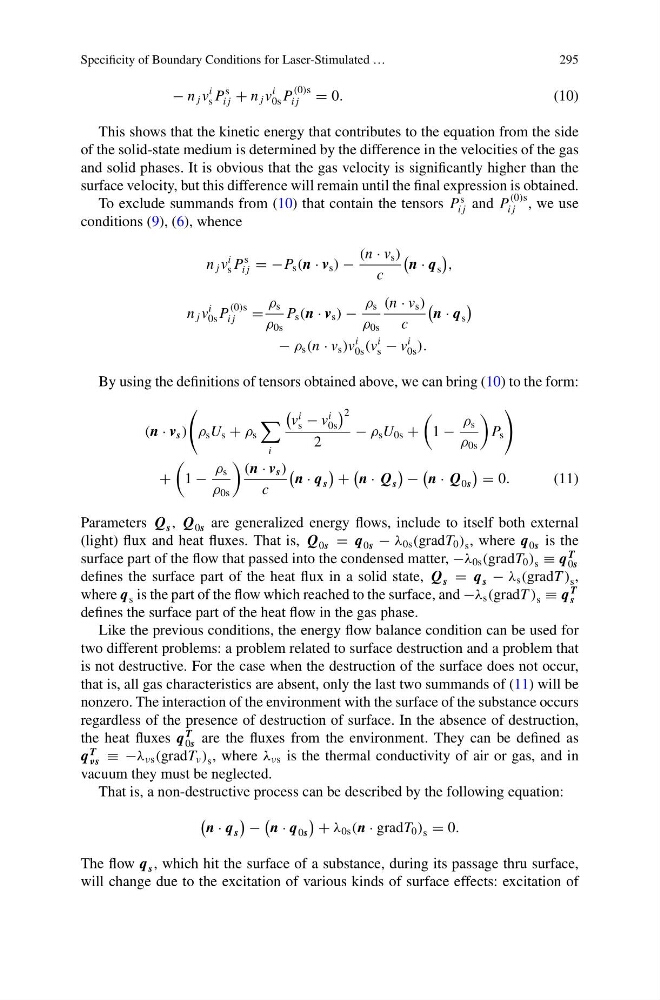
This shows that the kinetic energy that contributes to the equation from the side
of the solid-state medium is determined by the difference in the velocities of the gas
and solid phases. It is obvious that the gas velocity is significantly higher than the
surface velocity, but this difference will remain until the final expression is obtained.
To exclude summands from (10) that contain the tensors P
s
i j and P
(0)s
i j , we use
conditions (9), (6), whence
n j v
i
s P
s
i j = −P s (n · v s ) −
(n · v s )
c
n · q s
,
n j v
i
0s P
(0)s
i j
=
ρ s
ρ 0s
P s (n · v s ) −
ρ s
ρ 0s
(n · v s )
c
n · q s
− ρ s (n · v s )v
i
0s (v
i
s − v
i
0s ).
By using the definitions of tensors obtained above, we can bring (10) to the form:
(n · v s )
ρ s U s + ρ s
i
v
i
s − v
i
0s
2
2
− ρ s U 0s +
1 −
ρ s
ρ 0s
P s
+
1 −
ρ s
ρ 0s
(n · v s )
c
n · q s
+
n · Q s
−
n · Q 0s
= 0.
(11)
Parameters Q s , Q 0s are generalized energy flows, include to itself both external
(light) flux and heat fluxes. That is, Q 0s = q 0s − λ 0s (gradT 0 ) s , where q 0s is the
surface part of the flow that passed into the condensed matter, −λ 0s (gradT 0 ) s ≡ q
T
0s
defines the surface part of the heat flux in a solid state, Q s = q s − λ s (gradT ) s ,
where q s is the part of the flow which reached to the surface, and −λ s (gradT ) s ≡ q
T
s
defines the surface part of the heat flow in the gas phase.
Like the previous conditions, the energy flow balance condition can be used for
two different problems: a problem related to surface destruction and a problem that
is not destructive. For the case when the destruction of the surface does not occur,
that is, all gas characteristics are absent, only the last two summands of (11) will be
nonzero. The interaction of the environment with the surface of the substance occurs
regardless of the presence of destruction of surface. In the absence of destruction,
the heat fluxes q
T
0s are the fluxes from the environment. They can be defined as
q
T
νs ≡ −λ νs (gradT ν ) s , where λ νs is the thermal conductivity of air or gas, and in
vacuum they must be neglected.
That is, a non-destructive process can be described by the following equation:
n · q s
−
n · q 0s
+ λ 0s (n · gradT 0 ) s = 0.
The flow q s , which hit the surface of a substance, during its passage thru surface,
will change due to the excitation of various kinds of surface effects: excitation of
295
− n j v
i
s P
s
i j + n j v
i
0s P
(0)s
i j
= 0.
(10)
This shows that the kinetic energy that contributes to the equation from the side
of the solid-state medium is determined by the difference in the velocities of the gas
and solid phases. It is obvious that the gas velocity is significantly higher than the
surface velocity, but this difference will remain until the final expression is obtained.
To exclude summands from (10) that contain the tensors P
s
i j and P
(0)s
i j , we use
conditions (9), (6), whence
n j v
i
s P
s
i j = −P s (n · v s ) −
(n · v s )
c
n · q s
,
n j v
i
0s P
(0)s
i j
=
ρ s
ρ 0s
P s (n · v s ) −
ρ s
ρ 0s
(n · v s )
c
n · q s
− ρ s (n · v s )v
i
0s (v
i
s − v
i
0s ).
By using the definitions of tensors obtained above, we can bring (10) to the form:
(n · v s )
ρ s U s + ρ s
i
v
i
s − v
i
0s
2
2
− ρ s U 0s +
1 −
ρ s
ρ 0s
P s
+
1 −
ρ s
ρ 0s
(n · v s )
c
n · q s
+
n · Q s
−
n · Q 0s
= 0.
(11)
Parameters Q s , Q 0s are generalized energy flows, include to itself both external
(light) flux and heat fluxes. That is, Q 0s = q 0s − λ 0s (gradT 0 ) s , where q 0s is the
surface part of the flow that passed into the condensed matter, −λ 0s (gradT 0 ) s ≡ q
T
0s
defines the surface part of the heat flux in a solid state, Q s = q s − λ s (gradT ) s ,
where q s is the part of the flow which reached to the surface, and −λ s (gradT ) s ≡ q
T
s
defines the surface part of the heat flow in the gas phase.
Like the previous conditions, the energy flow balance condition can be used for
two different problems: a problem related to surface destruction and a problem that
is not destructive. For the case when the destruction of the surface does not occur,
that is, all gas characteristics are absent, only the last two summands of (11) will be
nonzero. The interaction of the environment with the surface of the substance occurs
regardless of the presence of destruction of surface. In the absence of destruction,
the heat fluxes q
T
0s are the fluxes from the environment. They can be defined as
q
T
νs ≡ −λ νs (gradT ν ) s , where λ νs is the thermal conductivity of air or gas, and in
vacuum they must be neglected.
That is, a non-destructive process can be described by the following equation:
n · q s
−
n · q 0s
+ λ 0s (n · gradT 0 ) s = 0.
The flow q s , which hit the surface of a substance, during its passage thru surface,
will change due to the excitation of various kinds of surface effects: excitation of