

Specificity of Boundary Conditions for Laser-Stimulated …
293
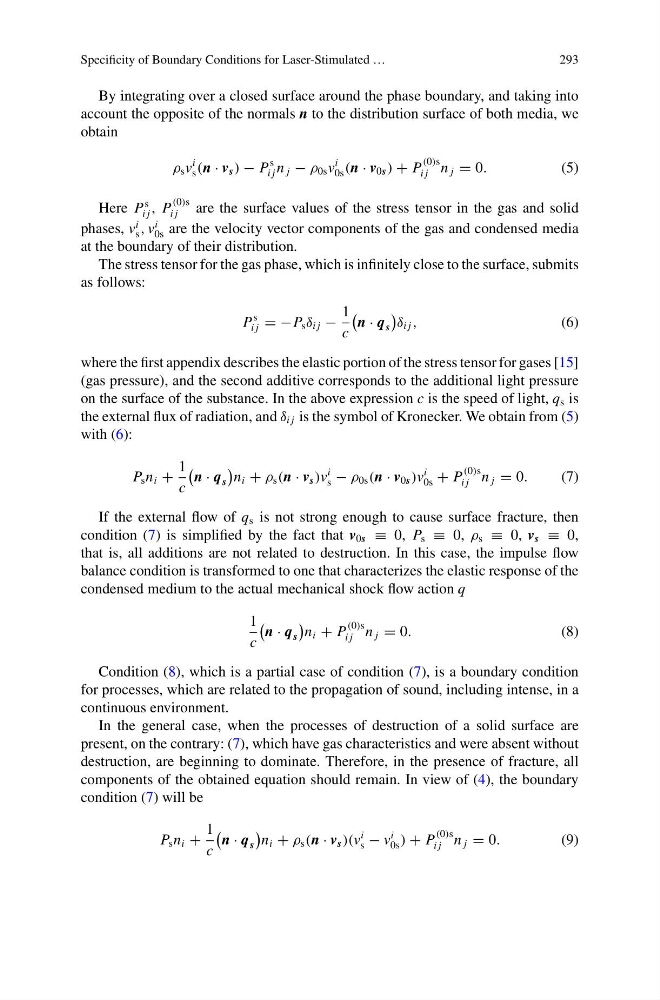
By integrating over a closed surface around the phase boundary, and taking into
account the opposite of the normals n to the distribution surface of both media, we
obtain
ρ s v
i
s (n · v s ) − P
s
i j n j − ρ 0s v
i
0s (n · v 0s ) + P
(0)s
i j n j = 0.
(5)
Here P
s
i j , P
(0)s
i j
are the surface values of the stress tensor in the gas and solid
phases, v
i
s , v
i
0s are the velocity vector components of the gas and condensed media
at the boundary of their distribution.
The stress tensor for the gas phase, which is infinitely close to the surface, submits
as follows:
P
s
i j = −P s δ i j −
1
c
n · q s
δ i j ,
(6)
where the first appendix describes the elastic portion of the stress tensor for gases [15]
(gas pressure), and the second additive corresponds to the additional light pressure
on the surface of the substance. In the above expression c is the speed of light, q s is
the external flux of radiation, and δ i j is the symbol of Kronecker. We obtain from (5)
with (6):
P s n i +
1
c
n · q s
n i + ρ s (n · v s )v
i
s − ρ 0s (n · v 0s )v
i
0s + P
(0)s
i j n j = 0.
(7)
If the external flow of q s is not strong enough to cause surface fracture, then
condition (7) is simplified by the fact that v 0s ≡ 0, P s ≡ 0, ρ s ≡ 0, v s ≡ 0,
that is, all additions are not related to destruction. In this case, the impulse flow
balance condition is transformed to one that characterizes the elastic response of the
condensed medium to the actual mechanical shock flow action q
1
c
n · q s
n i + P
(0)s
i j n j = 0.
(8)
Condition (8), which is a partial case of condition (7), is a boundary condition
for processes, which are related to the propagation of sound, including intense, in a
continuous environment.
In the general case, when the processes of destruction of a solid surface are
present, on the contrary: (7), which have gas characteristics and were absent without
destruction, are beginning to dominate. Therefore, in the presence of fracture, all
components of the obtained equation should remain. In view of (4), the boundary
condition (7) will be
P s n i +
1
c
n · q s
n i + ρ s (n · v s )(v
i
s − v
i
0s ) + P
(0)s
i j n j = 0.
(9)
293
By integrating over a closed surface around the phase boundary, and taking into
account the opposite of the normals n to the distribution surface of both media, we
obtain
ρ s v
i
s (n · v s ) − P
s
i j n j − ρ 0s v
i
0s (n · v 0s ) + P
(0)s
i j n j = 0.
(5)
Here P
s
i j , P
(0)s
i j
are the surface values of the stress tensor in the gas and solid
phases, v
i
s , v
i
0s are the velocity vector components of the gas and condensed media
at the boundary of their distribution.
The stress tensor for the gas phase, which is infinitely close to the surface, submits
as follows:
P
s
i j = −P s δ i j −
1
c
n · q s
δ i j ,
(6)
where the first appendix describes the elastic portion of the stress tensor for gases [15]
(gas pressure), and the second additive corresponds to the additional light pressure
on the surface of the substance. In the above expression c is the speed of light, q s is
the external flux of radiation, and δ i j is the symbol of Kronecker. We obtain from (5)
with (6):
P s n i +
1
c
n · q s
n i + ρ s (n · v s )v
i
s − ρ 0s (n · v 0s )v
i
0s + P
(0)s
i j n j = 0.
(7)
If the external flow of q s is not strong enough to cause surface fracture, then
condition (7) is simplified by the fact that v 0s ≡ 0, P s ≡ 0, ρ s ≡ 0, v s ≡ 0,
that is, all additions are not related to destruction. In this case, the impulse flow
balance condition is transformed to one that characterizes the elastic response of the
condensed medium to the actual mechanical shock flow action q
1
c
n · q s
n i + P
(0)s
i j n j = 0.
(8)
Condition (8), which is a partial case of condition (7), is a boundary condition
for processes, which are related to the propagation of sound, including intense, in a
continuous environment.
In the general case, when the processes of destruction of a solid surface are
present, on the contrary: (7), which have gas characteristics and were absent without
destruction, are beginning to dominate. Therefore, in the presence of fracture, all
components of the obtained equation should remain. In view of (4), the boundary
condition (7) will be
P s n i +
1
c
n · q s
n i + ρ s (n · v s )(v
i
s − v
i
0s ) + P
(0)s
i j n j = 0.
(9)