

292
L. V. Shmeleva et al.
System (1)–(3) is heterogeneous due to the presence of bulk sources and drains
in the gas phase at the phase transition of the solid into gas. To account for them in
(1) the function of sources—drains of mass R m is introduced, which has dimension
of mass of unit of volume per unit time [12], and in (2) the mass density of force f
acting on the flow gaseous substance from the radiation side [13] has an acceleration
dimension. The function R m and the force f are given by a specific problem statement.
Since system (1)–(3) is a system of differential equations that simultaneously
describe both phases—solid and gas, then to ensure the uniqueness of its solutions’ initial and boundary conditions should be formulated at the interface of these
phases. We state general boundary conditions of destruction and non-destruction of
the surface.
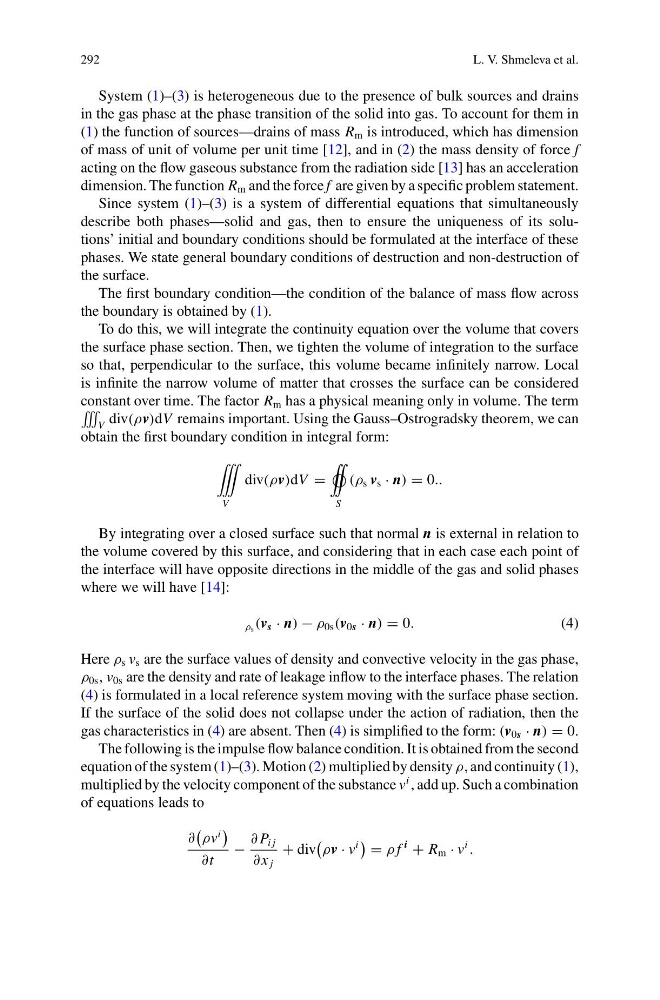
The first boundary condition—the condition of the balance of mass flow across
the boundary is obtained by (1).
To do this, we will integrate the continuity equation over the volume that covers
the surface phase section. Then, we tighten the volume of integration to the surface
so that, perpendicular to the surface, this volume became infinitely narrow. Local
is infinite the narrow volume of matter that crosses the surface can be considered
constant over time. The factor R m has a physical meaning only in volume. The term
˝
V div(ρv)dV remains important. Using the Gauss–Ostrogradsky theorem, we can
obtain the first boundary condition in integral form:
˚
V
div(ρv)dV =
S
(ρ s v s · n) = 0..
By integrating over a closed surface such that normal n is external in relation to
the volume covered by this surface, and considering that in each case each point of
the interface will have opposite directions in the middle of the gas and solid phases
where we will have [14]:
ρ s (v s · n) − ρ 0s (v 0s · n) = 0.
(4)
Here ρ s v s are the surface values of density and convective velocity in the gas phase,
ρ 0s , v 0s are the density and rate of leakage inflow to the interface phases. The relation
(4) is formulated in a local reference system moving with the surface phase section.
If the surface of the solid does not collapse under the action of radiation, then the
gas characteristics in (4) are absent. Then (4) is simplified to the form: (v 0s · n) = 0.
The following is the impulse flow balance condition. It is obtained from the second
equation of the system (1)–(3). Motion (2) multiplied by density ρ, and continuity (1),
multiplied by the velocity component of the substance v
i , add up. Such a combination
of equations leads to
∂
ρv
i
∂t
−
∂ P i j
∂ x j
+ div
ρv · v
i
= ρ f
i
+ R m · v
i
.
L. V. Shmeleva et al.
System (1)–(3) is heterogeneous due to the presence of bulk sources and drains
in the gas phase at the phase transition of the solid into gas. To account for them in
(1) the function of sources—drains of mass R m is introduced, which has dimension
of mass of unit of volume per unit time [12], and in (2) the mass density of force f
acting on the flow gaseous substance from the radiation side [13] has an acceleration
dimension. The function R m and the force f are given by a specific problem statement.
Since system (1)–(3) is a system of differential equations that simultaneously
describe both phases—solid and gas, then to ensure the uniqueness of its solutions’ initial and boundary conditions should be formulated at the interface of these
phases. We state general boundary conditions of destruction and non-destruction of
the surface.
The first boundary condition—the condition of the balance of mass flow across
the boundary is obtained by (1).
To do this, we will integrate the continuity equation over the volume that covers
the surface phase section. Then, we tighten the volume of integration to the surface
so that, perpendicular to the surface, this volume became infinitely narrow. Local
is infinite the narrow volume of matter that crosses the surface can be considered
constant over time. The factor R m has a physical meaning only in volume. The term
˝
V div(ρv)dV remains important. Using the Gauss–Ostrogradsky theorem, we can
obtain the first boundary condition in integral form:
˚
V
div(ρv)dV =
S
(ρ s v s · n) = 0..
By integrating over a closed surface such that normal n is external in relation to
the volume covered by this surface, and considering that in each case each point of
the interface will have opposite directions in the middle of the gas and solid phases
where we will have [14]:
ρ s (v s · n) − ρ 0s (v 0s · n) = 0.
(4)
Here ρ s v s are the surface values of density and convective velocity in the gas phase,
ρ 0s , v 0s are the density and rate of leakage inflow to the interface phases. The relation
(4) is formulated in a local reference system moving with the surface phase section.
If the surface of the solid does not collapse under the action of radiation, then the
gas characteristics in (4) are absent. Then (4) is simplified to the form: (v 0s · n) = 0.
The following is the impulse flow balance condition. It is obtained from the second
equation of the system (1)–(3). Motion (2) multiplied by density ρ, and continuity (1),
multiplied by the velocity component of the substance v
i , add up. Such a combination
of equations leads to
∂
ρv
i
∂t
−
∂ P i j
∂ x j
+ div
ρv · v
i
= ρ f
i
+ R m · v
i
.