

The Physical–Chemical Model of Nanoscaled Metal Component Formation …
273
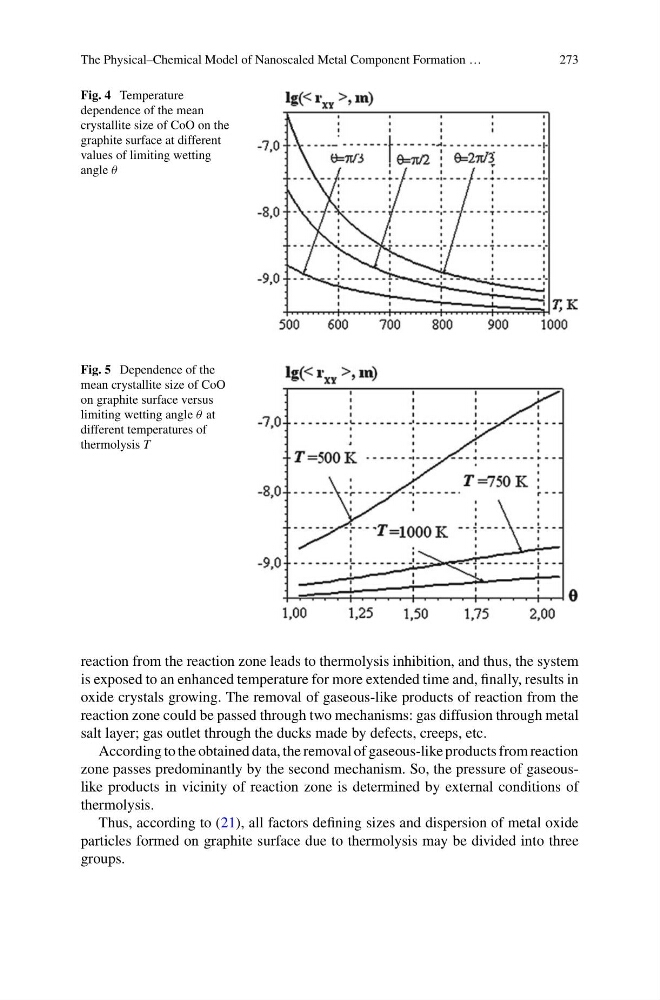
Fig. 4 Temperature
dependence of the mean
crystallite size of CoO on the
graphite surface at different
values of limiting wetting
angle θ
Fig. 5 Dependence of the
mean crystallite size of CoO
on graphite surface versus
limiting wetting angle θ at
different temperatures of
thermolysis T
reaction from the reaction zone leads to thermolysis inhibition, and thus, the system
is exposed to an enhanced temperature for more extended time and, finally, results in
oxide crystals growing. The removal of gaseous-like products of reaction from the
reaction zone could be passed through two mechanisms: gas diffusion through metal
salt layer; gas outlet through the ducks made by defects, creeps, etc.
According to the obtained data, the removal of gaseous-like products from reaction
zone passes predominantly by the second mechanism. So, the pressure of gaseouslike products in vicinity of reaction zone is determined by external conditions of
thermolysis.
Thus, according to (21), all factors defining sizes and dispersion of metal oxide
particles formed on graphite surface due to thermolysis may be divided into three
groups.
273
Fig. 4 Temperature
dependence of the mean
crystallite size of CoO on the
graphite surface at different
values of limiting wetting
angle θ
Fig. 5 Dependence of the
mean crystallite size of CoO
on graphite surface versus
limiting wetting angle θ at
different temperatures of
thermolysis T
reaction from the reaction zone leads to thermolysis inhibition, and thus, the system
is exposed to an enhanced temperature for more extended time and, finally, results in
oxide crystals growing. The removal of gaseous-like products of reaction from the
reaction zone could be passed through two mechanisms: gas diffusion through metal
salt layer; gas outlet through the ducks made by defects, creeps, etc.
According to the obtained data, the removal of gaseous-like products from reaction
zone passes predominantly by the second mechanism. So, the pressure of gaseouslike products in vicinity of reaction zone is determined by external conditions of
thermolysis.
Thus, according to (21), all factors defining sizes and dispersion of metal oxide
particles formed on graphite surface due to thermolysis may be divided into three
groups.