

274
L. Yu. Matzui et al.
The parameters characterizing the state of substrate, where metal oxide particles
are formed, can organize the first group. These parameters will change at using
different types of graphite materials as a substrate as well as using different oxidants
for activation of the surface of graphite material.
The second group consists of parameters depending on the type of salt, which is
being used for impregnation of graphite material.
The third group is formed by the external parameters of thermolysis. Let us
consider this set of parameters in more detail. The heating rate of the reacting material up to reaction temperature and the time of exposition at reaction temperature
could be also related to the external parameters of reaction as well as the listed above
parameters (thermolysis temperature, which is the most important parameter of the
reaction, and the rate of removal of gaseous products from the reaction zone). These
two parameters essentially influence the size of oxide particles being formed.
According to the reference data, the increasing of the heating rate causes the
decreasing of size and enhancement of imperfections of these crystallites whereas
the increasing of the exposition time at the temperature of reaction promotes the
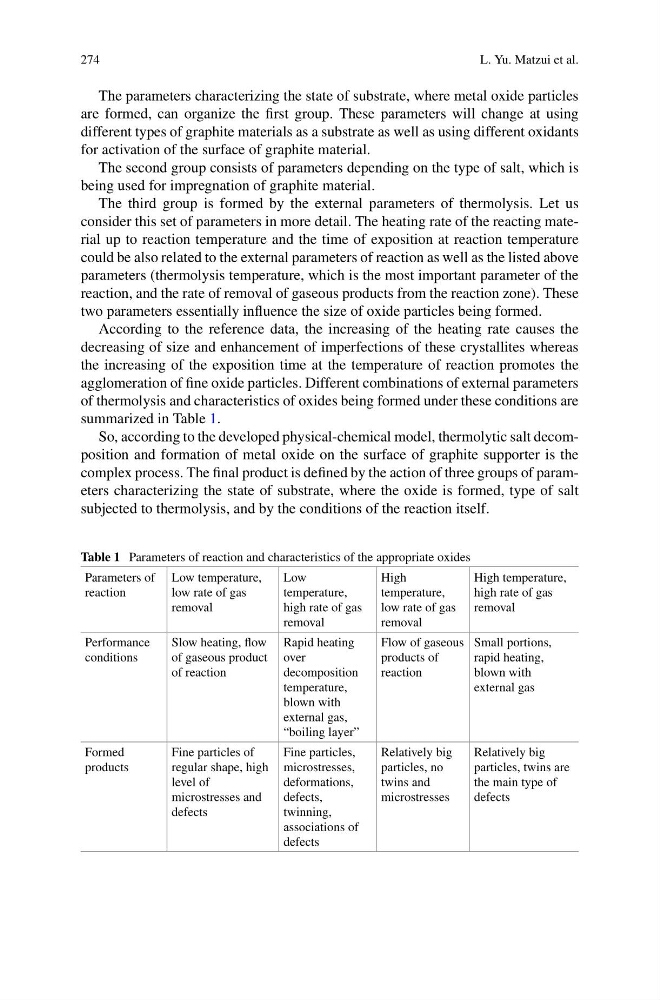
agglomeration of fine oxide particles. Different combinations of external parameters
of thermolysis and characteristics of oxides being formed under these conditions are
summarized in Table 1.
So, according to the developed physical-chemical model, thermolytic salt decomposition and formation of metal oxide on the surface of graphite supporter is the
complex process. The final product is defined by the action of three groups of parameters characterizing the state of substrate, where the oxide is formed, type of salt
subjected to thermolysis, and by the conditions of the reaction itself.
Table 1 Parameters of reaction and characteristics of the appropriate oxides
Parameters of
reaction
Low temperature,
low rate of gas
removal
Low
temperature,
high rate of gas
removal
High
temperature,
low rate of gas
removal
High temperature,
high rate of gas
removal
Performance
conditions
Slow heating, flow
of gaseous product
of reaction
Rapid heating
over
decomposition
temperature,
blown with
external gas,
“boiling layer”
Flow of gaseous
products of
reaction
Small portions,
rapid heating,
blown with
external gas
Formed
products
Fine particles of
regular shape, high
level of
microstresses and
defects
Fine particles,
microstresses,
deformations,
defects,
twinning,
associations of
defects
Relatively big
particles, no
twins and
microstresses
Relatively big
particles, twins are
the main type of
defects
L. Yu. Matzui et al.
The parameters characterizing the state of substrate, where metal oxide particles
are formed, can organize the first group. These parameters will change at using
different types of graphite materials as a substrate as well as using different oxidants
for activation of the surface of graphite material.
The second group consists of parameters depending on the type of salt, which is
being used for impregnation of graphite material.
The third group is formed by the external parameters of thermolysis. Let us
consider this set of parameters in more detail. The heating rate of the reacting material up to reaction temperature and the time of exposition at reaction temperature
could be also related to the external parameters of reaction as well as the listed above
parameters (thermolysis temperature, which is the most important parameter of the
reaction, and the rate of removal of gaseous products from the reaction zone). These
two parameters essentially influence the size of oxide particles being formed.
According to the reference data, the increasing of the heating rate causes the
decreasing of size and enhancement of imperfections of these crystallites whereas
the increasing of the exposition time at the temperature of reaction promotes the
agglomeration of fine oxide particles. Different combinations of external parameters
of thermolysis and characteristics of oxides being formed under these conditions are
summarized in Table 1.
So, according to the developed physical-chemical model, thermolytic salt decomposition and formation of metal oxide on the surface of graphite supporter is the
complex process. The final product is defined by the action of three groups of parameters characterizing the state of substrate, where the oxide is formed, type of salt
subjected to thermolysis, and by the conditions of the reaction itself.
Table 1 Parameters of reaction and characteristics of the appropriate oxides
Parameters of
reaction
Low temperature,
low rate of gas
removal
Low
temperature,
high rate of gas
removal
High
temperature,
low rate of gas
removal
High temperature,
high rate of gas
removal
Performance
conditions
Slow heating, flow
of gaseous product
of reaction
Rapid heating
over
decomposition
temperature,
blown with
external gas,
“boiling layer”
Flow of gaseous
products of
reaction
Small portions,
rapid heating,
blown with
external gas
Formed
products
Fine particles of
regular shape, high
level of
microstresses and
defects
Fine particles,
microstresses,
deformations,
defects,
twinning,
associations of
defects
Relatively big
particles, no
twins and
microstresses
Relatively big
particles, twins are
the main type of
defects