

272
L. Yu. Matzui et al.
The crystallite size of oxides on thermoexfoliated graphite surface depends on
parameters such as difference and specific difference of Gibbs potential of salt and
oxides g Salt-Oxide ; G Salt-Oxide , i.e., on the used salt type. At the analysis of salt type
influence on oxide phase properties, it is necessary to use not only (21), characterizing
final state of oxide phase but also (12) and (14) that determine the kinetics of phase
formation.
Equation (1) takes into account in an explicit form such external parameters as the temperature of the reaction as well as temperature dependences of
g Salt-Oxide ; G Salt-Oxide .
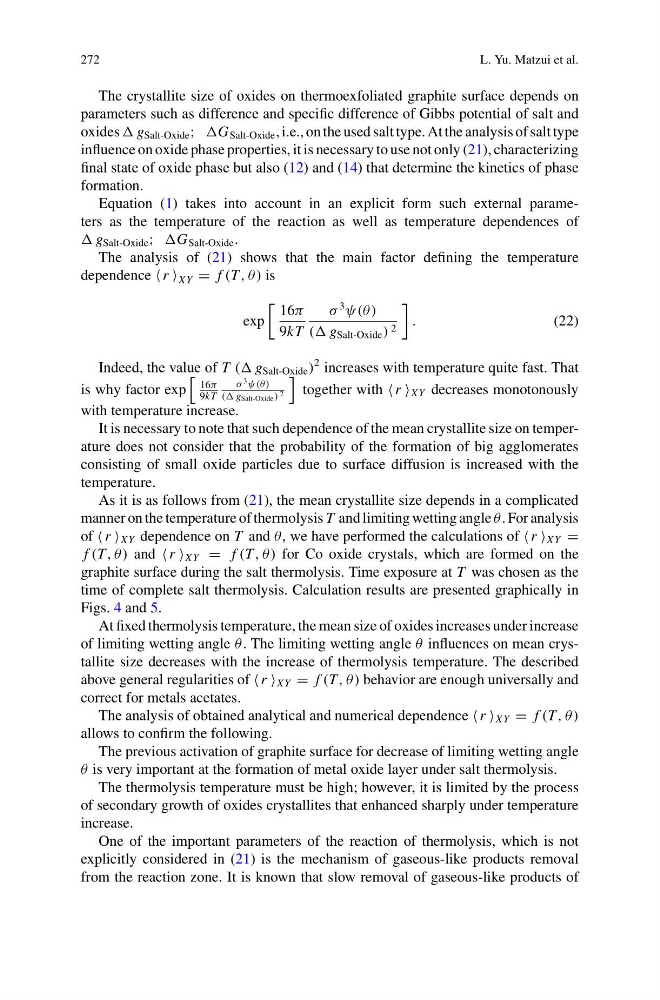
The analysis of (21) shows that the main factor defining the temperature
dependence r XY = f (T, θ) is
exp
16π
9kT
σ
3
ψ(θ )
( g Salt-Oxide ) 2
.
(22)
Indeed, the value of T ( g Salt-Oxide )
2 increases with temperature quite fast. That
is why factor exp
16π
9kT
σ
3 ψ(θ)
( g Salt-Oxide)
2
together with r XY decreases monotonously
with temperature increase.
It is necessary to note that such dependence of the mean crystallite size on temperature does not consider that the probability of the formation of big agglomerates
consisting of small oxide particles due to surface diffusion is increased with the
temperature.
As it is as follows from (21), the mean crystallite size depends in a complicated
manner on the temperature of thermolysis T and limiting wetting angle θ . For analysis
of r XY dependence on T and θ , we have performed the calculations of r XY =
f (T, θ) and r XY = f (T, θ) for Co oxide crystals, which are formed on the
graphite surface during the salt thermolysis. Time exposure at T was chosen as the
time of complete salt thermolysis. Calculation results are presented graphically in
Figs. 4 and 5.
At fixed thermolysis temperature, the mean size of oxides increases under increase
of limiting wetting angle θ . The limiting wetting angle θ influences on mean crystallite size decreases with the increase of thermolysis temperature. The described
above general regularities of r XY = f (T, θ) behavior are enough universally and
correct for metals acetates.
The analysis of obtained analytical and numerical dependence r XY = f (T, θ)
allows to confirm the following.
The previous activation of graphite surface for decrease of limiting wetting angle
θ is very important at the formation of metal oxide layer under salt thermolysis.
The thermolysis temperature must be high; however, it is limited by the process
of secondary growth of oxides crystallites that enhanced sharply under temperature
increase.
One of the important parameters of the reaction of thermolysis, which is not
explicitly considered in (21) is the mechanism of gaseous-like products removal
from the reaction zone. It is known that slow removal of gaseous-like products of
L. Yu. Matzui et al.
The crystallite size of oxides on thermoexfoliated graphite surface depends on
parameters such as difference and specific difference of Gibbs potential of salt and
oxides g Salt-Oxide ; G Salt-Oxide , i.e., on the used salt type. At the analysis of salt type
influence on oxide phase properties, it is necessary to use not only (21), characterizing
final state of oxide phase but also (12) and (14) that determine the kinetics of phase
formation.
Equation (1) takes into account in an explicit form such external parameters as the temperature of the reaction as well as temperature dependences of
g Salt-Oxide ; G Salt-Oxide .
The analysis of (21) shows that the main factor defining the temperature
dependence r XY = f (T, θ) is
exp
16π
9kT
σ
3
ψ(θ )
( g Salt-Oxide ) 2
.
(22)
Indeed, the value of T ( g Salt-Oxide )
2 increases with temperature quite fast. That
is why factor exp
16π
9kT
σ
3 ψ(θ)
( g Salt-Oxide)
2
together with r XY decreases monotonously
with temperature increase.
It is necessary to note that such dependence of the mean crystallite size on temperature does not consider that the probability of the formation of big agglomerates
consisting of small oxide particles due to surface diffusion is increased with the
temperature.
As it is as follows from (21), the mean crystallite size depends in a complicated
manner on the temperature of thermolysis T and limiting wetting angle θ . For analysis
of r XY dependence on T and θ , we have performed the calculations of r XY =
f (T, θ) and r XY = f (T, θ) for Co oxide crystals, which are formed on the
graphite surface during the salt thermolysis. Time exposure at T was chosen as the
time of complete salt thermolysis. Calculation results are presented graphically in
Figs. 4 and 5.
At fixed thermolysis temperature, the mean size of oxides increases under increase
of limiting wetting angle θ . The limiting wetting angle θ influences on mean crystallite size decreases with the increase of thermolysis temperature. The described
above general regularities of r XY = f (T, θ) behavior are enough universally and
correct for metals acetates.
The analysis of obtained analytical and numerical dependence r XY = f (T, θ)
allows to confirm the following.
The previous activation of graphite surface for decrease of limiting wetting angle
θ is very important at the formation of metal oxide layer under salt thermolysis.
The thermolysis temperature must be high; however, it is limited by the process
of secondary growth of oxides crystallites that enhanced sharply under temperature
increase.
One of the important parameters of the reaction of thermolysis, which is not
explicitly considered in (21) is the mechanism of gaseous-like products removal
from the reaction zone. It is known that slow removal of gaseous-like products of