

The Physical–Chemical Model of Nanoscaled Metal Component Formation …
269
J = K ν exp
−
A C
kT
,
(3)
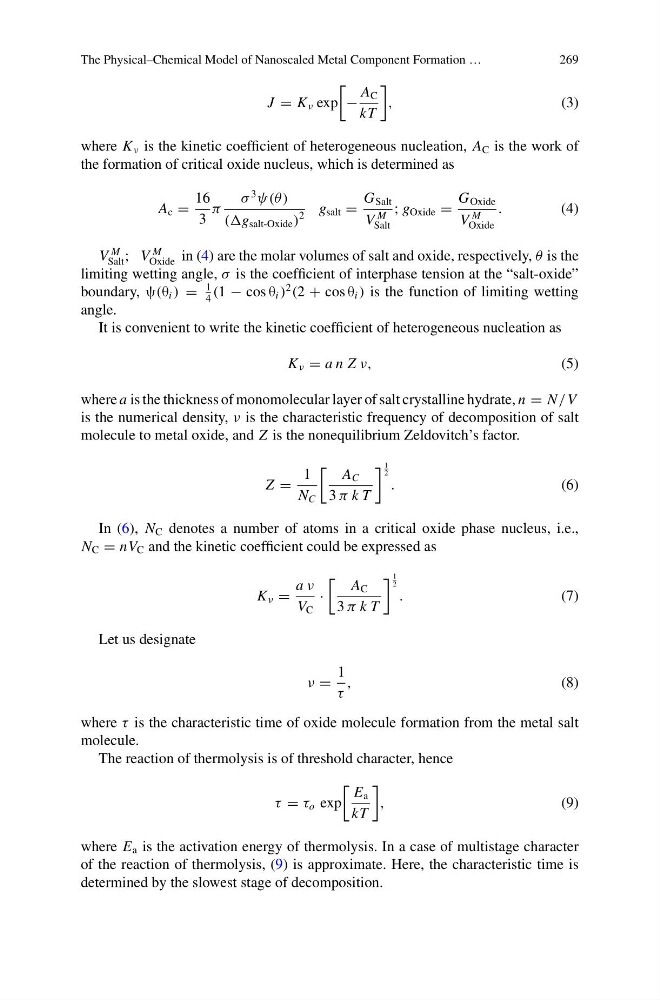
where K ν is the kinetic coefficient of heterogeneous nucleation, A C is the work of
the formation of critical oxide nucleus, which is determined as
A c =
16
3
π
σ
3
ψ(θ )
(g salt-Oxide )
2
g salt =
G Salt
V
M
Salt
; g Oxide =
G Oxide
V
M
Oxide
.
(4)
V
M
Salt ; V
M
Oxide in (4) are the molar volumes of salt and oxide, respectively, θ is the
limiting wetting angle, σ is the coefficient of interphase tension at the “salt-oxide”
boundary, ψ(θ i ) =
1
4
(1 − cos θ i )
2
(2 + cos θ i ) is the function of limiting wetting
angle.
It is convenient to write the kinetic coefficient of heterogeneous nucleation as
K ν = a n Z ν,
(5)
where a is the thickness of monomolecular layer of salt crystalline hydrate, n = N /V
is the numerical density, ν is the characteristic frequency of decomposition of salt
molecule to metal oxide, and Z is the nonequilibrium Zeldovitch’s factor.
Z =
1
N C
A C
3 π k T
1
2 .
(6)
In (6), N C denotes a number of atoms in a critical oxide phase nucleus, i.e.,
N C = nV C and the kinetic coefficient could be expressed as
K ν =
a ν
V C
·
A C
3 π k T
1
2 .
(7)
Let us designate
ν =
1
τ
,
(8)
where τ is the characteristic time of oxide molecule formation from the metal salt
molecule.
The reaction of thermolysis is of threshold character, hence
τ = τ o exp
E a
kT
,
(9)
where E a is the activation energy of thermolysis. In a case of multistage character
of the reaction of thermolysis, (9) is approximate. Here, the characteristic time is
determined by the slowest stage of decomposition.
269
J = K ν exp
−
A C
kT
,
(3)
where K ν is the kinetic coefficient of heterogeneous nucleation, A C is the work of
the formation of critical oxide nucleus, which is determined as
A c =
16
3
π
σ
3
ψ(θ )
(g salt-Oxide )
2
g salt =
G Salt
V
M
Salt
; g Oxide =
G Oxide
V
M
Oxide
.
(4)
V
M
Salt ; V
M
Oxide in (4) are the molar volumes of salt and oxide, respectively, θ is the
limiting wetting angle, σ is the coefficient of interphase tension at the “salt-oxide”
boundary, ψ(θ i ) =
1
4
(1 − cos θ i )
2
(2 + cos θ i ) is the function of limiting wetting
angle.
It is convenient to write the kinetic coefficient of heterogeneous nucleation as
K ν = a n Z ν,
(5)
where a is the thickness of monomolecular layer of salt crystalline hydrate, n = N /V
is the numerical density, ν is the characteristic frequency of decomposition of salt
molecule to metal oxide, and Z is the nonequilibrium Zeldovitch’s factor.
Z =
1
N C
A C
3 π k T
1
2 .
(6)
In (6), N C denotes a number of atoms in a critical oxide phase nucleus, i.e.,
N C = nV C and the kinetic coefficient could be expressed as
K ν =
a ν
V C
·
A C
3 π k T
1
2 .
(7)
Let us designate
ν =
1
τ
,
(8)
where τ is the characteristic time of oxide molecule formation from the metal salt
molecule.
The reaction of thermolysis is of threshold character, hence
τ = τ o exp
E a
kT
,
(9)
where E a is the activation energy of thermolysis. In a case of multistage character
of the reaction of thermolysis, (9) is approximate. Here, the characteristic time is
determined by the slowest stage of decomposition.