

270
L. Yu. Matzui et al.
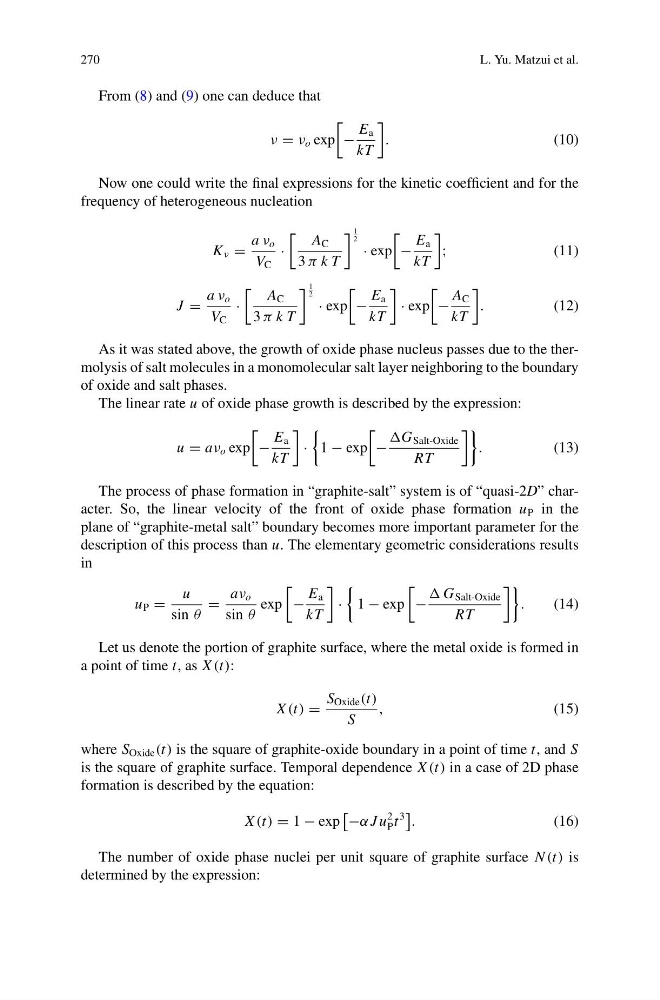
From (8) and (9) one can deduce that
ν = ν o exp
−
E a
kT
.
(10)
Now one could write the final expressions for the kinetic coefficient and for the
frequency of heterogeneous nucleation
K ν =
a ν o
V C
·
A C
3 π k T
1
2 · exp
−
E a
kT
;
(11)
J =
a ν o
V C
·
A C
3 π k T
1
2 · exp
−
E a
kT
· exp
−
A C
kT
.
(12)
As it was stated above, the growth of oxide phase nucleus passes due to the thermolysis of salt molecules in a monomolecular salt layer neighboring to the boundary
of oxide and salt phases.
The linear rate u of oxide phase growth is described by the expression:
u = aν o exp
−
E a
kT
·
1 − exp
−
G Salt-Oxide
RT
.
(13)
The process of phase formation in “graphite-salt” system is of “quasi-2D” character. So, the linear velocity of the front of oxide phase formation u P in the
plane of “graphite-metal salt” boundary becomes more important parameter for the
description of this process than u. The elementary geometric considerations results
in
u P =
u
sin θ
=
aν o
sin θ
exp
−
E a
kT
·
1 − exp
−
G Salt-Oxide
RT
.
(14)
Let us denote the portion of graphite surface, where the metal oxide is formed in
a point of time t, as X (t):
X (t) =
S Oxide (t)
S
,
(15)
where S Oxide (t) is the square of graphite-oxide boundary in a point of time t, and S
is the square of graphite surface. Temporal dependence X (t) in a case of 2D phase
formation is described by the equation:
X (t) = 1 − exp
−α J u
2
P t
3
.
(16)
The number of oxide phase nuclei per unit square of graphite surface N (t) is
determined by the expression:
L. Yu. Matzui et al.
From (8) and (9) one can deduce that
ν = ν o exp
−
E a
kT
.
(10)
Now one could write the final expressions for the kinetic coefficient and for the
frequency of heterogeneous nucleation
K ν =
a ν o
V C
·
A C
3 π k T
1
2 · exp
−
E a
kT
;
(11)
J =
a ν o
V C
·
A C
3 π k T
1
2 · exp
−
E a
kT
· exp
−
A C
kT
.
(12)
As it was stated above, the growth of oxide phase nucleus passes due to the thermolysis of salt molecules in a monomolecular salt layer neighboring to the boundary
of oxide and salt phases.
The linear rate u of oxide phase growth is described by the expression:
u = aν o exp
−
E a
kT
·
1 − exp
−
G Salt-Oxide
RT
.
(13)
The process of phase formation in “graphite-salt” system is of “quasi-2D” character. So, the linear velocity of the front of oxide phase formation u P in the
plane of “graphite-metal salt” boundary becomes more important parameter for the
description of this process than u. The elementary geometric considerations results
in
u P =
u
sin θ
=
aν o
sin θ
exp
−
E a
kT
·
1 − exp
−
G Salt-Oxide
RT
.
(14)
Let us denote the portion of graphite surface, where the metal oxide is formed in
a point of time t, as X (t):
X (t) =
S Oxide (t)
S
,
(15)
where S Oxide (t) is the square of graphite-oxide boundary in a point of time t, and S
is the square of graphite surface. Temporal dependence X (t) in a case of 2D phase
formation is described by the equation:
X (t) = 1 − exp
−α J u
2
P t
3
.
(16)
The number of oxide phase nuclei per unit square of graphite surface N (t) is
determined by the expression: