

206
A. E. Artyukhov et al.
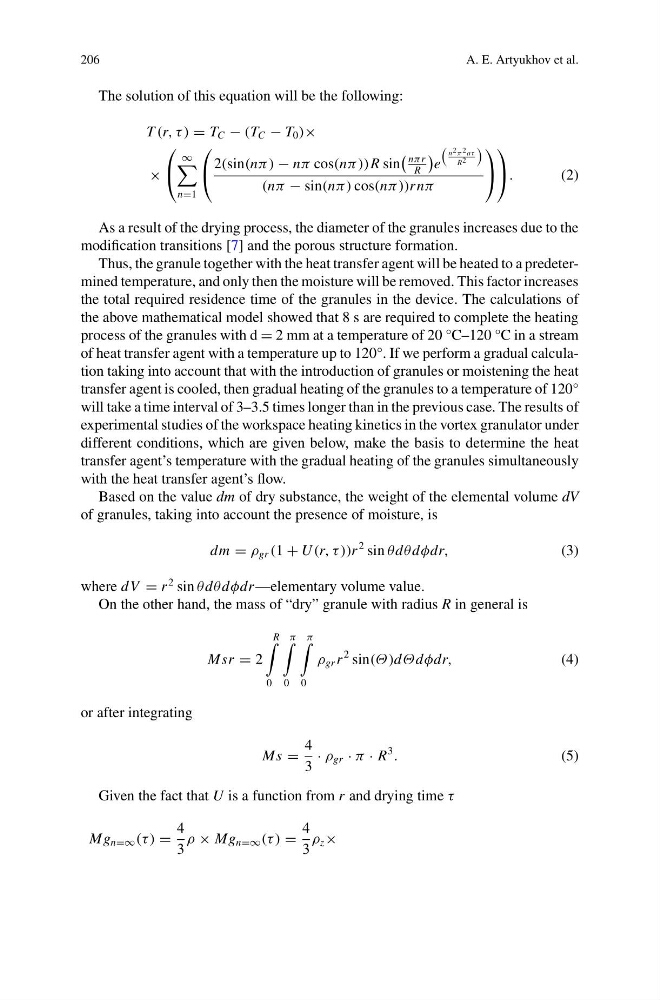
The solution of this equation will be the following:
T (r, τ ) = T C − (T C − T 0 )×
×
⎛
⎝
∞
n=1
⎛
⎝
2(sin(nπ) − nπ cos(nπ))R sin
nπr
R
e
n 2 π 2 aτ
R 2
(nπ − sin(nπ) cos(nπ))rnπ
⎞
⎠
⎞
⎠ .
(2)
As a result of the drying process, the diameter of the granules increases due to the
modification transitions [7] and the porous structure formation.
Thus, the granule together with the heat transfer agent will be heated to a predetermined temperature, and only then the moisture will be removed. This factor increases
the total required residence time of the granules in the device. The calculations of
the above mathematical model showed that 8 s are required to complete the heating
process of the granules with d = 2 mm at a temperature of 20 °C–120 °C in a stream
of heat transfer agent with a temperature up to 120°. If we perform a gradual calculation taking into account that with the introduction of granules or moistening the heat
transfer agent is cooled, then gradual heating of the granules to a temperature of 120°
will take a time interval of 3–3.5 times longer than in the previous case. The results of
experimental studies of the workspace heating kinetics in the vortex granulator under
different conditions, which are given below, make the basis to determine the heat
transfer agent’s temperature with the gradual heating of the granules simultaneously
with the heat transfer agent’s flow.
Based on the value dm of dry substance, the weight of the elemental volume dV
of granules, taking into account the presence of moisture, is
dm = ρ gr (1 + U (r, τ ))r
2 sin θ dθ dφdr,
(3)
where dV = r
2 sin θ dθ dφdr—elementary volume value.
On the other hand, the mass of “dry” granule with radius R in general is
Msr = 2
R
0
π
0
π
0
ρ gr r
2 sin(Θ)dΘdφdr,
(4)
or after integrating
Ms =
4
3
· ρ gr · π · R
3
.
(5)
Given the fact that U is a function from r and drying time τ
Mg n=∞ (τ ) =
4
3
ρ × Mg n=∞ (τ ) =
4
3
ρ z ×
A. E. Artyukhov et al.
The solution of this equation will be the following:
T (r, τ ) = T C − (T C − T 0 )×
×
⎛
⎝
∞
n=1
⎛
⎝
2(sin(nπ) − nπ cos(nπ))R sin
nπr
R
e
n 2 π 2 aτ
R 2
(nπ − sin(nπ) cos(nπ))rnπ
⎞
⎠
⎞
⎠ .
(2)
As a result of the drying process, the diameter of the granules increases due to the
modification transitions [7] and the porous structure formation.
Thus, the granule together with the heat transfer agent will be heated to a predetermined temperature, and only then the moisture will be removed. This factor increases
the total required residence time of the granules in the device. The calculations of
the above mathematical model showed that 8 s are required to complete the heating
process of the granules with d = 2 mm at a temperature of 20 °C–120 °C in a stream
of heat transfer agent with a temperature up to 120°. If we perform a gradual calculation taking into account that with the introduction of granules or moistening the heat
transfer agent is cooled, then gradual heating of the granules to a temperature of 120°
will take a time interval of 3–3.5 times longer than in the previous case. The results of
experimental studies of the workspace heating kinetics in the vortex granulator under
different conditions, which are given below, make the basis to determine the heat
transfer agent’s temperature with the gradual heating of the granules simultaneously
with the heat transfer agent’s flow.
Based on the value dm of dry substance, the weight of the elemental volume dV
of granules, taking into account the presence of moisture, is
dm = ρ gr (1 + U (r, τ ))r
2 sin θ dθ dφdr,
(3)
where dV = r
2 sin θ dθ dφdr—elementary volume value.
On the other hand, the mass of “dry” granule with radius R in general is
Msr = 2
R
0
π
0
π
0
ρ gr r
2 sin(Θ)dΘdφdr,
(4)
or after integrating
Ms =
4
3
· ρ gr · π · R
3
.
(5)
Given the fact that U is a function from r and drying time τ
Mg n=∞ (τ ) =
4
3
ρ × Mg n=∞ (τ ) =
4
3
ρ z ×