

Thermodynamic Calculation of Vortex Granulator Operation …
207
×
⎛
⎜
⎜
⎜
⎝
1 +
R
0
U p + (U o − U p )
∞
n=1
2(sin(nπ)−nπ cos(nπ))R sin(
nπr
R )e ( − nπmτ
R )
(nπ−sin(nπ) cos(nπ))rnπ
dr
R
⎞
⎟
⎟
⎟
⎠
(6)
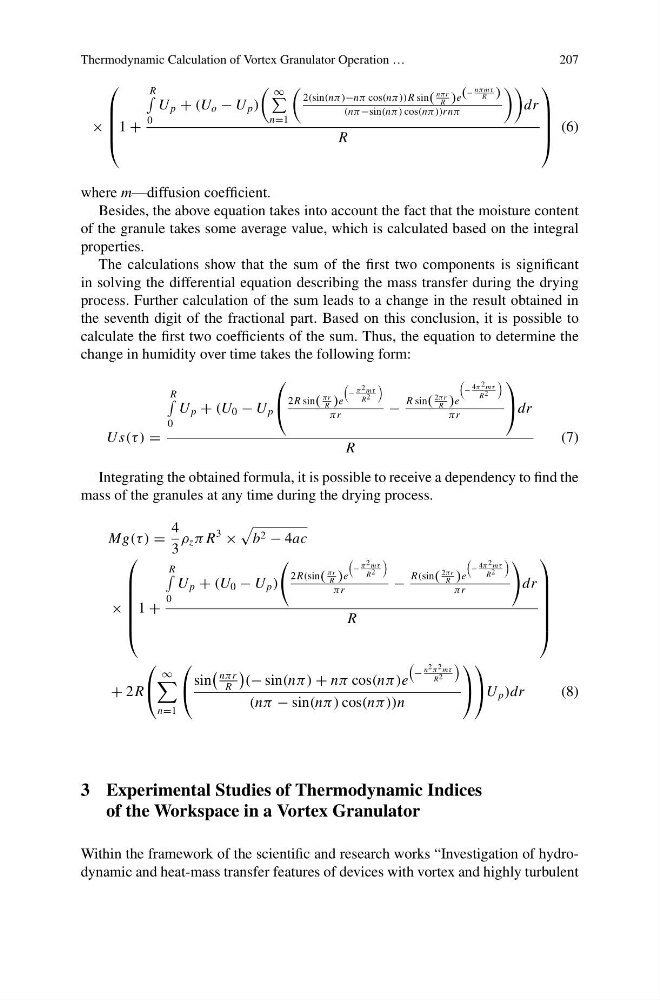
where m—diffusion coefficient.
Besides, the above equation takes into account the fact that the moisture content
of the granule takes some average value, which is calculated based on the integral
properties.
The calculations show that the sum of the first two components is significant
in solving the differential equation describing the mass transfer during the drying
process. Further calculation of the sum leads to a change in the result obtained in
the seventh digit of the fractional part. Based on this conclusion, it is possible to
calculate the first two coefficients of the sum. Thus, the equation to determine the
change in humidity over time takes the following form:
U s(τ ) =
R
0
U p + (U 0 − U p
⎛
⎝
2R sin(
πr
R )e
− π 2 mτ
R 2
πr
−
R sin(
2πr
R )e
− 4π 2 mτ
R 2
πr
⎞
⎠ dr
R
(7)
Integrating the obtained formula, it is possible to receive a dependency to find the
mass of the granules at any time during the drying process.
Mg(τ ) =
4
3
ρ z π R
3
×
b 2 − 4ac
×
⎛
⎜
⎜
⎜
⎜
⎜
⎝
1 +
R
0
U p + (U 0 − U p )
2R(sin(
πr
R )e
− π 2 mτ
R 2
πr
−
R(sin(
2πr
R )e
− 4π 2 mτ
R 2
πr
dr
R
⎞
⎟
⎟
⎟
⎟
⎟
⎠
+ 2R
⎛
⎝
∞
n=1
⎛
⎝
sin
nπr
R
(− sin(nπ) + nπ cos(nπ)e
−
n 2 π 2 mτ
R 2
(nπ − sin(nπ) cos(nπ))n
⎞
⎠
⎞
⎠ U p )dr
(8)
3 Experimental Studies of Thermodynamic Indices
of the Workspace in a Vortex Granulator
Within the framework of the scientific and research works “Investigation of hydrodynamic and heat-mass transfer features of devices with vortex and highly turbulent
207
×
⎛
⎜
⎜
⎜
⎝
1 +
R
0
U p + (U o − U p )
∞
n=1
2(sin(nπ)−nπ cos(nπ))R sin(
nπr
R )e ( − nπmτ
R )
(nπ−sin(nπ) cos(nπ))rnπ
dr
R
⎞
⎟
⎟
⎟
⎠
(6)
where m—diffusion coefficient.
Besides, the above equation takes into account the fact that the moisture content
of the granule takes some average value, which is calculated based on the integral
properties.
The calculations show that the sum of the first two components is significant
in solving the differential equation describing the mass transfer during the drying
process. Further calculation of the sum leads to a change in the result obtained in
the seventh digit of the fractional part. Based on this conclusion, it is possible to
calculate the first two coefficients of the sum. Thus, the equation to determine the
change in humidity over time takes the following form:
U s(τ ) =
R
0
U p + (U 0 − U p
⎛
⎝
2R sin(
πr
R )e
− π 2 mτ
R 2
πr
−
R sin(
2πr
R )e
− 4π 2 mτ
R 2
πr
⎞
⎠ dr
R
(7)
Integrating the obtained formula, it is possible to receive a dependency to find the
mass of the granules at any time during the drying process.
Mg(τ ) =
4
3
ρ z π R
3
×
b 2 − 4ac
×
⎛
⎜
⎜
⎜
⎜
⎜
⎝
1 +
R
0
U p + (U 0 − U p )
2R(sin(
πr
R )e
− π 2 mτ
R 2
πr
−
R(sin(
2πr
R )e
− 4π 2 mτ
R 2
πr
dr
R
⎞
⎟
⎟
⎟
⎟
⎟
⎠
+ 2R
⎛
⎝
∞
n=1
⎛
⎝
sin
nπr
R
(− sin(nπ) + nπ cos(nπ)e
−
n 2 π 2 mτ
R 2
(nπ − sin(nπ) cos(nπ))n
⎞
⎠
⎞
⎠ U p )dr
(8)
3 Experimental Studies of Thermodynamic Indices
of the Workspace in a Vortex Granulator
Within the framework of the scientific and research works “Investigation of hydrodynamic and heat-mass transfer features of devices with vortex and highly turbulent