

Thermodynamic Calculation of Vortex Granulator Operation …
205
having formed the pores, the granules need to undergo some drying process to ensure
the required strength. Otherwise, the granules can significantly lose their strength.
Thus, in the calculations, it is necessary to predict the kinetics description of
granule heating and to determine the minimum drying time, the value of which
exceeds the required time to warm the granules to the desired temperature.
The granule is a spherical body with pores, the peculiar size of which is the radius
R and in terms of the physicochemical properties in the calculations—the structure
of the granule’s substance (including moisture content as the main index).
In order to describe the influence of the thermodynamic parameters of the gas
flow on the humidified granule, a physical model was investigated. It is based on the
following principles:
– The selected diameter of the granules is determinant for the entire set of granules
in the workspace, i.e., the formation of the porous structure in the granules with
the selected diameter preferably defines the porous structure of the entire granules
flow;
– The granule is washed by a stream of gas (air) which has a constant temperature.
Thus, one may accurately assume that the surface temperature of the granules
during the whole residence time in the workspace will be constant;
– Due to the fact that the granules are small in size from 1 mm to 4 mm, and the
vast majority of granules obtained at nitrogen plants are granules in size from
2 mm to 3 mm, we can suppose that due to the hygroscopicity of the granules,
the humidification process should be minimized. So, one may presuppose that
moisture saturation occurs along the radius according to a linear law;
– The pore formation starts consecutively from the top layer. The pore formation
front moves along the radius of the granule to its center, representing a spherical
surface;
– Evaporating moisture is freely removed from the granule through the formed
pores in the previous layers of the substance with a larger diameter, “external”
layers (these layers are located closer to the surface of the granule) which form
the granule;
– The proportionality of the formed pores in the granules with the steam extracted
from moisture is the reason for the fact that the retention capacity of the granules
is greater than the moisture content.
Based on the above assumptions, it is possible to create a mathematical model
to determine the basic hydro- and thermodynamic parameters, the effect of which
enables it to create a porous structure in the granules.
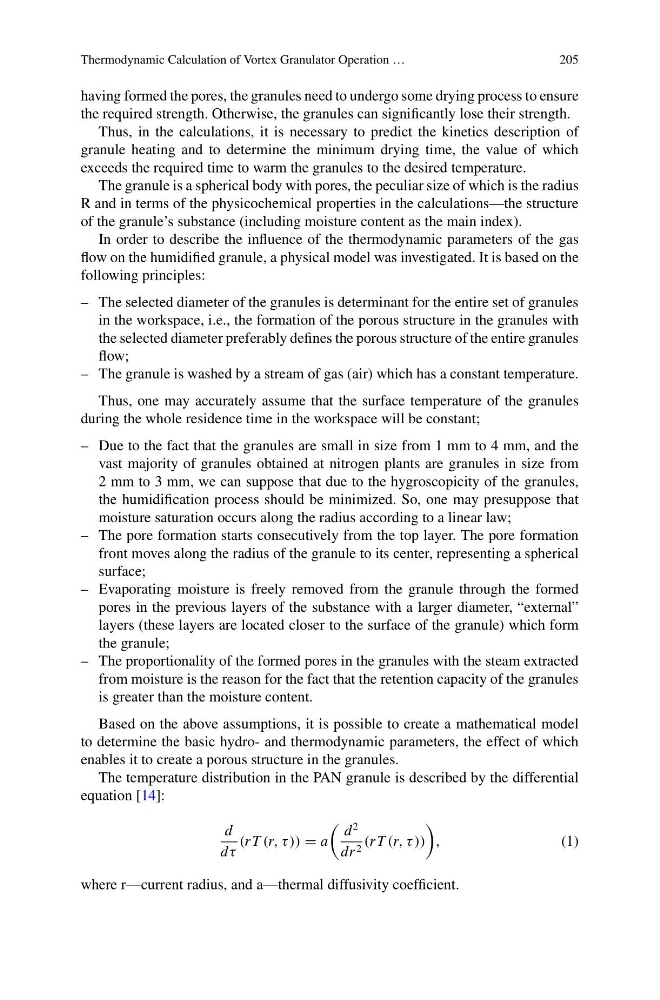
The temperature distribution in the PAN granule is described by the differential
equation [14]:
d
dτ
(r T (r, τ )) = a
d
2
dr 2 (r T (r, τ ))
,
(1)
where r—current radius, and a—thermal diffusivity coefficient.
205
having formed the pores, the granules need to undergo some drying process to ensure
the required strength. Otherwise, the granules can significantly lose their strength.
Thus, in the calculations, it is necessary to predict the kinetics description of
granule heating and to determine the minimum drying time, the value of which
exceeds the required time to warm the granules to the desired temperature.
The granule is a spherical body with pores, the peculiar size of which is the radius
R and in terms of the physicochemical properties in the calculations—the structure
of the granule’s substance (including moisture content as the main index).
In order to describe the influence of the thermodynamic parameters of the gas
flow on the humidified granule, a physical model was investigated. It is based on the
following principles:
– The selected diameter of the granules is determinant for the entire set of granules
in the workspace, i.e., the formation of the porous structure in the granules with
the selected diameter preferably defines the porous structure of the entire granules
flow;
– The granule is washed by a stream of gas (air) which has a constant temperature.
Thus, one may accurately assume that the surface temperature of the granules
during the whole residence time in the workspace will be constant;
– Due to the fact that the granules are small in size from 1 mm to 4 mm, and the
vast majority of granules obtained at nitrogen plants are granules in size from
2 mm to 3 mm, we can suppose that due to the hygroscopicity of the granules,
the humidification process should be minimized. So, one may presuppose that
moisture saturation occurs along the radius according to a linear law;
– The pore formation starts consecutively from the top layer. The pore formation
front moves along the radius of the granule to its center, representing a spherical
surface;
– Evaporating moisture is freely removed from the granule through the formed
pores in the previous layers of the substance with a larger diameter, “external”
layers (these layers are located closer to the surface of the granule) which form
the granule;
– The proportionality of the formed pores in the granules with the steam extracted
from moisture is the reason for the fact that the retention capacity of the granules
is greater than the moisture content.
Based on the above assumptions, it is possible to create a mathematical model
to determine the basic hydro- and thermodynamic parameters, the effect of which
enables it to create a porous structure in the granules.
The temperature distribution in the PAN granule is described by the differential
equation [14]:
d
dτ
(r T (r, τ )) = a
d
2
dr 2 (r T (r, τ ))
,
(1)
where r—current radius, and a—thermal diffusivity coefficient.