

New Effective Filter in the Spatial Domain for Speckle Noise Reduction
185
A computer model of a rough surface with the dimension 500 × 500 and pixel
size = 10 μm was chosen as an object. When illuminating this object with a
coherent light beam (λ = 0.5 μm), a field with a unit intensity and an arbitrary phase
distribution is obtained. Simulation of the propagation of an object wave through
lenses is done by the Fourier transform. The aperture diaphragm located at the focal
plane serves as a spatial filter with which one can adjust the speckle size. In the
computer model, this is done by multiplying the spectrum of the object by the function circ(x,y). After that, some reference wave is added to obtain the digital hologram.
Having calculated digital hologram in the initial state and with the addition of simple
deformation, we received a series of 100 phase fringe patterns of the object deformation with deformation step δ = 0.1 μm. In Fig. 6, some examples of obtained phase
maps are shown.
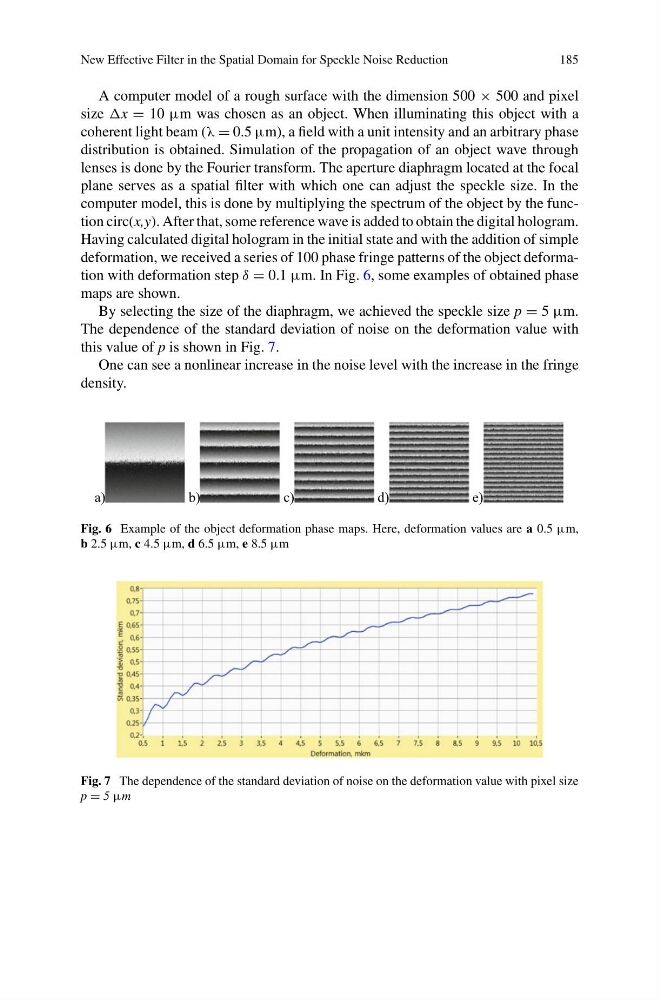
By selecting the size of the diaphragm, we achieved the speckle size p = 5 μm.
The dependence of the standard deviation of noise on the deformation value with
this value of p is shown in Fig. 7.
One can see a nonlinear increase in the noise level with the increase in the fringe
density.
а)
b)
c)
d)
e)
Fig. 6 Example of the object deformation phase maps. Here, deformation values are a 0.5 μm,
b 2.5 μm, c 4.5 μm, d 6.5 μm, e 8.5 μm
Fig. 7 The dependence of the standard deviation of noise on the deformation value with pixel size
p = 5 μm
185
A computer model of a rough surface with the dimension 500 × 500 and pixel
size = 10 μm was chosen as an object. When illuminating this object with a
coherent light beam (λ = 0.5 μm), a field with a unit intensity and an arbitrary phase
distribution is obtained. Simulation of the propagation of an object wave through
lenses is done by the Fourier transform. The aperture diaphragm located at the focal
plane serves as a spatial filter with which one can adjust the speckle size. In the
computer model, this is done by multiplying the spectrum of the object by the function circ(x,y). After that, some reference wave is added to obtain the digital hologram.
Having calculated digital hologram in the initial state and with the addition of simple
deformation, we received a series of 100 phase fringe patterns of the object deformation with deformation step δ = 0.1 μm. In Fig. 6, some examples of obtained phase
maps are shown.
By selecting the size of the diaphragm, we achieved the speckle size p = 5 μm.
The dependence of the standard deviation of noise on the deformation value with
this value of p is shown in Fig. 7.
One can see a nonlinear increase in the noise level with the increase in the fringe
density.
а)
b)
c)
d)
e)
Fig. 6 Example of the object deformation phase maps. Here, deformation values are a 0.5 μm,
b 2.5 μm, c 4.5 μm, d 6.5 μm, e 8.5 μm
Fig. 7 The dependence of the standard deviation of noise on the deformation value with pixel size
p = 5 μm