

172
Y. Kuziv et al.
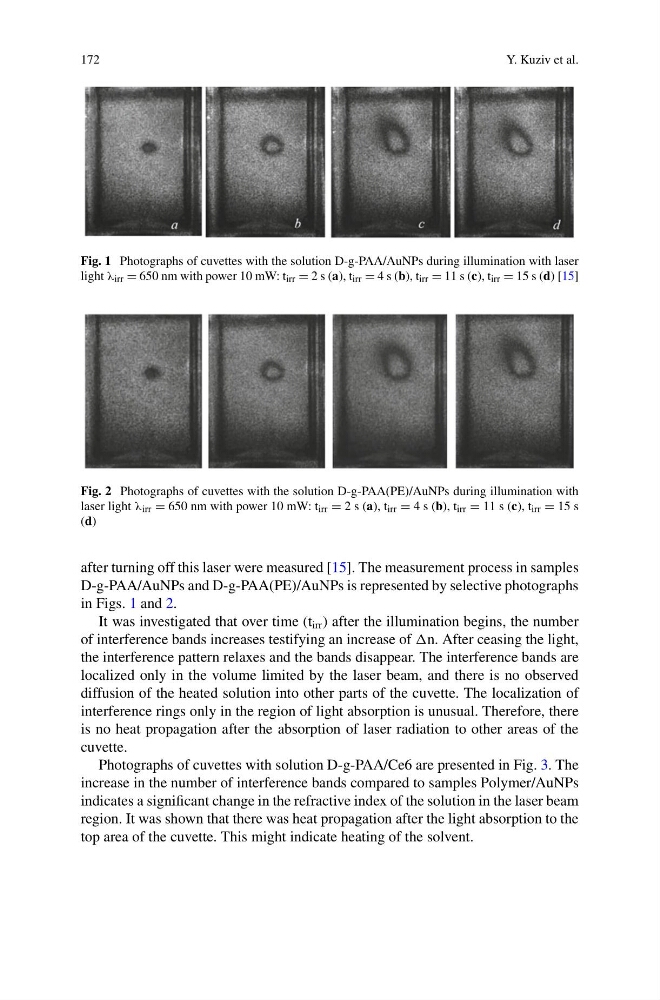
Fig. 1 Photographs of cuvettes with the solution D-g-PAA/AuNPs during illumination with laser
light λ irr = 650 nm with power 10 mW: t irr = 2 s (a), t irr = 4 s (b), t irr = 11 s (c), t irr = 15 s (d) [15]
Fig. 2 Photographs of cuvettes with the solution D-g-PAA(PE)/AuNPs during illumination with
laser light λ irr = 650 nm with power 10 mW: t irr = 2 s (a), t irr = 4 s (b), t irr = 11 s (c), t irr = 15 s
(d)
after turning off this laser were measured [15]. The measurement process in samples
D-g-PAA/AuNPs and D-g-PAA(PE)/AuNPs is represented by selective photographs
in Figs. 1 and 2.
It was investigated that over time (t irr ) after the illumination begins, the number
of interference bands increases testifying an increase of n. After ceasing the light,
the interference pattern relaxes and the bands disappear. The interference bands are
localized only in the volume limited by the laser beam, and there is no observed
diffusion of the heated solution into other parts of the cuvette. The localization of
interference rings only in the region of light absorption is unusual. Therefore, there
is no heat propagation after the absorption of laser radiation to other areas of the
cuvette.
Photographs of cuvettes with solution D-g-PAA/Ce6 are presented in Fig. 3. The
increase in the number of interference bands compared to samples Polymer/AuNPs
indicates a significant change in the refractive index of the solution in the laser beam
region. It was shown that there was heat propagation after the light absorption to the
top area of the cuvette. This might indicate heating of the solvent.
Y. Kuziv et al.
Fig. 1 Photographs of cuvettes with the solution D-g-PAA/AuNPs during illumination with laser
light λ irr = 650 nm with power 10 mW: t irr = 2 s (a), t irr = 4 s (b), t irr = 11 s (c), t irr = 15 s (d) [15]
Fig. 2 Photographs of cuvettes with the solution D-g-PAA(PE)/AuNPs during illumination with
laser light λ irr = 650 nm with power 10 mW: t irr = 2 s (a), t irr = 4 s (b), t irr = 11 s (c), t irr = 15 s
(d)
after turning off this laser were measured [15]. The measurement process in samples
D-g-PAA/AuNPs and D-g-PAA(PE)/AuNPs is represented by selective photographs
in Figs. 1 and 2.
It was investigated that over time (t irr ) after the illumination begins, the number
of interference bands increases testifying an increase of n. After ceasing the light,
the interference pattern relaxes and the bands disappear. The interference bands are
localized only in the volume limited by the laser beam, and there is no observed
diffusion of the heated solution into other parts of the cuvette. The localization of
interference rings only in the region of light absorption is unusual. Therefore, there
is no heat propagation after the absorption of laser radiation to other areas of the
cuvette.
Photographs of cuvettes with solution D-g-PAA/Ce6 are presented in Fig. 3. The
increase in the number of interference bands compared to samples Polymer/AuNPs
indicates a significant change in the refractive index of the solution in the laser beam
region. It was shown that there was heat propagation after the light absorption to the
top area of the cuvette. This might indicate heating of the solvent.