

Laser-Driven Behavior of the Nanosystem …
173
Fig. 3 Photographs of cuvettes with the solution D-g-PAA/Ce6 during illumination with laser light
λ irr = 650 nm with power 10 mW: t irr = 1 s (a), t irr = 2 s (b), t irr = 10 s (c), t irr = 30 s (d)
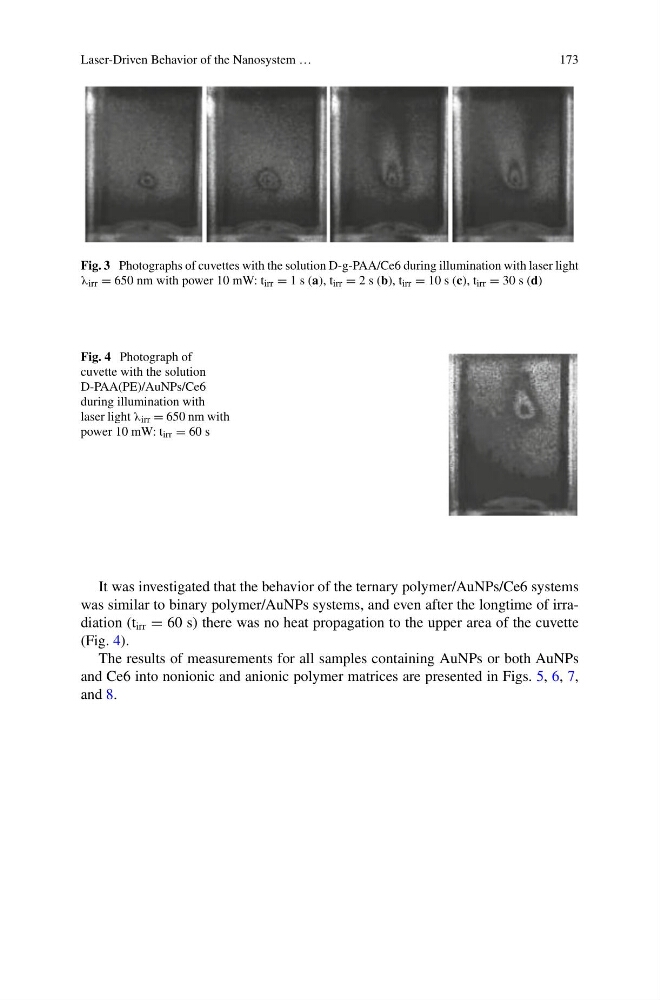
Fig. 4 Photograph of
cuvette with the solution
D-PAA(PE)/AuNPs/Ce6
during illumination with
laser light λ irr = 650 nm with
power 10 mW: t irr = 60 s
It was investigated that the behavior of the ternary polymer/AuNPs/Ce6 systems
was similar to binary polymer/AuNPs systems, and even after the longtime of irradiation (t irr = 60 s) there was no heat propagation to the upper area of the cuvette
(Fig. 4).
The results of measurements for all samples containing AuNPs or both AuNPs
and Ce6 into nonionic and anionic polymer matrices are presented in Figs. 5, 6, 7,
and 8.
173
Fig. 3 Photographs of cuvettes with the solution D-g-PAA/Ce6 during illumination with laser light
λ irr = 650 nm with power 10 mW: t irr = 1 s (a), t irr = 2 s (b), t irr = 10 s (c), t irr = 30 s (d)
Fig. 4 Photograph of
cuvette with the solution
D-PAA(PE)/AuNPs/Ce6
during illumination with
laser light λ irr = 650 nm with
power 10 mW: t irr = 60 s
It was investigated that the behavior of the ternary polymer/AuNPs/Ce6 systems
was similar to binary polymer/AuNPs systems, and even after the longtime of irradiation (t irr = 60 s) there was no heat propagation to the upper area of the cuvette
(Fig. 4).
The results of measurements for all samples containing AuNPs or both AuNPs
and Ce6 into nonionic and anionic polymer matrices are presented in Figs. 5, 6, 7,
and 8.