

Modified Two-Pole Approximation for Systems with Strong Electron Correlations …
131
where μ is the chemical potential, t
k
is the Fourier transform of the hopping
integral, U is the repulsion parameter for two electrons of opposite spin projections
on the same site, and d stands for the concentration of sites with two electrons
(doublons).
Spectra (1) and (2) are exact in band, and atomic limits yet these equations do not
reproduce the spectrum [10] obtained on the basis of effective t–J-model Hamiltonian
in the limit of small w/U ; moreover, these spectra do not contain a momentumindependent term ~w
2
/U , which is responsible for the kinetic exchange between the
nearest neighbors, key to antiferromagnetic ordering. For small U/w, if the system is
spin-polarized (n ↑ = n ↓ ), spectra (1) and (2) are modified; however, Hartree–Fock
terms n ↓ U and n ↑ U are not present. Single-electron Green functions which yield
spectra (1) and (2) have two poles, and the damping of quasiparticle states is absent;
therefore, it is desirable to go beyond the mentioned approximations. In this paper,
we develop an approach which extends the region of validity of analytic procedures
of papers [10–12] and removes the noted deficiencies.
2 Model Hamiltonian and Energy Spectrum
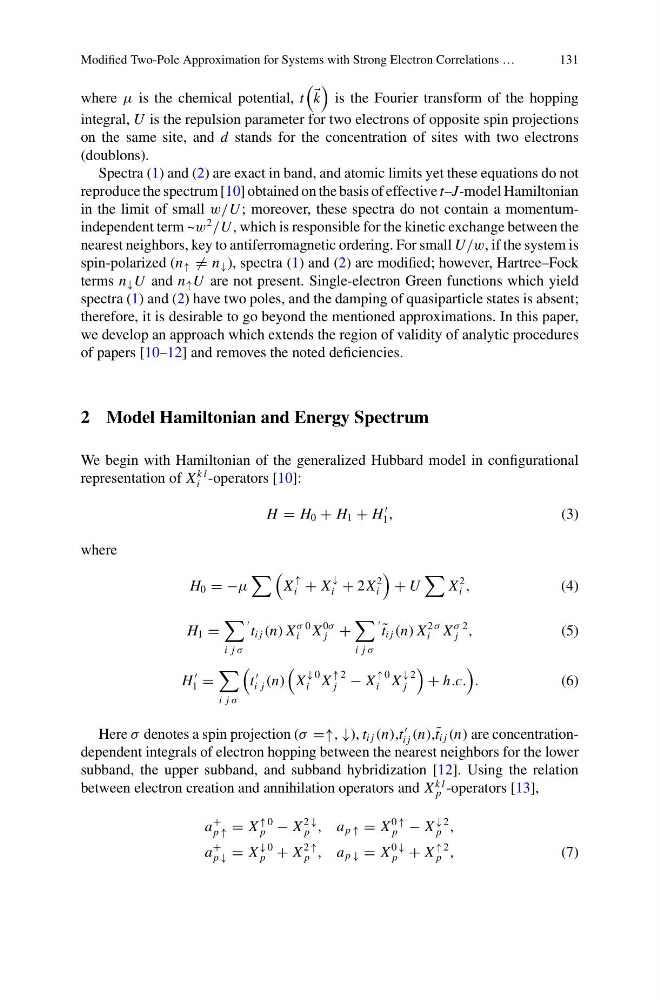
We begin with Hamiltonian of the generalized Hubbard model in configurational
representation of X
k l
i -operators [10]:
H = H 0 + H 1 + H
1 ,
(3)
where
H 0 = −μ
X
↑
i + X
↓
i + 2X
2
i
+ U
X
2
i ,
(4)
H 1 =
i j σ
t i j (n) X
σ 0
i X
0σ
j +
i j σ
˜
t i j (n) X
2 σ
i X
σ 2
j ,
(5)
H
1 =
i j σ
t
i j (n)
X
↓ 0
i X
↑ 2
j − X
↑ 0
i X
↓ 2
j
+ h.c.
.
(6)
Here σ denotes a spin projection (σ =↑, ↓), t i j (n),t
i j (n), ˜
t i j (n) are concentrationdependent integrals of electron hopping between the nearest neighbors for the lower
subband, the upper subband, and subband hybridization [12]. Using the relation
between electron creation and annihilation operators and X
k l
p -operators [13],
a
+
p ↑ = X
↑ 0
p − X
2 ↓
p , a p ↑ = X
0 ↑
p − X
↓ 2
p ,
a
+
p ↓ = X
↓ 0
p + X
2 ↑
p , a p ↓ = X
0 ↓
p + X
↑ 2
p ,
(7)
131
where μ is the chemical potential, t
k
is the Fourier transform of the hopping
integral, U is the repulsion parameter for two electrons of opposite spin projections
on the same site, and d stands for the concentration of sites with two electrons
(doublons).
Spectra (1) and (2) are exact in band, and atomic limits yet these equations do not
reproduce the spectrum [10] obtained on the basis of effective t–J-model Hamiltonian
in the limit of small w/U ; moreover, these spectra do not contain a momentumindependent term ~w
2
/U , which is responsible for the kinetic exchange between the
nearest neighbors, key to antiferromagnetic ordering. For small U/w, if the system is
spin-polarized (n ↑ = n ↓ ), spectra (1) and (2) are modified; however, Hartree–Fock
terms n ↓ U and n ↑ U are not present. Single-electron Green functions which yield
spectra (1) and (2) have two poles, and the damping of quasiparticle states is absent;
therefore, it is desirable to go beyond the mentioned approximations. In this paper,
we develop an approach which extends the region of validity of analytic procedures
of papers [10–12] and removes the noted deficiencies.
2 Model Hamiltonian and Energy Spectrum
We begin with Hamiltonian of the generalized Hubbard model in configurational
representation of X
k l
i -operators [10]:
H = H 0 + H 1 + H
1 ,
(3)
where
H 0 = −μ
X
↑
i + X
↓
i + 2X
2
i
+ U
X
2
i ,
(4)
H 1 =
i j σ
t i j (n) X
σ 0
i X
0σ
j +
i j σ
˜
t i j (n) X
2 σ
i X
σ 2
j ,
(5)
H
1 =
i j σ
t
i j (n)
X
↓ 0
i X
↑ 2
j − X
↑ 0
i X
↓ 2
j
+ h.c.
.
(6)
Here σ denotes a spin projection (σ =↑, ↓), t i j (n),t
i j (n), ˜
t i j (n) are concentrationdependent integrals of electron hopping between the nearest neighbors for the lower
subband, the upper subband, and subband hybridization [12]. Using the relation
between electron creation and annihilation operators and X
k l
p -operators [13],
a
+
p ↑ = X
↑ 0
p − X
2 ↓
p , a p ↑ = X
0 ↑
p − X
↓ 2
p ,
a
+
p ↓ = X
↓ 0
p + X
2 ↑
p , a p ↓ = X
0 ↓
p + X
↑ 2
p ,
(7)