

130
L. Didukh et al.
Physics of disordered low-dimensional structures is one of the most topical and
fast developing branches of the modern condensed matter theory. Interest in this field
is related to both new fundamental problems and phenomena and, from the other
side, prospects of developing new quantum devices and systems with unmatched
capacities for optoelectronics and nanoelectronics, metrology, novel IT technologies, communication techniques, etc. [1]. Studies of the low-dimensional systems
resulted in discoveries of new and already widely used phenomena as integer and
fractional quantum Hall effect, in two-dimensional electron gas, Wigner crystallization of quasi-two-dimensional electrons and holes, new composite quasiparticles and
electron excitations with fractional charges, high-frequency Bloch oscillation, and
many other effects. Operation of the modern semiconducting lasers on heterostructures is based on low-dimensional systems (quantum wells, self-organizing quantum
dots, and quantum threads) as well.
In various nanoscopic structures (nanomaterials), one can observe metal–insulator
transitions (MIT) similar to MIT in bulk materials. However, the noted transitions
from metallic to insulator state in nanomaterials have some differences, namely, the
transition takes place for a range of nanoparticle sizes and dimensions of the quasitwo-dimensional material, and there are compounds in which MIT exists only in
nanomaterial. One should note that nanomaterials have simpler structure than bulk
materials, and such complex phenomena as MIT can be more transparent. In recent
years, MIT in VO 2 is studied intensively in nanothreads [2], by femtosecond spectroscopy [3] (ultra-fast spectroscopy has been applied recently [4] to characterize
peculiarities of MIT in “canonical” Mott–Hubbard system (VCr) 2 O 3 )), in thin films
[5]. These studies prove that the transition is caused by electron–electron interactions but not by the lattice changes, which take place later. Electron-interaction-driven
MIT is observed also in SrRuO 3 nanofilms [6], Fe 3 O 4 nanocrystals [7], and conjugated conducting polymer-based nanothreads [8]. All the noted studies show that
further experimental and theoretical studies of electron-interaction-driven MIT in
nanomaterials are of importance.
Despite the recent progress in the field, the development of the analytical methods
is needed for nanoscale systems with strong electron correlations at arbitrary w to
U ratios and for arbitrary electron concentrations. In this context, we would like to
emphasize the approaches developed in papers [9, 10] (hereafter, approximation I)
and in papers [11, 12] (approximation II).
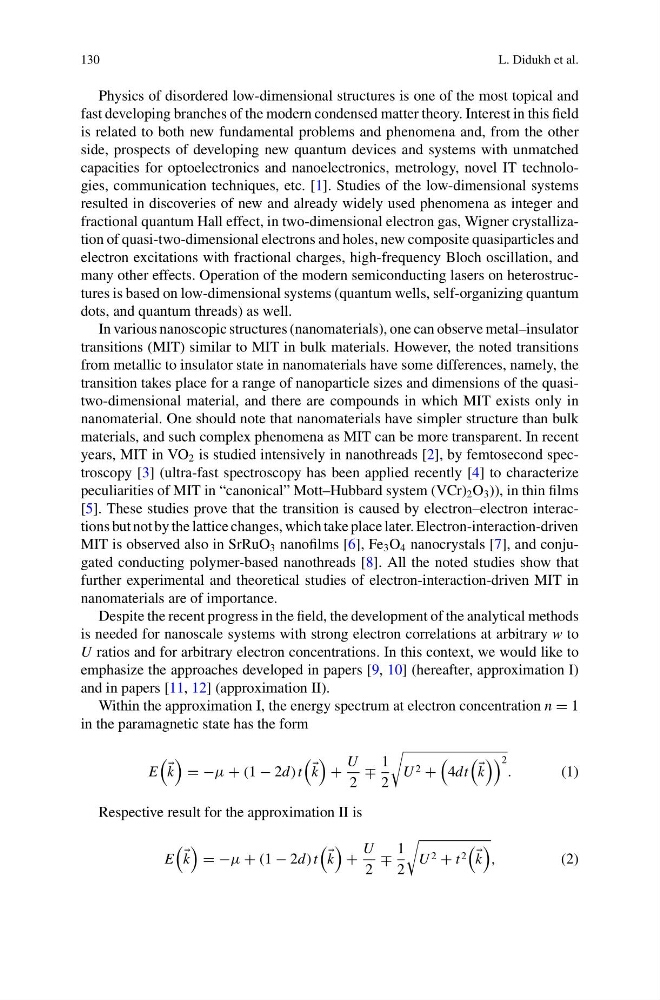
Within the approximation I, the energy spectrum at electron concentration n = 1
in the paramagnetic state has the form
E
k
= −μ + (1 − 2d)t
k
+
U
2
∓
1
2
U 2 +
4dt
k
2 .
(1)
Respective result for the approximation II is
E
k
= −μ + (1 − 2d) t
k
+
U
2
∓
1
2
U 2 + t 2
k
,
(2)
L. Didukh et al.
Physics of disordered low-dimensional structures is one of the most topical and
fast developing branches of the modern condensed matter theory. Interest in this field
is related to both new fundamental problems and phenomena and, from the other
side, prospects of developing new quantum devices and systems with unmatched
capacities for optoelectronics and nanoelectronics, metrology, novel IT technologies, communication techniques, etc. [1]. Studies of the low-dimensional systems
resulted in discoveries of new and already widely used phenomena as integer and
fractional quantum Hall effect, in two-dimensional electron gas, Wigner crystallization of quasi-two-dimensional electrons and holes, new composite quasiparticles and
electron excitations with fractional charges, high-frequency Bloch oscillation, and
many other effects. Operation of the modern semiconducting lasers on heterostructures is based on low-dimensional systems (quantum wells, self-organizing quantum
dots, and quantum threads) as well.
In various nanoscopic structures (nanomaterials), one can observe metal–insulator
transitions (MIT) similar to MIT in bulk materials. However, the noted transitions
from metallic to insulator state in nanomaterials have some differences, namely, the
transition takes place for a range of nanoparticle sizes and dimensions of the quasitwo-dimensional material, and there are compounds in which MIT exists only in
nanomaterial. One should note that nanomaterials have simpler structure than bulk
materials, and such complex phenomena as MIT can be more transparent. In recent
years, MIT in VO 2 is studied intensively in nanothreads [2], by femtosecond spectroscopy [3] (ultra-fast spectroscopy has been applied recently [4] to characterize
peculiarities of MIT in “canonical” Mott–Hubbard system (VCr) 2 O 3 )), in thin films
[5]. These studies prove that the transition is caused by electron–electron interactions but not by the lattice changes, which take place later. Electron-interaction-driven
MIT is observed also in SrRuO 3 nanofilms [6], Fe 3 O 4 nanocrystals [7], and conjugated conducting polymer-based nanothreads [8]. All the noted studies show that
further experimental and theoretical studies of electron-interaction-driven MIT in
nanomaterials are of importance.
Despite the recent progress in the field, the development of the analytical methods
is needed for nanoscale systems with strong electron correlations at arbitrary w to
U ratios and for arbitrary electron concentrations. In this context, we would like to
emphasize the approaches developed in papers [9, 10] (hereafter, approximation I)
and in papers [11, 12] (approximation II).
Within the approximation I, the energy spectrum at electron concentration n = 1
in the paramagnetic state has the form
E
k
= −μ + (1 − 2d)t
k
+
U
2
∓
1
2
U 2 +
4dt
k
2 .
(1)
Respective result for the approximation II is
E
k
= −μ + (1 − 2d) t
k
+
U
2
∓
1
2
U 2 + t 2
k
,
(2)