

114
G. Fijałkowska et al.
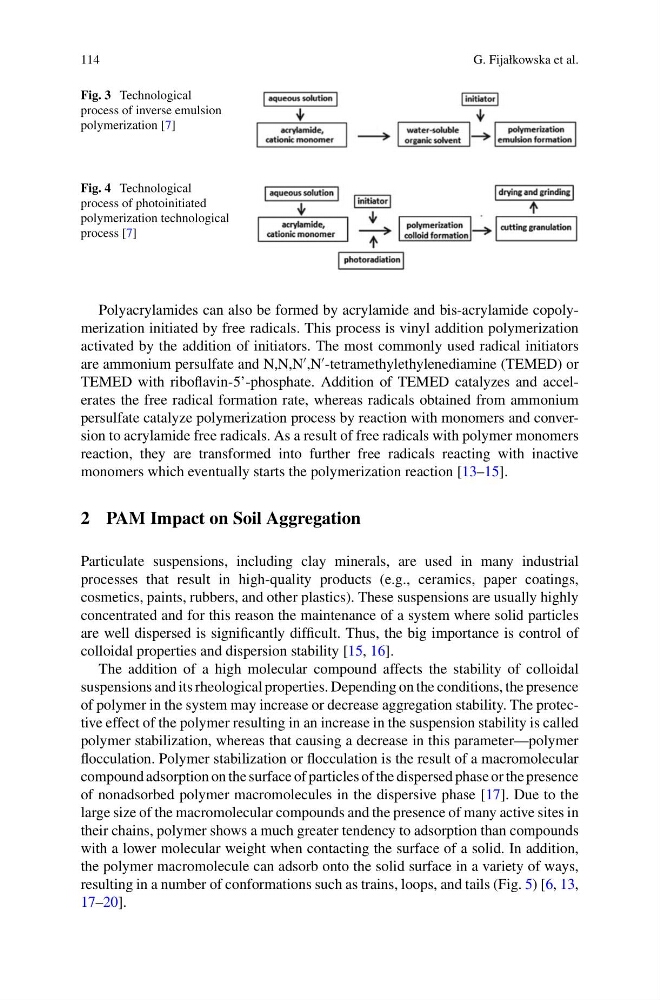
Fig. 3 Technological
process of inverse emulsion
polymerization [7]
Fig. 4 Technological
process of photoinitiated
polymerization technological
process [7]
Polyacrylamides can also be formed by acrylamide and bis-acrylamide copolymerization initiated by free radicals. This process is vinyl addition polymerization
activated by the addition of initiators. The most commonly used radical initiators
are ammonium persulfate and N,N,N
,N
-tetramethylethylenediamine (TEMED) or
TEMED with riboflavin-5’-phosphate. Addition of TEMED catalyzes and accelerates the free radical formation rate, whereas radicals obtained from ammonium
persulfate catalyze polymerization process by reaction with monomers and conversion to acrylamide free radicals. As a result of free radicals with polymer monomers
reaction, they are transformed into further free radicals reacting with inactive
monomers which eventually starts the polymerization reaction [13–15].
2 PAM Impact on Soil Aggregation
Particulate suspensions, including clay minerals, are used in many industrial
processes that result in high-quality products (e.g., ceramics, paper coatings,
cosmetics, paints, rubbers, and other plastics). These suspensions are usually highly
concentrated and for this reason the maintenance of a system where solid particles
are well dispersed is significantly difficult. Thus, the big importance is control of
colloidal properties and dispersion stability [15, 16].
The addition of a high molecular compound affects the stability of colloidal
suspensions and its rheological properties. Depending on the conditions, the presence
of polymer in the system may increase or decrease aggregation stability. The protective effect of the polymer resulting in an increase in the suspension stability is called
polymer stabilization, whereas that causing a decrease in this parameter—polymer
flocculation. Polymer stabilization or flocculation is the result of a macromolecular
compound adsorption on the surface of particles of the dispersed phase or the presence
of nonadsorbed polymer macromolecules in the dispersive phase [17]. Due to the
large size of the macromolecular compounds and the presence of many active sites in
their chains, polymer shows a much greater tendency to adsorption than compounds
with a lower molecular weight when contacting the surface of a solid. In addition,
the polymer macromolecule can adsorb onto the solid surface in a variety of ways,
resulting in a number of conformations such as trains, loops, and tails (Fig. 5) [6, 13,
17–20].
G. Fijałkowska et al.
Fig. 3 Technological
process of inverse emulsion
polymerization [7]
Fig. 4 Technological
process of photoinitiated
polymerization technological
process [7]
Polyacrylamides can also be formed by acrylamide and bis-acrylamide copolymerization initiated by free radicals. This process is vinyl addition polymerization
activated by the addition of initiators. The most commonly used radical initiators
are ammonium persulfate and N,N,N
,N
-tetramethylethylenediamine (TEMED) or
TEMED with riboflavin-5’-phosphate. Addition of TEMED catalyzes and accelerates the free radical formation rate, whereas radicals obtained from ammonium
persulfate catalyze polymerization process by reaction with monomers and conversion to acrylamide free radicals. As a result of free radicals with polymer monomers
reaction, they are transformed into further free radicals reacting with inactive
monomers which eventually starts the polymerization reaction [13–15].
2 PAM Impact on Soil Aggregation
Particulate suspensions, including clay minerals, are used in many industrial
processes that result in high-quality products (e.g., ceramics, paper coatings,
cosmetics, paints, rubbers, and other plastics). These suspensions are usually highly
concentrated and for this reason the maintenance of a system where solid particles
are well dispersed is significantly difficult. Thus, the big importance is control of
colloidal properties and dispersion stability [15, 16].
The addition of a high molecular compound affects the stability of colloidal
suspensions and its rheological properties. Depending on the conditions, the presence
of polymer in the system may increase or decrease aggregation stability. The protective effect of the polymer resulting in an increase in the suspension stability is called
polymer stabilization, whereas that causing a decrease in this parameter—polymer
flocculation. Polymer stabilization or flocculation is the result of a macromolecular
compound adsorption on the surface of particles of the dispersed phase or the presence
of nonadsorbed polymer macromolecules in the dispersive phase [17]. Due to the
large size of the macromolecular compounds and the presence of many active sites in
their chains, polymer shows a much greater tendency to adsorption than compounds
with a lower molecular weight when contacting the surface of a solid. In addition,
the polymer macromolecule can adsorb onto the solid surface in a variety of ways,
resulting in a number of conformations such as trains, loops, and tails (Fig. 5) [6, 13,
17–20].