

Polyacrylamide Soil Conditioners: The Impact …
113
There are four main kinds of cationic polyacrylamide synthesis technologies: in
aqueous solution, in dispersion, by inverse emulsion, or through photoinitiated polymerization [7]. These methods had experienced numerous developments and modifications such as free radical copolymerization or grafting processes [8]. Due to these
methods, application of PAM with relatively high molecular weight can be obtained
but characterized by short duration, high prize, and poor stability. In industry, mostly
free radical polymerization method including abovementioned technologies is used.
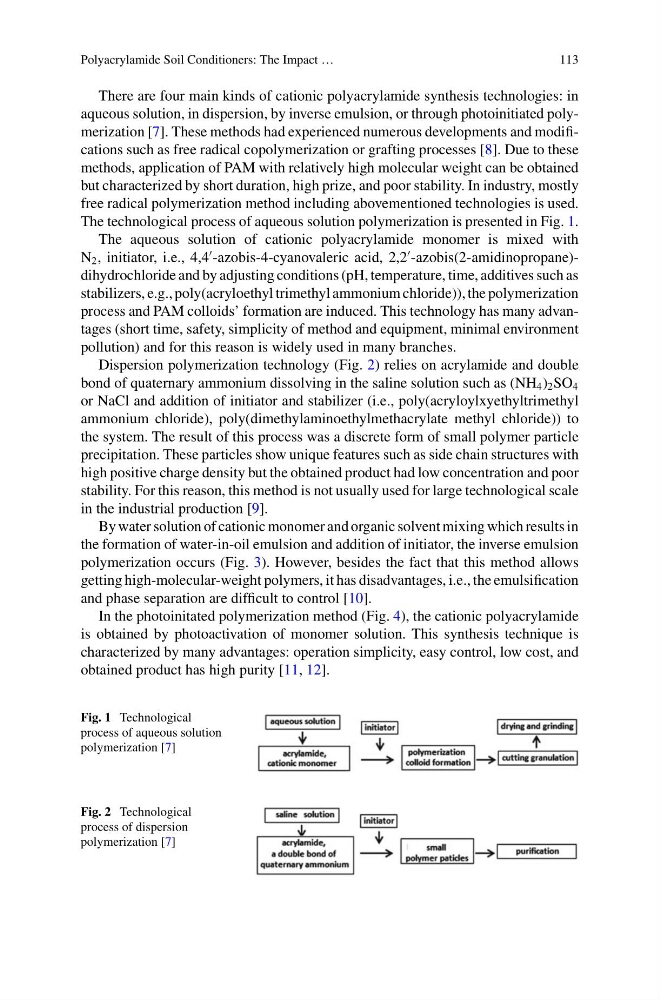
The technological process of aqueous solution polymerization is presented in Fig. 1.
The aqueous solution of cationic polyacrylamide monomer is mixed with
N 2 , initiator, i.e., 4,4
-azobis-4-cyanovaleric acid, 2,2
-azobis(2-amidinopropane)dihydrochloride and by adjusting conditions (pH, temperature, time, additives such as
stabilizers, e.g., poly(acryloethyl trimethyl ammonium chloride)), the polymerization
process and PAM colloids’ formation are induced. This technology has many advantages (short time, safety, simplicity of method and equipment, minimal environment
pollution) and for this reason is widely used in many branches.
Dispersion polymerization technology (Fig. 2) relies on acrylamide and double
bond of quaternary ammonium dissolving in the saline solution such as (NH 4 ) 2 SO 4
or NaCl and addition of initiator and stabilizer (i.e., poly(acryloylxyethyltrimethyl
ammonium chloride), poly(dimethylaminoethylmethacrylate methyl chloride)) to
the system. The result of this process was a discrete form of small polymer particle
precipitation. These particles show unique features such as side chain structures with
high positive charge density but the obtained product had low concentration and poor
stability. For this reason, this method is not usually used for large technological scale
in the industrial production [9].
By water solution of cationic monomer and organic solvent mixing which results in
the formation of water-in-oil emulsion and addition of initiator, the inverse emulsion
polymerization occurs (Fig. 3). However, besides the fact that this method allows
getting high-molecular-weight polymers, it has disadvantages, i.e., the emulsification
and phase separation are difficult to control [10].
In the photoinitated polymerization method (Fig. 4), the cationic polyacrylamide
is obtained by photoactivation of monomer solution. This synthesis technique is
characterized by many advantages: operation simplicity, easy control, low cost, and
obtained product has high purity [11, 12].
Fig. 1 Technological
process of aqueous solution
polymerization [7]
Fig. 2 Technological
process of dispersion
polymerization [7]
113
There are four main kinds of cationic polyacrylamide synthesis technologies: in
aqueous solution, in dispersion, by inverse emulsion, or through photoinitiated polymerization [7]. These methods had experienced numerous developments and modifications such as free radical copolymerization or grafting processes [8]. Due to these
methods, application of PAM with relatively high molecular weight can be obtained
but characterized by short duration, high prize, and poor stability. In industry, mostly
free radical polymerization method including abovementioned technologies is used.
The technological process of aqueous solution polymerization is presented in Fig. 1.
The aqueous solution of cationic polyacrylamide monomer is mixed with
N 2 , initiator, i.e., 4,4
-azobis-4-cyanovaleric acid, 2,2
-azobis(2-amidinopropane)dihydrochloride and by adjusting conditions (pH, temperature, time, additives such as
stabilizers, e.g., poly(acryloethyl trimethyl ammonium chloride)), the polymerization
process and PAM colloids’ formation are induced. This technology has many advantages (short time, safety, simplicity of method and equipment, minimal environment
pollution) and for this reason is widely used in many branches.
Dispersion polymerization technology (Fig. 2) relies on acrylamide and double
bond of quaternary ammonium dissolving in the saline solution such as (NH 4 ) 2 SO 4
or NaCl and addition of initiator and stabilizer (i.e., poly(acryloylxyethyltrimethyl
ammonium chloride), poly(dimethylaminoethylmethacrylate methyl chloride)) to
the system. The result of this process was a discrete form of small polymer particle
precipitation. These particles show unique features such as side chain structures with
high positive charge density but the obtained product had low concentration and poor
stability. For this reason, this method is not usually used for large technological scale
in the industrial production [9].
By water solution of cationic monomer and organic solvent mixing which results in
the formation of water-in-oil emulsion and addition of initiator, the inverse emulsion
polymerization occurs (Fig. 3). However, besides the fact that this method allows
getting high-molecular-weight polymers, it has disadvantages, i.e., the emulsification
and phase separation are difficult to control [10].
In the photoinitated polymerization method (Fig. 4), the cationic polyacrylamide
is obtained by photoactivation of monomer solution. This synthesis technique is
characterized by many advantages: operation simplicity, easy control, low cost, and
obtained product has high purity [11, 12].
Fig. 1 Technological
process of aqueous solution
polymerization [7]
Fig. 2 Technological
process of dispersion
polymerization [7]