

112
G. Fijałkowska et al.
polyacrylamides obtained as a result of polymerization or copolymerization of acrylamides, often contain in their macromolecules about 1–3% of anionic groups [4].
These groups are formed as a result of monomer amide groups hydrolysis. In order to
obtain a polyacrylamide with a lower ionic group content, factors such as temperature,
pH, monomer concentration, and type of polymerization initiator should be manipulated. Nonionic polyacrylamide can be produced from acrylamide monomer by free
radical polymerization using various initiation methods. This monomer is produced
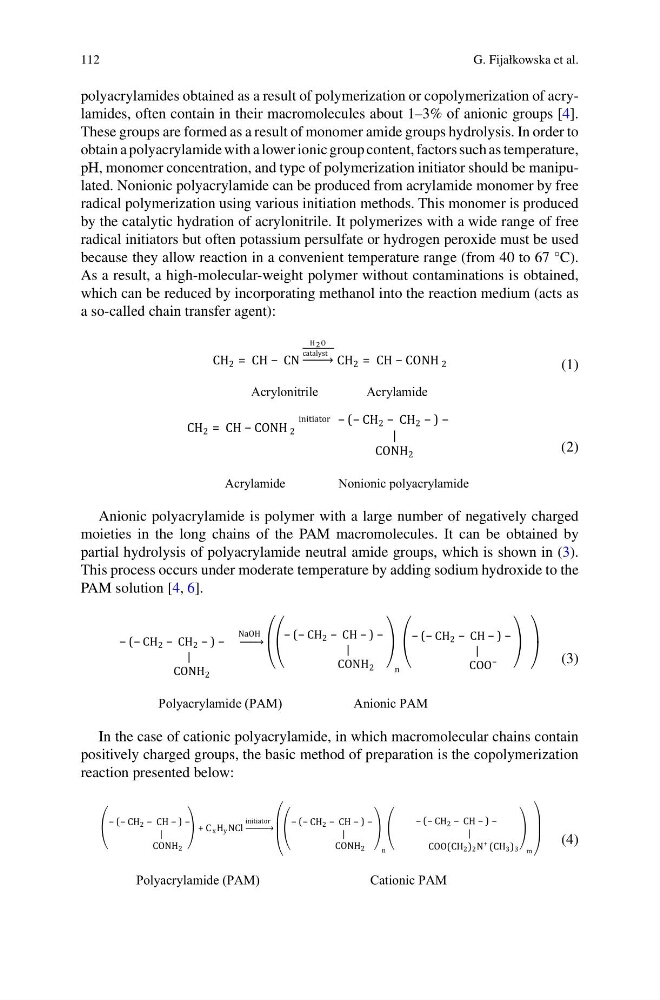
by the catalytic hydration of acrylonitrile. It polymerizes with a wide range of free
radical initiators but often potassium persulfate or hydrogen peroxide must be used
because they allow reaction in a convenient temperature range (from 40 to 67 °C).
As a result, a high-molecular-weight polymer without contaminations is obtained,
which can be reduced by incorporating methanol into the reaction medium (acts as
a so-called chain transfer agent):
CH 2 = CH − CN
H 2 O
catalyst CH 2 = CH − CONH 2
Acrylonitrile
Acrylamide
(1)
CH 2 = CH − CONH 2
initiator − (− CH 2 − CH 2 − ) −
|
CONH 2
Acrylamide
Nonionic polyacrylamide
(2)
Anionic polyacrylamide is polymer with a large number of negatively charged
moieties in the long chains of the PAM macromolecules. It can be obtained by
partial hydrolysis of polyacrylamide neutral amide groups, which is shown in (3).
This process occurs under moderate temperature by adding sodium hydroxide to the
PAM solution [4, 6].
− (− CH 2 − CH 2 − ) −
|
CONH 2
NaOH
− (− CH 2 − CH − ) −
|
CONH 2
n
− (− CH 2 − CH − ) −
|
COO
−
Polyacrylamide (PAM)
Anionic PAM
(3)
In the case of cationic polyacrylamide, in which macromolecular chains contain
positively charged groups, the basic method of preparation is the copolymerization
reaction presented below:
− (− CH 2 − CH − ) −
|
CONH 2
+ C x H y NCl
initiator
− (− CH 2 − CH − ) −
|
CONH 2
n
− (− CH 2 − CH − ) −
|
COO(CH 2 ) 2 N + (CH 3 ) 3 m
Polyacrylamide (PAM)
Cationic PAM
(4)
G. Fijałkowska et al.
polyacrylamides obtained as a result of polymerization or copolymerization of acrylamides, often contain in their macromolecules about 1–3% of anionic groups [4].
These groups are formed as a result of monomer amide groups hydrolysis. In order to
obtain a polyacrylamide with a lower ionic group content, factors such as temperature,
pH, monomer concentration, and type of polymerization initiator should be manipulated. Nonionic polyacrylamide can be produced from acrylamide monomer by free
radical polymerization using various initiation methods. This monomer is produced
by the catalytic hydration of acrylonitrile. It polymerizes with a wide range of free
radical initiators but often potassium persulfate or hydrogen peroxide must be used
because they allow reaction in a convenient temperature range (from 40 to 67 °C).
As a result, a high-molecular-weight polymer without contaminations is obtained,
which can be reduced by incorporating methanol into the reaction medium (acts as
a so-called chain transfer agent):
CH 2 = CH − CN
H 2 O
catalyst CH 2 = CH − CONH 2
Acrylonitrile
Acrylamide
(1)
CH 2 = CH − CONH 2
initiator − (− CH 2 − CH 2 − ) −
|
CONH 2
Acrylamide
Nonionic polyacrylamide
(2)
Anionic polyacrylamide is polymer with a large number of negatively charged
moieties in the long chains of the PAM macromolecules. It can be obtained by
partial hydrolysis of polyacrylamide neutral amide groups, which is shown in (3).
This process occurs under moderate temperature by adding sodium hydroxide to the
PAM solution [4, 6].
− (− CH 2 − CH 2 − ) −
|
CONH 2
NaOH
− (− CH 2 − CH − ) −
|
CONH 2
n
− (− CH 2 − CH − ) −
|
COO
−
Polyacrylamide (PAM)
Anionic PAM
(3)
In the case of cationic polyacrylamide, in which macromolecular chains contain
positively charged groups, the basic method of preparation is the copolymerization
reaction presented below:
− (− CH 2 − CH − ) −
|
CONH 2
+ C x H y NCl
initiator
− (− CH 2 − CH − ) −
|
CONH 2
n
− (− CH 2 − CH − ) −
|
COO(CH 2 ) 2 N + (CH 3 ) 3 m
Polyacrylamide (PAM)
Cationic PAM
(4)