

Composites Containing Inorganic Ion Exchangers …
103
can undergo dissociation or are capable of ion adsorption [72]. Possible charging
mechanisms of the GO surface are as follows:
(i) deprotonation of carboxylic groups:
−COOH + H 2 0 → −COO
−
+ H 3 O
+
,
(2)
(ii) deprotonation of phenolic groups
−OH + H 2 0 → −O
−
+ H 3 O
+
,
(3)
(iii) proton complexation of the π-electron system of graphene planes acting as
Lewis basic sites:
C π + 2H 2 O → C π H 3 O
+
+ OH
−
.
(4)
At last, (iv) protonation of various Bronsted basic oxygen species (epoxy and
carbonyl groups) is also possible. Dissociation of functional groups (schemes (2) and
(3)) provides cation adsorption. Protonation of them and π-electron system results in
anion adsorption. As suggested in [72], namely, dissociation determines the surface
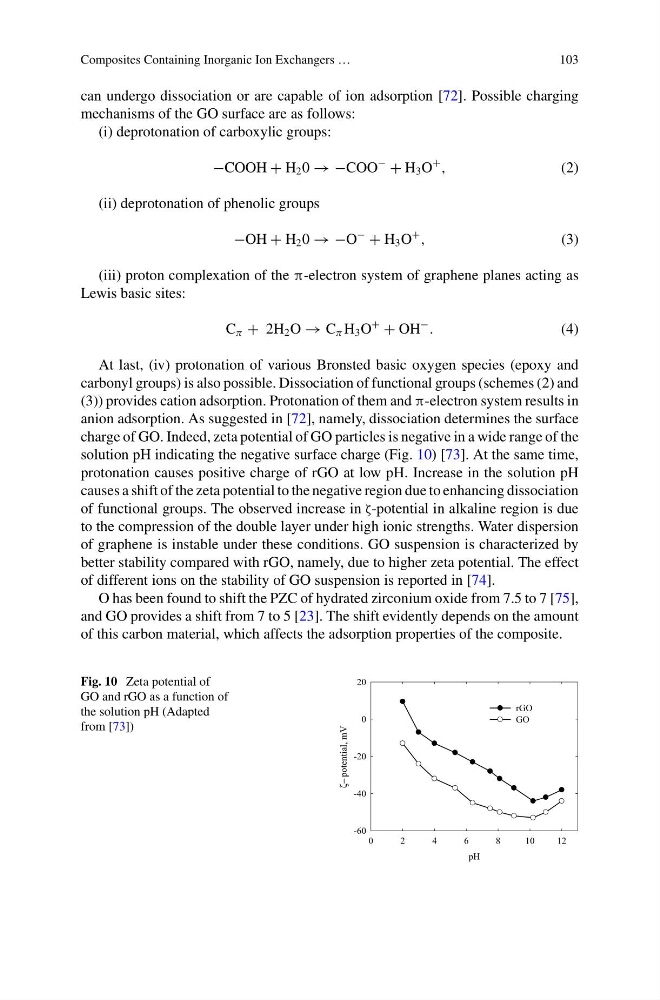
charge of GO. Indeed, zeta potential of GO particles is negative in a wide range of the
solution pH indicating the negative surface charge (Fig. 10) [73]. At the same time,
protonation causes positive charge of rGO at low pH. Increase in the solution pH
causes a shift of the zeta potential to the negative region due to enhancing dissociation
of functional groups. The observed increase in ζ-potential in alkaline region is due
to the compression of the double layer under high ionic strengths. Water dispersion
of graphene is instable under these conditions. GO suspension is characterized by
better stability compared with rGO, namely, due to higher zeta potential. The effect
of different ions on the stability of GO suspension is reported in [74].
O has been found to shift the PZC of hydrated zirconium oxide from 7.5 to 7 [75],
and GO provides a shift from 7 to 5 [23]. The shift evidently depends on the amount
of this carbon material, which affects the adsorption properties of the composite.
Fig. 10 Zeta potential of
GO and rGO as a function of
the solution pH (Adapted
from [73])
pH
0
2
4
6
8
1 0
1 2
ζ− potential, mV
-60
-40
-20
0
20
rGO
GO
103
can undergo dissociation or are capable of ion adsorption [72]. Possible charging
mechanisms of the GO surface are as follows:
(i) deprotonation of carboxylic groups:
−COOH + H 2 0 → −COO
−
+ H 3 O
+
,
(2)
(ii) deprotonation of phenolic groups
−OH + H 2 0 → −O
−
+ H 3 O
+
,
(3)
(iii) proton complexation of the π-electron system of graphene planes acting as
Lewis basic sites:
C π + 2H 2 O → C π H 3 O
+
+ OH
−
.
(4)
At last, (iv) protonation of various Bronsted basic oxygen species (epoxy and
carbonyl groups) is also possible. Dissociation of functional groups (schemes (2) and
(3)) provides cation adsorption. Protonation of them and π-electron system results in
anion adsorption. As suggested in [72], namely, dissociation determines the surface
charge of GO. Indeed, zeta potential of GO particles is negative in a wide range of the
solution pH indicating the negative surface charge (Fig. 10) [73]. At the same time,
protonation causes positive charge of rGO at low pH. Increase in the solution pH
causes a shift of the zeta potential to the negative region due to enhancing dissociation
of functional groups. The observed increase in ζ-potential in alkaline region is due
to the compression of the double layer under high ionic strengths. Water dispersion
of graphene is instable under these conditions. GO suspension is characterized by
better stability compared with rGO, namely, due to higher zeta potential. The effect
of different ions on the stability of GO suspension is reported in [74].
O has been found to shift the PZC of hydrated zirconium oxide from 7.5 to 7 [75],
and GO provides a shift from 7 to 5 [23]. The shift evidently depends on the amount
of this carbon material, which affects the adsorption properties of the composite.
Fig. 10 Zeta potential of
GO and rGO as a function of
the solution pH (Adapted
from [73])
pH
0
2
4
6
8
1 0
1 2
ζ− potential, mV
-60
-40
-20
0
20
rGO
GO